Cathy's Expedition to Penistone Crags
Wuthering HeightsCatherine Linton's expedition to Penistone Crags marks the moment the carefully guarded world of Thrushcross Grange cracks open. Until she reached the age of thirteen, she had never once been beyond the range of the park by herself; Gimmerton was an unsubstantial name in her ears, and Wuthering Heights and Mr. Heathcliff did not exist for her. She was a perfect recluse, apparently perfectly contented, educated entirely by her father, who took her learning on himself and made it an amusement. Her spirit was high, though not rough, and she had a capacity for intense attachments that reminded Ellen Dean of her mother, yet she could be soft and mild as a dove, with a gentle voice and pensive expression. This was the child who, in the summer's full prime, would break her bounds and ride out to meet her inheritance of storm and ruin.
The Breaking of Bounds
The expedition began as an innocent game of imagination. With Edgar Linton away for three weeks attending to business, Catherine was left to Ellen Dean's peculiar vigilance, with reiterated orders that she must not wander out of the park. The first day or two she sat in a corner of the library, too sad for either reading or playing, but this quiet state was succeeded by an interval of impatient, fretful weariness. Ellen, too busy and too old to run up and down amusing her, hit on a method by which she might entertain herself: she sent her on travels round the grounds, now on foot, now on a pony, indulging her with a patient audience of all her real and imaginary adventures when she returned. Catherine took such a taste for this solitary rambling that she often contrived to remain out from breakfast till tea. Ellen did not fear her breaking bounds, because the gates were generally locked, and she thought the girl would scarcely venture forth alone if they stood wide open. Unluckily, her confidence proved misplaced. One morning at eight o'clock, Catherine announced she was that day an Arabian merchant, going to cross the Desert with his caravan, and demanded plenty of provision for herself and beasts: a horse, and three camels personated by a large hound and a couple of pointers. Ellen got together good store of dainties and slung them in a basket on one side of the saddle, and Catherine sprang up as gay as a fairy, sheltered by her wide-brimmed hat and gauze veil from the July sun, and trotted off with a merry laugh, mocking Ellen's cautious counsel to avoid galloping and come back early.
The naughty thing never made her appearance at tea. One traveller, the hound, being an old dog and fond of its ease, returned, but neither Cathy, nor the pony, nor the two pointers were visible in any direction. Ellen despatched emissaries down this path and that, and at last went wandering in search of her herself. A labourer working at a fence round a plantation on the borders of the grounds told her he had seen the young lady at morn: she would have him cut her a hazel switch, and then she leapt her Galloway over the hedge yonder, where it is lowest, and galloped out of sight. Ellen struck directly that she must have started for Penistone Crags, and pushed through a gap which the man was repairing, making straight to the high-road. She walked as if for a wager, mile after mile, till a turn brought her in view of the Heights, but no Catherine could she detect, far or near. The Crags lie about a mile and a half beyond Mr. Heathcliff's place, and that is four from the Grange, so Ellen began to fear night would fall ere she could reach them. She reflected on the possibility that Catherine might have slipped in clambering among them, been killed, or broken some of her bones. Her suspense was truly painful, and at first it gave her delightful relief to observe, in hurrying by the farmhouse, Charlie, the fiercest of the pointers, lying under a window, with swelled head and bleeding ear.
First Meeting with Hareton
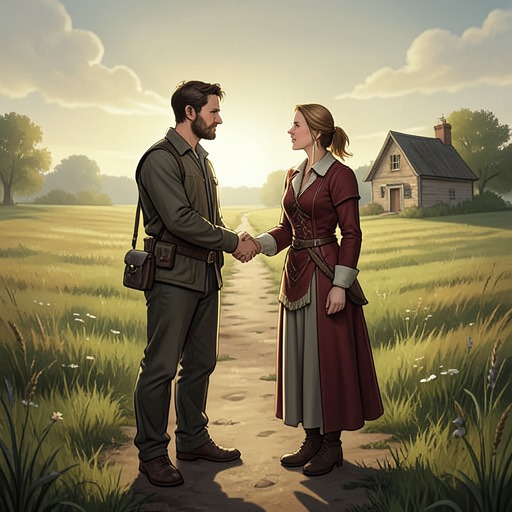
Ellen opened the wicket and ran to the door, knocking vehemently for admittance. A woman whom she knew, who formerly lived at Gimmerton and had been servant there since the death of Mr. Earnshaw, answered, saying that both Heathcliff and Joseph were off and would not return this hour or more. Ellen entered and beheld her stray lamb seated on the hearth, rocking herself in a little chair that had been her mother's when a child. Her hat was hung against the wall, and she seemed perfectly at home, laughing and chattering in the best spirits imaginable, to Hareton—now a great, strong lad of eighteen—who stared at her with considerable curiosity and astonishment, comprehending precious little of the fluent succession of remarks and questions which her tongue never ceased pouring forth. Ellen concealed her joy under an angry countenance, declaring this was Catherine's last ride till papa came back, and that she would not trust her over the threshold again. Catherine cried gaily that she should have a pretty story to tell to-night, and asked Ellen if she had ever been there in her life before.
The meeting was charged with a misunderstanding that revealed the depth of Hareton's degradation. Catherine, in her innocence, took Hareton for a servant, and the discovery that he was her cousin—that this rough, unlettered youth was her rude-bred kindred—gathered fresh grief from reflection, and she flung herself into Ellen's arms for refuge from the idea. Hareton, recovering from his disgust at being taken for a servant, seemed moved by her distress, and having fetched the pony round to the door, he took, to propitiate her, a fine crooked-legged terrier whelp from the kennel, and putting it into her hand, bid her whist, for he meant nought. Pausing in her lamentations, she surveyed him with a glance of awe and horror, then burst forth anew. Ellen could scarcely refrain from smiling at this antipathy to the poor fellow, who was a well-made, athletic youth, good-looking in features, and stout and healthy, but attired in garments befitting his daily occupations of working on the farm and lounging among the moors after rabbits and game. Yet Ellen thought she could detect in his physiognomy a mind owning better qualities than his father ever possessed—good things lost amid a wilderness of weeds, whose rankness far over-topped their neglected growth, but evidence of a wealthy soil that might yield luxuriant crops under other and favourable circumstances.
Heathcliff's Design
The expedition did not end with the meeting at the farmhouse. On the way back, Heathcliff intercepted them and insisted Catherine come in to see his son, Linton. Ellen whispered to Catherine that she mustn't, on any account, accede to the proposal, that it was entirely out of the question. Catherine asked why aloud, saying she was tired of running and the ground was dewy, and that Heathcliff said she had seen his son—he was mistaken, she thought, but she guessed where he lived: at the farmhouse she visited in coming from Penistone Crags. Heathcliff told Ellen to hold her tongue, that it would be a treat for Catherine to look in on them, and ordered Hareton to get forwards with the lass. Ellen cried that Catherine was not going to any such place, struggling to release her arm which he had seized, but Catherine was almost at the door-stones already, scampering round the brow at full speed. Her appointed companion did not pretend to escort her: he shied off by the road-side, and vanished. Ellen protested that Heathcliff meant no good, and that there Catherine would see Linton, and all would be told as soon as ever they returned, and she should have the blame. Heathcliff answered that he wanted her to see Linton, that he was looking better these few days, and that they would soon persuade her to keep the visit secret. Ellen replied that the harm of it was that her father would hate her if he found she suffered Catherine to enter his house, and that she was convinced Heathcliff had a bad design in encouraging her to do so.
Heathcliff then revealed his design in full. 'My design is as honest as possible,' he said. 'I'll inform you of its whole scope. That the two cousins may fall in love, and get married. I'm acting generously to your master: his young chit has no expectations, and should she second my wishes she'll be provided for at once as joint successor with Linton.' Ellen answered that if Linton died, and his life was quite uncertain, Catherine would be the heir. 'No, she would not,' he said. 'There is no clause in the will to secure it so: his property would go to me; but, to prevent disputes, I desire their union, and am resolved to bring it about.' This cold calculation laid bare the economic machinery of Heathcliff's revenge: the marriage was not a matter of love but of property, a scheme to secure his son's inheritance and complete his usurpation of both houses. The innocent expedition to the Crags had delivered Catherine directly into the orbit of this design.
Consequences and Significance
The expedition to Penistone Crags was the hinge on which the second generation's story turned. It was the first time Catherine had ever encountered the world her mother had left behind, and it brought her face to face with Hareton, the boy whose degradation was the living monument of Heathcliff's revenge. The meeting also set in motion the courtship that would lead to Catherine's detention and forced marriage to Linton Heathcliff, her captivity at Wuthering Heights, and ultimately her widowhood. Yet the expedition also planted the seed of the novel's reconciliation: the first glimpse of Hareton's buried qualities, the wealthy soil that might yield luxuriant crops under other and favourable circumstances, was the beginning of the relationship that would, in the end, redeem the Heights. The journey that began as a child's game of Arabian merchant crossing the desert ended by crossing the boundary between the two houses, and between the two generations, carrying Catherine from the sheltered innocence of Thrushcross Grange into the stormy inheritance of Wuthering Heights. It was, in miniature, the whole movement of the novel: the breaking of bounds, the encounter with the other, and the slow, painful work of reclaiming what was lost.