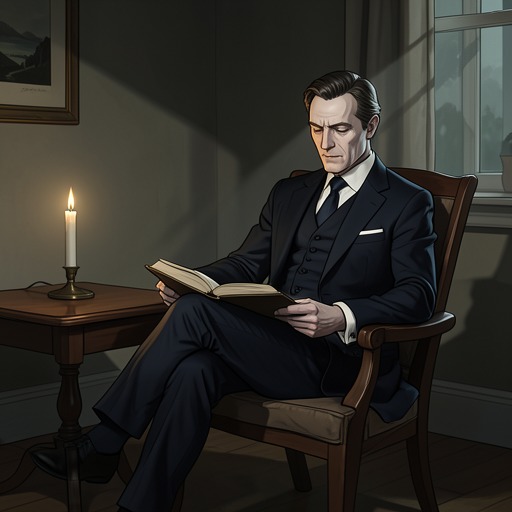
Edgar Linton strikes Heathcliff
Wuthering HeightsEdgar Linton strikes Heathcliff is the pivotal physical confrontation at Thrushcross Grange that ends Heathcliff's tolerated visits, banishes him from the house, and ignites his explicit vow of revenge against Edgar, Catherine, and Isabella. The blow, delivered after Heathcliff deliberately provokes Edgar by mocking him as a 'lamb' and threatening to kick him, marks the moment Heathcliff's patient scheming gives way to open hostility, and it sets in motion the chain of abductions, forced marriages, and property seizures that devastate both families.
Causes and Background
The quarrel erupts from a long-simmering tension that Edgar has tried to contain. Edgar admits he has been 'so far forbearing' with Heathcliff, not because he is ignorant of Heathcliff's 'miserable, degraded character,' but because he felt Heathcliff was 'only partly responsible' for it, and because Catherine wished to keep up the acquaintance. Edgar's forbearance has limits, however: he declares Heathcliff's presence 'a moral poison that would contaminate the most virtuous,' and he gives notice that Heathcliff must depart instantly, warning that 'three minutes' delay will render it involuntary and ignominious.' The immediate trigger is Heathcliff's outrageous talk about Isabella, which Catherine herself later admits she could have diverted had Edgar not been listening at the door. Catherine's own provocation compounds the crisis: when Edgar confronts her, she asks whether he has been listening at the door in a tone 'particularly calculated to provoke her husband,' and Heathcliff, who had raised his eyes at Edgar's first speech, gives a sneering laugh on purpose to draw Edgar's attention to himself.
The Confrontation and the Blow
Heathcliff responds to Edgar's ultimatum with derision, measuring the height and breadth of the speaker 'with an eye full of derision' and taunting, 'Cathy, this lamb of yours threatens like a bull! It is in danger of splitting its skull against my knuckles.' He then declares he is 'mortally sorry' that Edgar is 'not worth knocking down.' Catherine, rather than defending her husband, exclaims that in old days this would win Edgar knighthood, and mockingly reassures him, 'Cheer up! you sha'n't be hurt! Your type is not a lamb, it's a sucking leveret.' Heathcliff joins in the humiliation, calling Edgar a 'milk-blooded coward' and a 'slavering, shivering thing,' and says he would not strike Edgar with his fist but would kick him with his foot and experience 'considerable satisfaction.' The decisive moment comes when Heathcliff approaches and gives the chair on which Edgar rests a push. Edgar, who 'had better have kept his distance,' springs erect and strikes Heathcliff full on the throat with a blow that would have levelled a slighter man. The blow takes Heathcliff's breath for a minute, and while he chokes, Edgar walks out by the back door into the yard and from thence to the front entrance.
Aftermath and Escalation
Catherine immediately urges Heathcliff to flee, warning that Edgar will return 'with a brace of pistols and half-a-dozen assistants' and that Edgar would never forgive Heathcliff for overhearing the conversation. Heathcliff refuses to retreat, thundering, 'Do you suppose I'm going with that blow burning in my gullet? By hell, no! I'll crush his ribs in like a rotten hazel-nut before I cross the threshold! If I don't floor him now, I shall murder him some time.' Ellen Dean interposes with a lie, claiming Edgar is not coming and that the coachman and two gardeners, each armed with a bludgeon, are approaching. When the gardeners and coachman do arrive, with Edgar himself among them, Heathcliff on second thoughts resolves to avoid a struggle against three underlings: he seizes the poker, smashes the lock from the inner door, and makes his escape as they tramp in. Catherine, 'very much excited,' tells Ellen she is 'nearly distracted,' that 'a thousand smiths' hammers are beating in my head,' and that the uproar is owing to Isabella. She asks Ellen to tell Edgar she is 'in danger of being seriously ill,' adding, 'I wish it may prove true. He has startled and distressed me shockingly! I want to frighten him.'
Heathcliff's Vow of Revenge
Before the blow, Heathcliff had already revealed his vengeful intentions. When Catherine tells him of Isabella's secret affection, he thanks her sarcastically and swears, 'I swear I'll make the most of it.' He also declares that he knows Catherine has 'treated me infernally—infernally!' and warns that if she fancies he will 'suffer unrevenged,' he will convince her of the contrary 'in a very little while.' Yet he insists he seeks no revenge on Catherine herself: 'That's not the plan. The tyrant grinds down his slaves and they don't turn against him; they crush those beneath them.' He tells Catherine she is welcome to torture him to death for her amusement, but she must allow him to amuse himself 'in the same style.' The confrontation with Edgar hardens this resolve into a specific plan. Heathcliff's later actions confirm that the blow at Thrushcross Grange is the turning point: he begins haunting the Grange garden, spending six hours there the very night after the quarrel, and he tells Ellen he will return every night and every day until he finds an opportunity of entering, threatening to knock down Edgar and to threaten off his servants with pistols. His stated purpose is to see Catherine and hear from herself how she is and why she has been ill, but his methods reveal the depth of his rage.
Consequences and Legacy
The blow at Thrushcross Grange is the first open breach in the fragile truce between the households, and it sets the pattern for Heathcliff's subsequent conquests. Within the immediate aftermath, Heathcliff's banishment from the Grange does not stop his pursuit of Catherine; instead, it drives him to more desperate measures. The confrontation also exposes the fault lines in Catherine and Edgar's marriage: Catherine openly mocks Edgar's cowardice, and Edgar's resort to physical violence, while momentarily triumphant, only deepens Heathcliff's determination. The event foreshadows Heathcliff's later seizure of Wuthering Heights, where he proves to the attorney that Hindley Earnshaw had mortgaged every yard of land he owned for cash to supply his mania for gaming, and that Heathcliff himself was the mortgagee. In that manner, Hareton, who should have been 'the first gentleman in the neighbourhood,' is reduced to 'a state of complete dependence on his father's inveterate enemy.' The same pattern of legal and economic conquest repeats with the younger generation: Heathcliff openly states his design that the two cousins, Catherine Linton and Linton Heathcliff, should fall in love and marry, so that Catherine will be 'provided for at once as joint successor with Linton.' When Edgar, divining that Heathcliff's purpose is to secure the personal property as well as the estate to his son, alters his will to put Catherine's fortune in the hands of trustees, Heathcliff responds by having Linton bequeath the whole of his and Catherine's moveable property to his father, leaving Catherine 'destitute of cash and friends' and unable to disturb his possession. The blow at Thrushcross Grange thus initiates the chain of events that culminates in Heathcliff's total usurpation of both estates, and it stands as the moment when Heathcliff's patient, calculating revenge is first openly declared and physically answered.