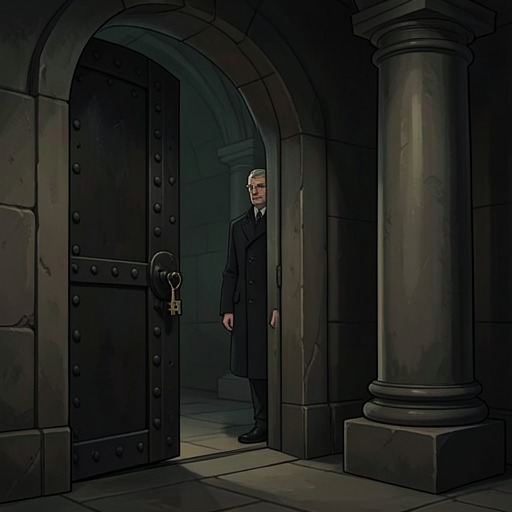
Edgar Linton's will
Wuthering HeightsEdgar Linton's will stands as the Lintons' final, desperate legal bulwark against Heathcliff's encroachment, a document whose careful provisions are nonetheless outflanked by the very legal machinery they invoke. Drafted in the shadow of Heathcliff's open threats and his son Linton's failing health, the will represents Edgar's attempt to control what he cannot otherwise protect: his daughter Catherine's fortune and her future. Its fate reveals the novel's grim thesis that the law, far from being a shield for the vulnerable, is a weapon readily seized by the ruthless.
The Will's Origins and Purpose
The will was conceived in a moment of acute crisis, when Edgar Linton, confined to his sickbed at Thrushcross Grange, divined the true scope of his enemy's ambition. He understood that Heathcliff's purpose was to secure not only the Earnshaw estate but also the Linton personal property for his son, Linton Heathcliff—or, more accurately, for himself. Edgar was puzzled why Heathcliff did not simply wait for his decease, ignorant of how nearly he and his nephew would quit the world together. This ignorance drove him to act, and he determined that his will must be altered. Instead of leaving Catherine's fortune at her own disposal, he resolved to place it in the hands of trustees for her use during her life, and for her children, if she had any, after her. By this means, he calculated, the fortune could not fall to Heathcliff should Linton die. The will was thus a preemptive strike, a legal fortification erected against a siege Edgar could already see coming.
The Will's Execution and Its Immediate Failure
The will's provisions were immediately tested and found wanting. When Edgar lay dying, his daughter Catherine was held prisoner at Wuthering Heights, and his attempts to retrieve her were thwarted. He dispatched a man to fetch the attorney, Mr. Green, and four more men, provided with serviceable weapons, to demand his young lady of her jailor. The single servant returned first, reporting that Mr. Green was out and had to be waited for two hours, after which he claimed to have business in the village but promised to be at Thrushcross Grange before morning. The four men came back unaccompanied, bringing word that Catherine was too ill to quit her room and that Heathcliff would not suffer them to see her. Edgar, unaware of the depth of the betrayal, died blissfully, murmuring to his daughter, "I am going to her; and you, darling child, shall come to us!" His death was so peaceful that none could have noticed the exact minute. It was only after his passing that the full extent of the legal corruption became clear: Mr. Green had sold himself to Heathcliff, and that was the cause of his delay in obeying Edgar's summons.
The Will's Subversion by Mr. Green
Mr. Green's corruption turned Edgar's final legal act into a hollow gesture. Upon arriving at Thrushcross Grange after Edgar's death, the lawyer took upon himself to order everything and everybody about the place, giving all the servants but Ellen Dean notice to quit. He would have carried his delegated authority to the point of insisting that Edgar Linton should not be buried beside his wife, but in the chapel with his family. Only the existence of the will itself, and Ellen Dean's loud protestations against any infringement of its directions, hindered this final indignity. The funeral was hurried over, and Catherine, now Mrs. Linton Heathcliff, was suffered to stay at the Grange only until her father's corpse had quitted it. The will that was meant to protect her inheritance could not protect her from being turned out of her own home, nor could it prevent the lawyer who should have enforced it from becoming the agent of her dispossession.
The Will's Legacy and the Pattern of Legal Dispossession
The fate of Edgar's will echoes a broader pattern of legal dispossession that runs through the novel, a pattern in which documents meant to secure inheritance instead become instruments of ruin. The will's failure mirrors the earlier fate of Hareton Earnshaw, whose father Hindley mortgaged every yard of land he owned for cash to supply his mania for gaming, with Heathcliff as the mortgagee. The lawyer who had been Earnshaw's as well as Edgar's advised that Heathcliff should be let alone, affirming that if the truth were known, Hareton would be found little else than a beggar. "His father died in debt," he said, "the whole property is mortgaged, and the sole chance for the natural heir is to allow him an opportunity of creating some interest in the creditor's heart, that he may be inclined to deal leniently towards him." In that manner, Hareton, who should have been the first gentleman in the neighbourhood, was reduced to a state of complete dependence on his father's inveterate enemy, living in his own house as a servant, deprived of the advantage of wages, quite unable to right himself because of his friendlessness and his ignorance that he has been wronged. The law, in both cases, proved to be not a protector of the innocent but a mechanism for the powerful to consolidate their gains.
The Will's Final Irony
The ultimate irony of Edgar's will is that its careful provisions were rendered moot by the very forces it sought to contain. After Linton Heathcliff's death, Heathcliff went up to Catherine once to show her Linton's will, which bequeathed the whole of his, and what had been her, moveable property to his father. The poor creature had been threatened or coaxed into that act during her week's absence, when his uncle died. The lands, being a minor, Linton could not meddle with, but Heathcliff claimed and kept them in his wife's right and his also, supposedly legally. Catherine, destitute of cash and friends, could not disturb his possession. Edgar's trust, designed to keep the fortune from Heathcliff's grasp, could not prevent the fortune from being absorbed into the very estate it was meant to protect against. The will, in the end, was not a shield but a formality, a document whose power was entirely dependent on the integrity of the legal system that Heathcliff had already corrupted. Its fate stands as a testament to the novel's bleak vision of a world where paper promises are no match for ruthless will.