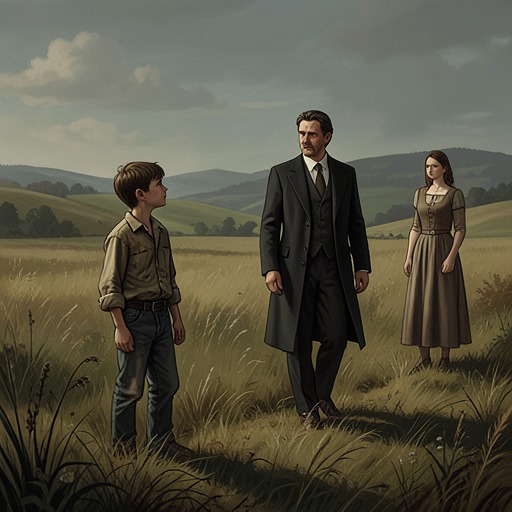
Hareton burns his books
Wuthering HeightsHareton Earnshaw, the rightful heir of Wuthering Heights, burns his books in a moment of anguished humiliation, an act that stands as one of the novel's most painful illustrations of how inherited degradation destroys the possibility of self-improvement. Reduced by Heathcliff's machinations to a state of complete dependence, living in his own house as a servant without wages, Hareton had secretly begun to teach himself to read, driven by shame at Catherine Linton's scorn and hope of her approval. When she ridicules his stumbling attempts and mispronunciations, he gathers half a dozen volumes and hurls them onto the fire, sacrificing his secret studies in a fit of spleen that reveals both his wounded pride and the depth of his longing to be worthy of her regard.
The Context of Hareton's Degradation
Hareton's position at the time of the burning is the culmination of a long process of dispossession engineered by Heathcliff. After Hindley Earnshaw's death, Heathcliff proved to the attorney—and through him to Edgar Linton—that Hindley had mortgaged every yard of his land for cash to supply his mania for gaming, and that Heathcliff himself was the mortgagee. In this manner, Hareton, who should have been the first gentleman in the neighbourhood, was reduced to complete dependence on his father's inveterate enemy, living in his own house as a servant, deprived even of wages, and quite unable to right himself because of his friendlessness and his ignorance that he had been wronged. The lawyer had earlier advised that Hareton would be found little else than a beggar, since his father died in debt and the whole property was mortgaged, leaving the natural heir only the chance of creating some interest in the creditor's heart. Heathcliff, having secured the property, held firm possession and treated Hareton as a menial, so that the young man grew up in a state of degradation that made his later aspiration to literacy all the more poignant.
The Secret Studies and the Provocation
Hareton's attempt to educate himself was a quiet rebellion against the condition imposed on him. He had been content with daily labour and rough animal enjoyments until Catherine crossed his path; her presence awakened in him a desire for something higher. Shame at her scorn and hope of her approval were his first prompters to these pursuits, and he began to teach himself to read in secret, selecting for his study the very books that Catherine herself loved most. When she discovers his efforts, however, she does not encourage him but mocks his ignorance, laughing at his drawling tone as he reads a portion of a book that had obviously been often turned over, and then provokingly commencing a verse of an old ballad in the same fashion. She tells Ellen Dean that Hareton began to teach himself to read once, and because she laughed, he burned his books and dropped the attempt, asking whether he was not a fool. Her cruelty is compounded by her possessiveness: she declares that those books, both prose and verse, are consecrated to her by other associations, and she hates to have them debased and profaned in his mouth, complaining that of all the volumes he has selected her favourite pieces as if out of deliberate malice.
The Burning and Its Immediate Aftermath
Hareton's response to this torment is physical and final. His chest heaves in silence as he labours under a severe sense of mortification and wrath, and when his self-love can endure no further torment, he gives a manual check to her saucy tongue—a physical argument, the only mode he has of balancing the account. He then gathers the books and hurls them on the fire, and Ellen Dean reads in his countenance what anguish it is to offer that sacrifice to spleen. As the volumes consume, he recalls the pleasure they had already imparted and the triumph and ever-increasing pleasure he had anticipated from them, as well as the incitement to his secret studies. Catherine, sucking her damaged lip and watching the conflagration with indignant eyes, cries that this is all the good that such a brute as he can get from them. The scene is a perfect inversion of the novel's larger pattern of aspiration crushed by circumstance: where Heathcliff's revenge had systematically destroyed Hareton's inheritance and status, Catherine's mockery destroys the one thing Hareton had built for himself—his fragile, secret hope of rising.
The Significance of the Act
The burning of the books is not merely an isolated outburst but a defining moment in Hareton's arc and in the novel's meditation on class, education, and the possibility of redemption. It echoes the broader theme of thwarted potential that runs through the book, from Heathcliff's own mysterious origins and his monomaniacal revenge to Catherine Earnshaw's declaration that her love for Heathcliff resembles the eternal rocks beneath, a source of little visible delight but necessary. Hareton's sacrifice of his books is a surrender to the brute condition that Heathcliff and, inadvertently, Catherine have imposed on him, yet it also carries a defiant dignity: he refuses to let his aspirations be mocked, preferring to destroy them himself rather than have them profaned. The act foreshadows the later reconciliation between Hareton and Catherine, when she will come to regret her cruelty and he will risk learning again, and it stands as a testament to the novel's conviction that even the most degraded soul retains the capacity for longing and the pain that longing brings. In the end, Hareton's grief at Heathcliff's death—he sits by the corpse all night, weeping in bitter earnest, pressing its hand and kissing the sarcastic, savage face that everyone else shrank from contemplating—shows that the capacity for love and loss survives even the burning of books, and that the hope Catherine once destroyed can, with time and remorse, be rekindled.