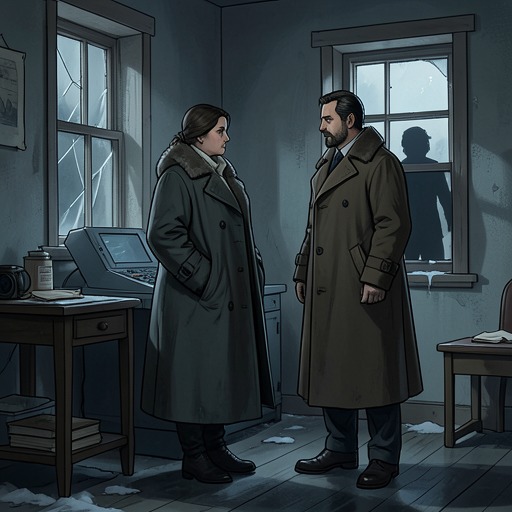
Heathcliff hangs Fanny
Wuthering HeightsHeathcliff's hanging of Fanny, Isabella Linton's little springer spaniel, stands as one of the most chilling and emblematic acts of cruelty in Wuthering Heights. It is the first thing Isabella sees him do upon leaving Thrushcross Grange as his wife, a deliberate and public demonstration of his contempt for her and everything she loves. The act is not a spontaneous outburst of rage but a calculated performance, a declaration of the terms of their marriage delivered in the language of violence against a helpless creature. It announces, before any word is spoken, that Heathcliff's revenge will extend to the innocent, and that Isabella's former life of comfort and affection is now forfeit.
The Act and Its Discovery
The hanging is discovered by Ellen Dean in the dead of night, at around two o'clock in the morning, as she hurries through the garden of Thrushcross Grange to fetch medical aid for the ailing Catherine Linton. At a place where a bridle hook is driven into the wall, Ellen sees something white moving irregularly, evidently by another agent than the wind. Despite her haste, she stops to examine it, fearing that it might be a creature of the other world. Her surprise and perplexity are great when, by touch more than vision, she discovers Isabella's springer, Fanny, suspended by a handkerchief and nearly at its last gasp. Ellen quickly releases the animal and lifts it into the garden, wondering how it could have got out there and what mischievous person had treated it so. She had seen the dog follow its mistress upstairs when she went to bed, and the mystery of its appearance at the bridle hook deepens the sense of violation. As she unties the knot round the hook, she repeatedly catches the beat of horses' feet galloping at some distance, a strange sound in that place at that hour, though she hardly gives the circumstance a thought amid the greater crisis of Catherine's illness.
Heathcliff's Own Account
Heathcliff himself later confirms the act and reveals its deliberate cruelty in a conversation with Ellen at Wuthering Heights. He recounts that the first thing Isabella saw him do, on coming out of the Grange, was to hang up her little dog. When she pleaded for its life, the first words he uttered were a wish that he had the hanging of every being belonging to her, except one—a remark Isabella possibly took as an exception for herself. Heathcliff presents this as evidence of his honesty, boasting that he never told her a lie about his feelings and that she cannot accuse him of showing one bit of deceitful softness. He frames the hanging not as an aberration but as the truthful revelation of his character, the brutal unveiling of the reality behind the romantic hero Isabella had imagined. The act serves as his declaration that her infatuation was built on a fabulous notion of his character, and that he is now teaching her, through such lessons, to know him as he truly is.
Context and Significance
The hanging of Fanny must be understood within the broader pattern of animal imagery and cruelty that runs through the novel. The dogs at Wuthering Heights are themselves presented as savage and unaccustomed to affection; when Mr. Lockwood attempts to caress the canine mother, she responds with a long, guttural gnarl, and Heathcliff warns him that she is not accustomed to being spoiled, not kept for a pet. The household's animals mirror its master's nature—unsoftened, watchful, and quick to attack. In contrast, the Linton children at Thrushcross Grange are seen through the window by the young Heathcliff and Catherine, with Isabella screaming and Edgar weeping over a little dog they had nearly pulled in two between them, a scene of pampered, hysterical pet-keeping that the Earnshaw children despise. Fanny belongs to this world of indulgence, and Heathcliff's hanging of her is an attack on that world itself, a violent rejection of the sentimentality and comfort it represents. The act also foreshadows the novel's other cruelties against the vulnerable—the lapwing's nest that Heathcliff traps, leaving the old birds to dare not come, and the degradation of Hareton, who is reduced to a state of complete dependence on his father's inveterate enemy, living in his own house as a servant. Heathcliff's cruelty to animals is of a piece with his cruelty to people; both are expressions of a will to power that recognizes no innocence.
The Marriage It Defines
The hanging establishes the dynamic of Heathcliff and Isabella's marriage from its very first moment. Isabella had abandoned the elegancies, comforts, and friends of her former home to fix contentedly in the wilderness of Wuthering Heights with him, picturing in him a hero of romance and expecting unlimited indulgences from his chivalrous devotion. Heathcliff, by contrast, regards her as hardly a rational creature, so obstinately has she persisted in forming a fabulous notion of his character. The hanging of Fanny is his first correction of that notion, the inaugural act of a campaign of torment that he describes as a labour of Hercules. He tells Ellen that he keeps strictly within the limits of the law, having avoided giving Isabella the slightest right to claim a separation, and that the nuisance of her presence outweighs the gratification to be derived from tormenting her. The dog's death is thus the opening move in a marriage that is not a union but a punishment, a legal trap from which Isabella cannot escape. It is also the proof of Heathcliff's own account of his nature: he has no pity, and the more the worms writhe, the more he yearns to crush out their entrails. Fanny is the first worm, and Isabella is the next.
Thematic Resonance
The hanging of Fanny resonates with the novel's deepest themes of power, revenge, and the corruption of innocence. Heathcliff's cruelty to the dog is an act of pure domination, a demonstration that he can inflict suffering on the helpless without consequence. It is also a rehearsal for his later, more elaborate cruelties—the imprisonment of Catherine Linton, the manipulation of his sickly son Linton, the usurpation of Wuthering Heights through mortgages and legal chicanery. The act reveals the moral vacuum at the heart of Heathcliff's revenge: his grievances against Hindley and Edgar are real, but his methods extend far beyond his actual wrongs, consuming the innocent along with the guilty. Isabella's dog is the first innocent to die, but she is not the last. The hanging also underscores the novel's insistence on the physical reality of suffering, the way violence against animals and humans alike is rendered with unflinching specificity. Fanny is not a symbol but a creature, suspended by a handkerchief, nearly at its last gasp, and her death is a fact that cannot be explained away. In this, the act stands as a testament to the novel's refusal to soften or sentimentalize the brutality of its world, and to Heathcliff's own monomaniacal pursuit of a satisfaction that, as he later confesses, his soul's bliss kills his body but does not satisfy itself.