Heathcliff's Opening of Catherine's Coffin
Wuthering HeightsHeathcliff's Opening of Catherine's Coffin stands as the most extreme expression of his lifelong, all-consuming attachment to Catherine Earnshaw. Where grief in others seeks comfort in memory or faith, Heathcliff's sorrow drives him to violate the grave itself, to look upon the face of the dead woman he loved, and to plot a physical union that would outlast death. The act, confessed to Ellen Dean in a moment of strange, half-smiling candor, transforms his private anguish into a gothic desecration that scandalizes the neighborhood and binds his fate to Catherine's even beyond the grave.
The Confession and Its Setting
Heathcliff reveals the exhumation to Ellen Dean at Wuthering Heights, in the very room where he has just studied a portrait of the late Mrs. Linton. The confession comes almost casually, as if the horror of the deed has been worn smooth by repetition. He tells her that he had the sexton, who was digging Edgar Linton's grave, remove the earth from Catherine's coffin lid, and that he opened it. He had thought, once, that he would have stayed there with her body. When he saw her face again—'it is hers yet!'—the sexton had hard work to stir him. The sexton warned that the air would change her features, and so Heathcliff struck one side of the coffin loose and covered it up again, deliberately choosing not Linton's side, cursing that Edgar had not been 'soldered in lead.' He then bribed the sexton to pull away the side of his own coffin when he is laid in the grave, and to slide his body out too, so that by the time Edgar Linton reaches them, he will not know which is which. Ellen Dean's immediate response is moral outrage: 'You were very wicked, Mr. Heathcliff! were you not ashamed to disturb the dead?' His answer reveals the strange logic of his obsession—he expected a transformation on raising the lid, but is better pleased that it should not commence until he shares it.
The Night of the First Attempt
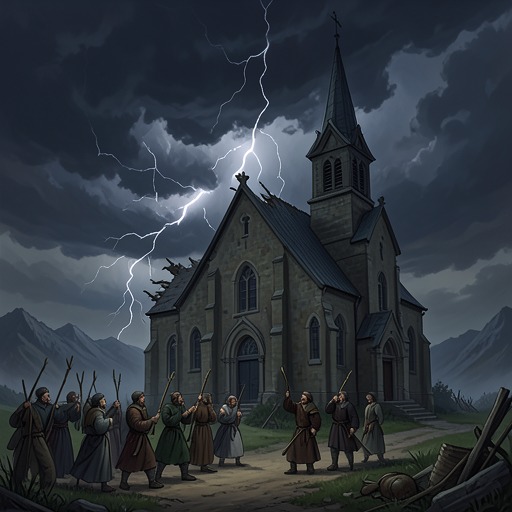
Heathcliff's confession leads him to recount the night of Catherine's burial itself, when his compulsion first took physical form. The day she was buried there came a fall of snow. In the evening he went to the churchyard, where it blew bleak as winter and all around was solitary. He did not fear that her 'fool of a husband' would wander up the glen so late, and no one else had business there. Alone, and conscious that two yards of loose earth were the sole barrier between them, he said to himself: 'I'll have her in my arms again! If she be cold, I'll think it is this north wind that chills me; and if she be motionless, it is sleep.' He got a spade from the tool-house and began to delve with all his might. The spade scraped the coffin; he fell to work with his hands; the wood commenced cracking about the screws. He was on the point of attaining his object when he seemed to hear a sigh from someone above, close at the edge of the grave, and bending down. He muttered, 'If I can only get this off, I wish they may shovel in the earth over us both!' and wrenched at it more desperately still. There was another sigh, close at his ear. He appeared to feel the warm breath of it displacing the sleet-laden wind. He knew no living thing in flesh and blood was by, but as certainly as one perceives the approach to some substantial body in the dark, he felt that Cathy was there—not under him, but on the earth.
The Consolation of Her Presence
That sensation of Catherine's presence, felt at the very edge of her open grave, transformed Heathcliff's labor of agony into sudden relief. A sense of relief flowed from his heart through every limb. He relinquished his digging, turned consoled at once—'unspeakably consoled.' Her presence remained with him while he re-filled the grave, and led him home. He was sure he should see her there; he was sure she was with him, and he could not help talking to her. Yet when he reached the Heights, the door was fastened, and he remembered that 'that accursed Earnshaw and my wife opposed my entrance.' He stopped to kick the breath out of Hindley, then hurried upstairs to his room and hers. He looked round impatiently—he felt her by him, could almost see her, and yet could not. He ought to have sweat blood then, from the anguish of his yearning, from the fervour of his supplications to have but one glimpse. He had not one. She showed herself, as she often was in life, a devil to him. And since then, sometimes more and sometimes less, he had been the sport of that intolerable torture.
The Eighteen Years of Haunting
The failed exhumation inaugurated eighteen years of supernatural torment. Heathcliff describes how his nerves were kept at such a stretch that, if they had not resembled catgut, they would long ago have relaxed to the feebleness of Linton's. When he sat in the house with Hareton, it seemed that on going out he should meet her; when he walked on the moors he should meet her coming in. When he went from home he hastened to return; she must be somewhere at the Heights, he was certain. When he slept in her chamber—he was beaten out of that. He could not lie there, for the moment he closed his eyes, she was either outside the window, or sliding back the panels, or entering the room, or even resting her darling head on the same pillow as she did when a child, and he must open his lids to see. And so he opened and closed them a hundred times a night—to be always disappointed. It racked him. He often groaned aloud, till that old rascal Joseph no doubt believed that his conscience was playing the fiend inside of him. Now, since he had seen her, he was pacified—a little. It was a strange way of killing: not by inches, but by fractions of hairbreadths, to beguile him with the spectre of a hope through eighteen years.
The Desecration's Aftermath and Legacy
The exhumation's consequences ripple through the novel's final movements. Heathcliff's confession to Ellen Dean occurs on the very day he forces Catherine Linton to leave Thrushcross Grange for Wuthering Heights, telling her she will need no ponies there, for her own feet will serve her. The act of opening Catherine's coffin is thus entangled with his ongoing campaign of revenge against the Linton and Earnshaw families. When Heathcliff himself dies, he is buried, to the scandal of the whole neighbourhood, as he wished. The attendance at his funeral comprehended only Hareton Earnshaw, Ellen Dean, the sexton, and six men to carry the coffin. The six men departed when they had let it down into the grave; the others stayed to see it covered. Hareton, with a streaming face, dug green sods and laid them over the brown mould himself. The country folks, if asked, would swear on the Bible that Heathcliff walks: there are those who speak to having met him near the church, and on the moor, and even within this house. An old man by the kitchen fire affirms he has seen two of them looking out of his chamber window on every rainy night since his death. The desecration of Catherine's grave, and Heathcliff's bribe to have the sides of their coffins removed, thus culminates in a haunting that unites the lovers in death as they never could be in life—and that the neighbourhood, with its tales of wandering ghosts, refuses to let rest.