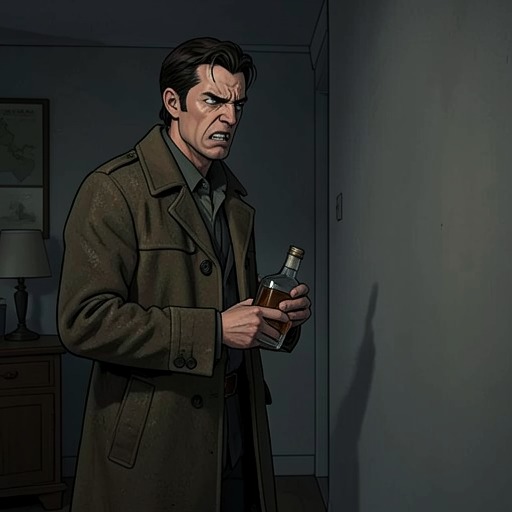
Hindley's Return with Frances
Wuthering HeightsHindley Earnshaw's return to Wuthering Heights, coming home for his father's funeral, is the moment the household's fragile equilibrium shatters. He arrives not alone but with a wife, a development that amazes the household and sets the neighbours gossiping. The woman's identity is a mystery: Hindley never informs anyone what she was or where she was born, and the implication is that she had neither money nor name to recommend her, or he would scarcely have kept the union from his father. This secret marriage, revealed only at the moment of mourning, establishes Frances as an ambiguous figure from the start, an outsider whose presence will have profound consequences for everyone at the Heights.
The Return and the Mystery of Frances
The event unfolds against the backdrop of Mr. Earnshaw's death, a time of grief that Hindley's arrival transforms into a source of scandal. The new Mrs. Earnshaw is not one who would disturb the house on her own account; every object she sees delights her, and she takes pleasure in the wide space of the main room, the pewter dishes, and the dog-kennel. Yet her behaviour during the funeral preparations is unsettling: she runs to her chamber, shivering and clasping her hands, asking repeatedly if the mourners are gone, and describing with hysterical emotion the effect that seeing black has on her. She confesses she is afraid of dying, a fear that seems absurd given her youth and bright, diamond-sparkling eyes, though Ellen Dean notes she is rather thin, breathes quickly on the stairs, starts at sudden noises, and coughs troublesomely. These symptoms, which Ellen fails to interpret, are the first hints of the consumption that will later claim Frances, marking her as a figure of fragility and doom from her very first appearance.
The Transformation of Hindley and the Household Order
Hindley himself is altered considerably in the three years of his absence. He has grown sparer, lost his colour, and speaks and dresses quite differently. On the very day of his return, he tells Joseph and Ellen Dean that they must henceforth quarter themselves in the back-kitchen, leaving the main house for him and his wife. He had intended to carpet and paper a small spare room for a parlour, but Frances expresses such pleasure at the white floor, the huge glowing fireplace, and the wide space that he drops the intention. This reordering of the domestic space is a symbolic act: the servants are pushed to the margins, and the centre of the house becomes the domain of the new master and mistress. The change is not merely physical but hierarchical, signalling Hindley's assumption of absolute authority over the household he has inherited.
The Reawakening of Hatred and Heathcliff's Degradation
Frances's initial affection for the household extends to Catherine, whom she treats as a sister, prattling to her, kissing her, running about with her, and giving her quantities of presents. But this affection tires very soon, and when she grows peevish, Hindley becomes tyrannical. A few words from her evincing a dislike to Heathcliff are enough to rouse in him all his old hatred of the boy. The consequence is swift and brutal: Hindley drives Heathcliff from their company to the servants, deprives him of the instructions of the curate, and insists that he labour out of doors, compelling him to work as hard as any other lad on the farm. This degradation is the direct result of Frances's influence, however passive, and it marks the beginning of Heathcliff's long fall from the position of a favoured child to that of a common labourer. The boy bears it pretty well at first because Catherine teaches him what she learns and works or plays with him in the fields, but the seeds of resentment are sown, and the couple's shared defiance of Hindley's authority becomes their chief amusement, running away to the moors in the morning and remaining there all day, laughing at the punishments that follow.
The Legacy of the Return
Hindley's return with Frances sets the stage for the novel's central conflicts. The degradation of Heathcliff, initiated by Frances's dislike and Hindley's tyranny, fuels the bitterness that will drive him to seek revenge. The couple's neglect of the children, leaving them to run wild on the moors, also leads directly to the expedition to Thrushcross Grange, where Catherine is bitten by the Lintons' bulldog and the course of her life is irrevocably altered. Frances's own fragility, her fear of death and her consumption, foreshadows the mortality that will haunt the Earnshaw family. And the economic ruin that Hindley's dissipation will bring, mortgaging every yard of land he owns to supply his mania for gaming, is the eventual means by which Heathcliff, as mortgagee, will seize possession of Wuthering Heights, reducing Hareton, the rightful heir, to a state of complete dependence on his father's inveterate enemy. The return of the prodigal son, with his mysterious bride, is thus the catalyst for the tragedy that engulfs two families.