Hindley's knife-pistol
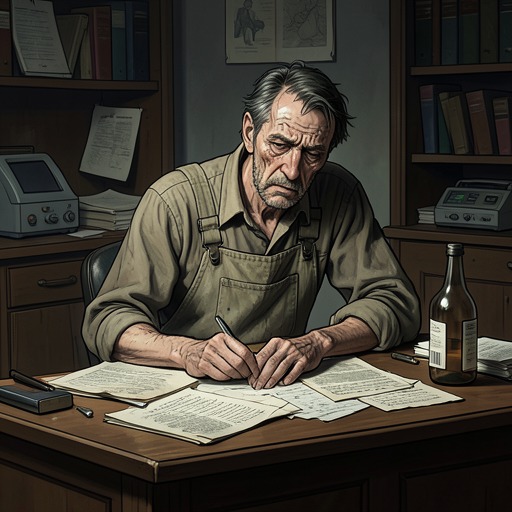
Wuthering HeightsHindley's knife-pistol is a curiously-constructed weapon that fuses a pistol with a double-edged spring knife attached to the barrel, a device that appears in the narrative at the precise moment when Hindley Earnshaw's dissipation has reached its desperate zenith. The weapon is not merely a tool but a material embodiment of Hindley's self-destructive obsession with killing Heathcliff, an obsession that he himself describes as a devil that urges him to thwart his own schemes by murdering his enemy. The pistol's hybrid nature—combining the ranged threat of a firearm with the intimate brutality of a blade—mirrors the way Hindley's violence has become both calculated and chaotic, a nightly ritual of attempted murder that he cannot resist even when he recalls a hundred reasons to refrain.
The Weapon's Introduction and Hindley's Compulsion
The knife-pistol first comes to light when Hindley shows it to Ellen Dean, pulling it from his waistcoat and asking whether it is not a great tempter to a desperate man. He confesses that he cannot resist going up with it every night to try Heathcliff's door, resolved that if he ever finds it open, Heathcliff is done for. This nightly ritual is performed invariably, even when, the minute before, Hindley has been recalling reasons to refrain. He attributes this compulsion to some devil that urges him to thwart his own schemes by killing Heathcliff, and he warns Ellen that when the time comes, not all the angels in heaven shall save his enemy. Ellen's reaction to the weapon is telling: she surveys it inquisitively, and a hideous notion strikes her—how powerful she should be possessing such an instrument. She takes it from his hand and touches the blade, and Hindley looks astonished at the expression her face assumes, which is not horror but covetousness. He snatches the pistol back jealously, shuts the knife, and returns it to its concealment, a gesture that reveals both his possessiveness over the weapon and his recognition that its power tempts even those who should be horrified by it.
The Fight and the Weapon's Misfire
The knife-pistol's most consequential moment comes during a violent confrontation at Wuthering Heights, when Heathcliff, having returned to the house, finds himself facing Hindley's weapon. Ellen Dean, who narrates the scene, admits that she would not have aided or abetted an attempt on Hindley's life for anything, but she wishes that he were dead and is fearfully disappointed when Heathcliff flings himself on Earnshaw's weapon and wrenches it from his grasp. The charge explodes, and the knife, in springing back, closes into its owner's wrist—a cruel irony in which the hybrid weapon turns against the man who wielded it. Heathcliff pulls the knife away by main force, slitting up the flesh as it passes on, and thrusts it dripping into his pocket. He then takes a stone, strikes down the division between two windows, and springs in. Hindley has fallen senseless with excessive pain and the flow of blood that gushes from an artery or a large vein. The ruffian—Heathcliff—kicks and tramples on him, dashes his head repeatedly against the flags, and holds Ellen with one hand to prevent her summoning Joseph. He exerts preterhuman self-denial in abstaining from finishing Hindley completely, but getting out of breath, he finally desists and drags the apparently inanimate body onto the settle. There he tears off the sleeve of Earnshaw's coat and binds up the wound with brutal roughness, spitting and cursing during the operation as energetically as he had kicked before. The weapon that Hindley had intended as the instrument of Heathcliff's death becomes the instrument of his own near-fatal wounding, a reversal that encapsulates the self-destructive logic of his revenge.
The Weapon's Role in Heathcliff's Ascendancy
The knife-pistol's significance extends beyond the single fight, as it becomes emblematic of the broader transfer of power that follows. Hindley's father died in debt, and the whole property is mortgaged; the sole chance for the natural heir, Hareton, is to allow him an opportunity of creating some interest in the creditor's heart. Heathcliff, as the mortgagee, holds firm possession of Wuthering Heights and proves to the attorney—who in turn proves it to Edgar Linton—that Earnshaw had mortgaged every yard of land he owned for cash to supply his mania for gaming. In that manner, Hareton, who should now be the first gentleman in the neighbourhood, is reduced to a state of complete dependence on his father's inveterate enemy, living in his own house as a servant, deprived of the advantage of wages, quite unable to right himself because of his friendlessness and his ignorance that he has been wronged. The knife-pistol, which Hindley had hoped would be the instrument of his revenge, instead becomes a symbol of his failure: the violence he directed at Heathcliff rebounded upon himself, and the weapon that was meant to secure his dominance instead marked the moment of his physical and material collapse. The pistol's misfire is thus not an accident but a structural inevitability, the material world itself refusing to serve a man whose schemes have already been undermined by his own dissipation.
The Weapon's Aftermath and the Persistence of Violence
The aftermath of the fight reveals how deeply the knife-pistol's violence has reshaped the household. Ellen, being at liberty, loses no time in seeking the old servant Joseph, who, having gathered by degrees the purport of her hasty tale, hurries below, gasping as he descends the steps two at once. The scene of Hindley lying senseless, his blood gushing from the wound, marks the end of any pretense of equality between the two men: from this point forward, Heathcliff is the master in all but name, and Hindley's remaining life is a slow decline into death. The weapon itself, having been thrust dripping into Heathcliff's pocket, disappears from the narrative as a physical object, but its effects persist. The violence it enabled becomes the template for Heathcliff's later cruelties, and the pattern of self-inflicted harm—the knife closing into its owner's wrist—recurs throughout the novel as characters' schemes for revenge consistently turn back upon themselves. The knife-pistol is thus not merely a plot device but a material symbol of the novel's central irony: that the instruments of vengeance are always double-edged, and that those who reach for them are as likely to be wounded as to wound.
The Weapon as Legal and Narrative Instrument
The knife-pistol also participates in the novel's broader engagement with law and property, as the violence it embodies is inseparable from the legal machinations that follow. Heathcliff's acquisition of Wuthering Heights is accomplished not through the weapon but through the mortgage that Hindley signed in his mania for gaming, yet the weapon's presence haunts this legal transfer. The fight in which the knife-pistol misfires is the physical counterpart to the legal dispossession that follows: just as the weapon turns against its owner, so too does Hindley's own profligacy turn against him, leaving Hareton dependent on his father's enemy. The weapon thus stands at the intersection of physical and legal violence, a reminder that in the world of Wuthering Heights, power is secured both by force and by the manipulation of property law. Heathcliff's later actions—altering wills, claiming property in his wife's right, threatening Catherine Linton with Linton's will—all follow the pattern established in the fight with the knife-pistol, where the aggressor's own instrument becomes the means of his undoing. The weapon's misfire is the novel's first great demonstration of this principle, and it sets the terms for everything that follows.