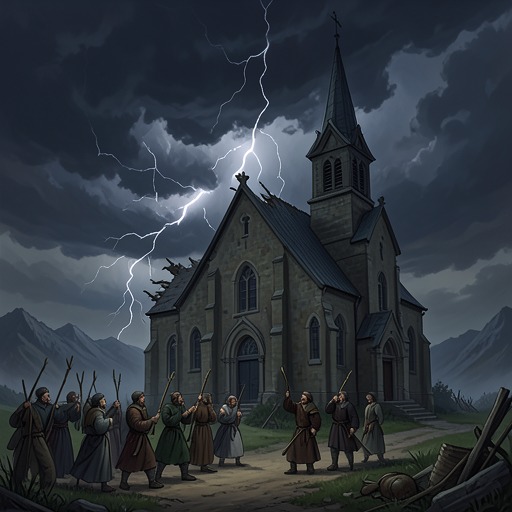
I'll have her in my arms again!
Wuthering HeightsI'll have her in my arms again! is the most concentrated expression of Heathcliff's refusal to surrender Catherine Earnshaw to death. Uttered to himself as he stood alone in the churchyard on the evening of her burial, with only two yards of loose earth between him and her coffin, the words are at once a lover's vow, a madman's delusion, and a metaphysical claim that the boundaries of mortality do not apply to their bond. The sentence carries the entire weight of his character: the monomaniacal intensity, the literal-minded determination to undo what nature has done, and the absolute conviction that Catherine belongs to him beyond the grave. It is the point where his grief turns from passive suffering into active, even sacrilegious, action, and it foreshadows the strange transformation that will eventually release him from his eighteen years of torment.
The Vow at the Grave
The words were spoken under circumstances that reveal their full desperation. On the day Catherine was buried, a fall of snow had come, and in the evening Heathcliff went to the churchyard alone, confident that her husband would not wander up the glen so late and that no one else had business there. Standing over the fresh grave, he said to himself, "I'll have her in my arms again! If she be cold, I'll think it is this north wind that chills me; and if she be motionless, it is sleep." The qualification is as revealing as the vow itself: he was not merely hoping to hold her corpse, but preparing his own mind to reinterpret the evidence of death as something temporary and benign. He fetched a spade from the tool-house and began to delve with all his might, scraping the coffin and then falling to work with his hands as the wood commenced cracking about the screws. He was on the point of attaining his object when he seemed to hear a sigh from someone above, close at the edge of the grave and bending down. He muttered that if he could only get the coffin open, he wished they might shovel in the earth over them both, and wrenched at it more desperately still. Another sigh came, close at his ear, and he appeared to feel the warm breath of it displacing the sleet-laden wind. He knew no living thing in flesh and blood was by, yet as certainly as one perceives the approach of a substantial body in the dark, he felt that Cathy was there, not under him but on the earth. A sudden sense of relief flowed from his heart through every limb; he relinquished his labour of agony and turned consoled at once, unspeakably consoled. Her presence remained with him while he re-filled the grave and led him home.
The Roots of the Claim
The vow did not emerge from nothing; it was the logical endpoint of a lifelong conviction that Catherine and Heathcliff were not two people but one being. Years earlier, Catherine had tried to explain this to Ellen Dean, insisting that her great miseries in this world had been Heathcliff's miseries, which she watched and felt each from the beginning, and that her great thought in living was himself. "If all else perished, and he remained, I should still continue to be; and if all else remained, and he were annihilated, the universe would turn to a mighty stranger," she said, and then declared flatly, "Nelly, I am Heathcliff!" Her love for him, she said, resembled the eternal rocks beneath, a source of little visible delight but necessary, unlike her love for Edgar Linton, which was like the foliage in the woods that time would change as winter changes the trees. This doctrine of mutual identity is the philosophical ground on which Heathcliff's grave-side vow stands: if Catherine is Heathcliff, then her death is not a separation but a mutilation, and reclaiming her is not theft but the restoration of a severed self. When he later cried out that he could not live without his life and could not live without his soul, he was giving voice to the same logic that made him dig for her body.
The Unanswered Prayer and the Haunting
For eighteen years after that night, the vow went unfulfilled, and its failure became the engine of Heathcliff's torment. He told Ellen Dean that he was wild after Catherine died, eternally praying from dawn to dawn for her spirit to return to him, and that he had a strong faith in ghosts and a conviction that they could and did exist among the living. Yet she showed herself, as she often was in life, a devil to him, and he became the sport of intolerable torture. When he sat in the house with Hareton Earnshaw, it seemed that on going out he should meet her; when he walked on the moors, he should meet her coming in. When he went from home he hastened to return, certain she must be somewhere at the Heights. When he slept in her chamber, he was beaten out of it, for the moment he closed his eyes she was either outside the window, or sliding back the panels, or entering the room, or even resting her darling head on the same pillow as she did when a child, and he must open his lids to see. He opened and closed them a hundred times a night, to be always disappointed. He often groaned aloud till old Joseph no doubt believed his conscience was playing the fiend inside him. He described the experience as a strange way of killing, not by inches but by fractions of hairbreadths, beguiling him with the spectre of a hope through eighteen years. The vow had become a curse: he had asked her to haunt him, and she had obliged, but haunting was not holding.
The Fulfilment and Its Paradox
The vow was finally answered not by a reunion with Catherine's body but by a strange change that overtook Heathcliff in his last days. He confessed to Ellen Dean that he had lost the faculty of enjoying the destruction of his enemies, and that he was too idle to destroy for nothing. He took so little interest in his daily life that he hardly remembered to eat and drink. He told her that Hareton's aspect was the ghost of his immortal love, of his wild endeavours to hold his right, his degradation, his pride, his happiness, and his anguish, and that the entire world was a dreadful collection of memoranda that Catherine did exist and that he had lost her. Yet he also said that since he had seen her, he was pacified, a little. The pacification came from the conviction, born at the grave, that she was with him, and it culminated in his death, after which he was buried as he wished, to the scandal of the whole neighbourhood. The country folk would swear on the Bible that he walks, and there were those who spoke of meeting him near the church, on the moor, and even within the house itself. The old man by the kitchen fire affirmed he had seen two of them looking out of his chamber window on every rainy night since his death. The vow, which began as a demand to hold a corpse, ended as a promise of a shared haunting, the two of them together at last in the only form the world would allow.
The Speech Act of the Vow
The power of the phrase lies in its nature as a performative utterance, a speech act that does not describe a wish but commits the speaker to an action. Heathcliff does not say he hopes to hold her, or that he wishes he could; he declares that he will have her in his arms again, and the declaration itself becomes the motive force of his subsequent life. It stands in stark contrast to his other great utterances, which are curses and threats directed outward at his enemies, such as his vow that Catherine Earnshaw should not rest as long as he was living, or his declaration that he had no pity and that the more the worms writhe, the more he yearns to crush out their entrails. Those are speech acts of destruction; this one is a speech act of possession, and it is the only one of his vows that is ultimately fulfilled, though in a form he could not have predicted when he stood over the grave with the spade in his hand. The phrase also echoes and answers Catherine's own words, her insistence that she is Heathcliff and that their souls are made of the same stuff. If she was right, then his vow to hold her again was not madness but the most literal statement of his identity, and its fulfilment in death was the only possible conclusion to a life that had never been his own to live.