Mr. Earnshaw
Wuthering HeightsMr. Earnshaw, the original master of Wuthering Heights, is the patriarch whose fateful decision to bring home a starving foundling from the streets of Liverpool sets the novel's entire tragic cycle in motion. His impulsive compassion for a dirty, ragged, black-haired child—whom he christens Heathcliff after a son who died in childhood—shatters the domestic peace of his household, igniting a lifelong enmity between his natural son Hindley and the adopted boy, and forging a bond with his daughter Catherine that transcends death itself. Mr. Earnshaw's character is defined by a stern but loving nature, a fatal partiality for Heathcliff that breeds resentment, and a death that leaves his children vulnerable to the destructive forces he unwittingly unleashed.
Identity and Background
Mr. Earnshaw is introduced through the carved inscription over the principal door of Wuthering Heights, which bears the date '1500' and the name 'Hareton Earnshaw,' establishing his family as an ancient line in the region. He is a kind-hearted but sometimes severe man, as recalled by Nelly Dean, who notes that he promised to bring her a pocketful of apples and pears when he set off on a journey to Liverpool. He is the father of Hindley and Catherine Earnshaw, and the master of a household that includes the servant Joseph and the young Nelly Dean, who sat eating her porridge with the children. His wife, Mrs. Earnshaw, is a less prominent figure, and his relationship with her is marked by her initial horror at the foundling he brings home.
The Fateful Journey to Liverpool
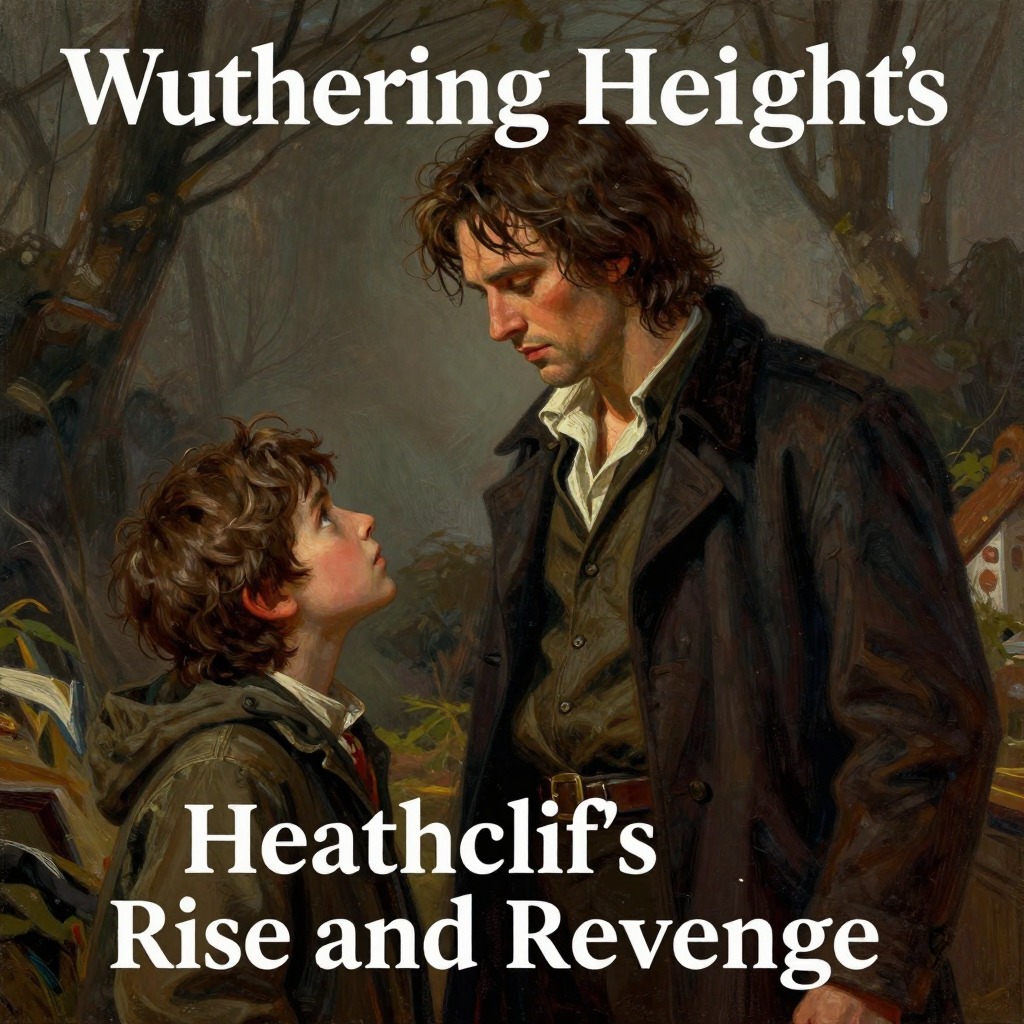
One fine summer morning at the beginning of harvest, Mr. Earnshaw came downstairs dressed for a journey and announced to his son Hindley, his daughter Cathy, and Nelly that he was going to Liverpool, a walk of sixty miles each way. He asked what they would like him to bring: Hindley named a fiddle, and six-year-old Cathy, who could ride any horse in the stable, chose a whip. He promised Nelly a pocketful of apples and pears, kissed his children, and set off. His absence seemed long to the family, and on the third evening, Mrs. Earnshaw expected him by supper-time. When he finally arrived around eleven o'clock, he threw himself into a chair, laughing and groaning, and bid them all stand off, for he was nearly killed. He opened his great-coat, which he held bundled up in his arms, and revealed a dirty, ragged, black-haired child, big enough to walk and talk, with a face that looked older than Catherine's. He explained that he had found the child starving, houseless, and as good as dumb in the streets of Liverpool, and after inquiring for its owner in vain, he decided to bring it home rather than leave it as he found it. Mrs. Earnshaw was ready to fling the gipsy brat out of doors, but Mr. Earnshaw told her to take it as a gift of God, though it was as dark almost as if it came from the devil. He ordered Nelly to wash it, give it clean things, and let it sleep with the children.
Partiality and Its Consequences
From the very beginning, Mr. Earnshaw's adoption of Heathcliff bred bad feeling in the house. He took to Heathcliff strangely, believing all he said (though the boy said precious little, and generally the truth), and petting him up far above Cathy, who was too mischievous and wayward for a favourite. This favoritism made Hindley regard his father as an oppressor rather than a friend, and Heathcliff as a usurper of his parent's affections and his privileges. Mr. Earnshaw's partiality was so pronounced that he would fly into a fury if anyone attempted to impose upon or domineer over his favourite, and he became painfully jealous lest a word should be spoken amiss to him. This humouring of his whims was rich nourishment to the child's pride and black tempers. The curate, seeing the discord, advised that Hindley should be sent to college, and Mr. Earnshaw agreed, though with a heavy spirit, saying Hindley was nought and would never thrive where he wandered. The servant Joseph, a self-righteous Pharisee, encouraged Mr. Earnshaw to regard Hindley as a reprobate and heaped the heaviest blame on Catherine, further poisoning the family atmosphere.
Death and Legacy
Mr. Earnshaw died quietly in his chair one October evening, seated by the fireside, with a high wind blustering round the house. In his final moments, he was surrounded by his family: Nelly, a little removed from the hearth, busy at her knitting; Joseph reading his Bible; Miss Cathy, who had been sick, leaning against her father's knee; and Heathcliff lying on the floor with his head in her lap. Before he fell into a doze, the master stroked Cathy's bonny hair, pleased to see her gentle, and asked, 'Why canst thou not always be a good lass, Cathy?' She turned her face up to his, laughed, and answered, 'Why cannot you always be a good man, father?' When she saw him vexed again, she kissed his hand and said she would sing him to sleep. She began singing very low, till his fingers dropped from hers and his head sank on his breast. After a half-hour of silence, Joseph stepped forward to rouse the master for prayers and bed, but he would not move. Catherine, putting her arms round his neck, discovered her loss directly and screamed out, 'Oh, he's dead, Heathcliff! he's dead!' The two children set up a heart-breaking cry, and Nelly joined her wail to theirs. Mr. Earnshaw's death left his children in the hands of Hindley, who returned home for the funeral with a wife and a heart full of hatred for Heathcliff, immediately driving the boy from their company to the servants and depriving him of the curate's instruction. The old master's dying wish for peace was thus utterly thwarted, and his legacy became one of unresolved conflict and simmering revenge.
Thematic Significance
Mr. Earnshaw's character embodies the novel's central tension between natural affection and social order. His decision to adopt Heathcliff is an act of pure, impulsive humanity, but it violates the unspoken codes of class and family that govern his world. His partiality, born of pity and a recognition of the boy's suffering, paradoxically becomes the seed of destruction, as it fuels Hindley's jealousy and Heathcliff's sense of entitlement. In his death, the protective figure is removed, and the children are left to the mercies of a world that will not forgive Heathcliff's origins. Mr. Earnshaw's grave, like his life, marks the point where the Earnshaw line begins its decline, and his memory lingers as a reminder of the kindness that, in this harsh world, could not be sustained.