Mr. Earnshaw (elder)
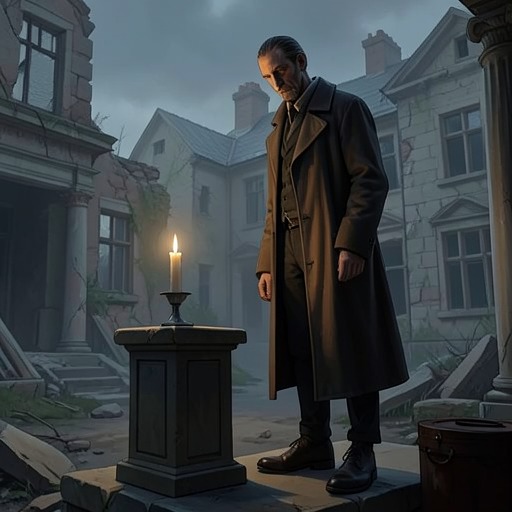
Wuthering HeightsMr. Earnshaw (elder) is the original master of Wuthering Heights, the patriarch whose single impulsive act of charity sets the entire tragedy of the novel in motion. He is the father of Hindley Earnshaw and Catherine Earnshaw, and the man who, on a business trip to Liverpool, finds a starving, homeless, and nearly mute child in the streets and decides to bring him home. This decision, made with a kind heart but without foresight, introduces Heathcliff into the Earnshaw household and ultimately leads to the ruin of both families. Mr. Earnshaw's death, which occurs quietly in his chair one October evening, marks the end of the old order and unleashes the jealousies and hatreds that define the rest of the story.
Identity and Background
Mr. Earnshaw is introduced through the recollections of Ellen Dean, who was almost always at Wuthering Heights as a child because her mother had nursed Hindley Earnshaw. He is described as a man with a kind heart, though rather severe sometimes, and he is the undisputed authority of his household. His position as a landowner and father is central to his identity; he is the one who gives orders to Joseph, the servant, and who doles out presents to his children. He is also a man of considerable physical vigor, as evidenced by his plan to walk the sixty miles to Liverpool and back, a journey he describes as "a long spell." This physicality is part of his character, making his sudden decline and death all the more striking. He is a man of his time and class, strict and grave with his children, yet capable of deep, if misguided, affection.
The Liverpool Journey and the Arrival of Heathcliff
The pivotal event of Mr. Earnshaw's life, and the catalyst for the novel's plot, is his journey to Liverpool. Before leaving, he asks his son Hindley what he should bring him, allowing him to choose anything as long as it is little, since he will walk the sixty miles each way. Hindley names a fiddle, while the young Catherine, hardly six years old, chooses a whip. He also promises Ellen Dean a pocketful of apples and pears, showing his consideration for those beneath his station. His absence lasts three days, and the family grows anxious. When he finally returns, just about eleven o'clock, he is nearly killed from the walk, laughing and groaning, and he carries a great-coat bundled in his arms. Inside is a dirty, ragged, black-haired child, big enough to walk and talk, whose face looks older than Catherine's. The master explains that he found the child starving, houseless, and as good as dumb in the streets of Liverpool, and after inquiring for its owner with no success, he decided to bring it home rather than leave it as he found it. He presents the child as "a gift of God," though he admits it is "as dark almost as if it came from the devil." This act of charity is met with immediate hostility from his wife, who is ready to fling the "gipsy brat" out of doors, and from his children, who are disappointed that their presents were lost in attending to the stranger. Hindley's fiddle is crushed to morsels, and Catherine's whip is lost, earning Heathcliff their immediate resentment. Mr. Earnshaw, however, is determined, and he instructs Ellen to wash the child, give it clean things, and let it sleep with the children.
Favoritism and Family Conflict
In the course of time, Mr. Earnshaw begins to fail. His strength leaves him suddenly, and as he is confined to the chimney-corner, he grows grievously irritable. A nothing vexes him, and suspected slights of his authority nearly throw him into fits. This irritability is especially pronounced when anyone attempts to impose upon or domineer over his favourite, Heathcliff. He becomes painfully jealous lest a word should be spoken amiss to him, having gotten into his head the notion that because he likes Heathcliff, all hate him and long to do him an ill-turn. This partiality is a disadvantage to the lad, as the kinder members of the household humour the master's preference, which serves as rich nourishment to the child's pride and black tempers. The favoritism also deepens the rift between Heathcliff and Hindley. Twice or thrice, Hindley's manifestation of scorn, while his father is near, rouses the old man to a fury, and he seizes his stick to strike him, shaking with rage that he cannot do it. The curate eventually advises that the young man should be sent to college, and Mr. Earnshaw agrees, though with a heavy spirit, saying that Hindley is nought and will never thrive as where he wandered. This decision, while removing the immediate source of conflict, sets Hindley on a path that will lead to his own ruin and his cruel treatment of Heathcliff after his father's death.
Death and Its Immediate Aftermath
Mr. Earnshaw's death comes quietly and unexpectedly. He dies in his chair one October evening, seated by the fire-side, with a high wind blustering round the house and roaring in the chimney. The scene is one of domestic tranquility: Ellen is a little removed from the hearth, busy at her knitting, while Joseph reads his Bible near the table. Miss Cathy, who has been sick, leans against her father's knee, and Heathcliff lies on the floor with his head in her lap. Before he falls into a doze, the master strokes Catherine's bonny hair, pleased to see her gentle, and asks, "Why canst thou not always be a good lass, Cathy?" She turns her face up to his, laughs, and answers, "Why cannot you always be a good man, father?" When she sees him vexed again, she kisses his hand and says she will sing him to sleep. She begins singing very low, until his fingers drop from hers and his head sinks on his breast. The family keeps as mute as mice for a full half-hour, until Joseph, having finished his chapter, steps forward to rouse the master for prayers and bed. He calls him by name and touches his shoulder, but he will not move. Joseph takes the candle and looks at him, and Ellen, sensing something wrong, seizes the children each by an arm and whispers them to go upstairs. Catherine, however, puts her arms round his neck to bid him good-night, and discovers her loss directly, screaming out, "Oh, he's dead, Heathcliff! he's dead!" They both set up a heart-breaking cry. His death leaves his children vulnerable: Catherine is left to the mercy of her brother Hindley, who returns with his new wife Frances and immediately degrades Heathcliff to the status of a servant, and the household descends into the chaos that will define the rest of the novel.
Legacy and Narrative Significance
Mr. Earnshaw's legacy is felt long after his death. His act of bringing Heathcliff into the family is the root cause of the novel's central conflicts. His favoritism creates the enmity between Heathcliff and Hindley that leads to Heathcliff's degradation and eventual flight. His death removes the only protective figure Heathcliff has, leaving him vulnerable to Hindley's cruelty. The old master's decision to send Hindley to college, made with a heavy spirit, also has far-reaching consequences, as Hindley returns with a wife and a mania for gaming that leads him to mortgage every yard of land he owns. This mortgage is later used by Heathcliff to take over Wuthering Heights, reducing Hareton, who should have been the first gentleman in the neighbourhood, to a state of complete dependence on his father's inveterate enemy. Mr. Earnshaw's own words about Hindley, that he is "nought, and would never thrive as where he wandered," prove prophetic. Even in death, his presence is felt in the structure of the household he created. The house itself, with its Hareton Earnshaw door inscription, stands as a monument to his family's former status, a status that is usurped and then finally restored after Heathcliff's death. Joseph, the old servant, sees the restoration of the "lawful master and the ancient stock" as a return to the proper order that Mr. Earnshaw represented. The old master's kindness, his severity, and his fatal act of charity are thus the foundation upon which the entire tragedy of Wuthering Heights is built.