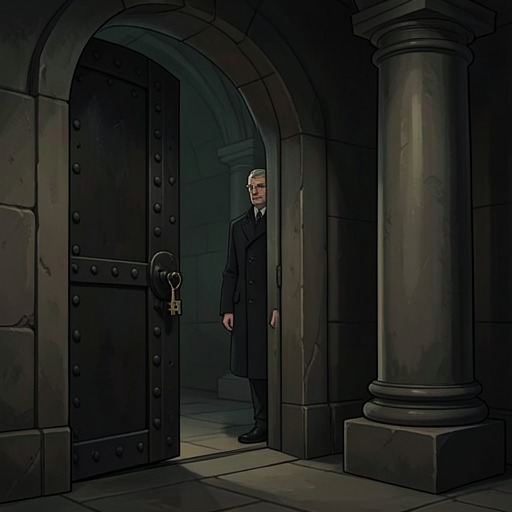
Mr. Green
Wuthering HeightsMr. Green is the attorney who serves as the legal instrument of Heathcliff's final triumph over the Linton family. Though he appears only in the closing stages of the narrative, his actions determine the fate of the Linton fortune and estate. He is the lawyer who had also served Hindley Earnshaw, and his professional treachery — selling himself to Heathcliff at the crucial moment of Edgar Linton's death — completes the usurper's conquest of both Wuthering Heights and Thrushcross Grange. His role exposes the novel's deep critique of a legal system that fails to protect the vulnerable and instead becomes a weapon in the hands of the powerful and the ruthless.
Role as the Earnshaw Family Lawyer
Mr. Green's connection to the Earnshaw family predates his betrayal of the Lintons. He had been Hindley Earnshaw's lawyer as well, and it was to him that Ellen Dean turned when she sought to investigate the state of Hindley's affairs after his death. When Ellen called at the village and asked him to accompany her to Wuthering Heights, he shook his head and advised that Heathcliff should be left alone, affirming that if the truth were known, Hareton would be found little else than a beggar. He explained that Hindley's father had died in debt, that the whole property was mortgaged, and that the sole chance for the natural heir was to allow him an opportunity of creating some interest in the creditor's heart, so that he might be inclined to deal leniently towards him. This early counsel reveals Mr. Green's coldly pragmatic view of the law: he sees the legal situation not as a matter of justice for the wronged heir, but as a calculation of how best to appease the creditor. His advice effectively abandoned Hareton's cause before it was ever pursued, and it foreshadows the lawyer's later willingness to serve the stronger party.
The Attorney Who Proved Heathcliff's Claim
Mr. Green's professional services were instrumental in establishing Heathcliff's hold on Wuthering Heights. After Hindley's death, the guest became the master of Wuthering Heights, holding firm possession and proving to the attorney — who, in turn, proved it to Edgar Linton — that Earnshaw had mortgaged every yard of land he owned for cash to supply his mania for gaming, and that Heathcliff was the mortgagee. In that manner, Hareton, who should have been the first gentleman in the neighbourhood, was reduced to a state of complete dependence on his father's inveterate enemy, living in his own house as a servant, deprived of the advantage of wages, quite unable to right himself because of his friendlessness and his ignorance that he had been wronged. Mr. Green's role here is that of the legal functionary who certifies the legitimacy of an unjust seizure. By proving Heathcliff's claim as mortgagee, he converts what might have been contested into an established legal fact, and his professional authority is what convinces Edgar Linton not to interfere. The lawyer's neutrality is itself a form of complicity: he does not create the injustice, but his certification of it makes it unassailable.
The Betrayal of Edgar Linton
Mr. Green's decisive act of treachery occurs at the moment of Edgar Linton's death. When Edgar, divining that one of his enemy's purposes was to secure the personal property as well as the estate to his son, or rather himself, determined to alter his will — instead of leaving Catherine's fortune at her own disposal, he decided to put it in the hands of trustees for her use during life, and for her children after her, so that it could not fall to Heathcliff should Linton die — he sent for his lawyer. Ellen Dean despatched a man to fetch the attorney, but Mr. Green was out when the servant arrived at his house, and the servant had to wait two hours for his re-entrance; then Mr. Green told him he had a little business in the village that must be done, but he would be at Thrushcross Grange before morning. He never came that night. The delay was deliberate: Mr. Green had sold himself to Heathcliff, and that was the cause of his delay in obeying his master's summons. By the time he appeared, at dinner-time the next day, Edgar Linton was dead, and the will had not been altered. The lawyer's treachery is all the more damning because it is so quiet and so professional — a missed appointment, a small piece of business in the village — and yet it decides the entire inheritance. He had called at Wuthering Heights to get his instructions how to behave, and those instructions were to let Edgar die without changing his will.
The Usurpation of the Grange
After Edgar's death, Mr. Green took upon himself to order everything and everybody about the place. He gave all the servants but Ellen Dean notice to quit. He would have carried his delegated authority to the point of insisting that Edgar Linton should not be buried beside his wife, but in the chapel with his family; only the existence of the will hindered that, along with Ellen's loud protestations against any infringement of its directions. The funeral was hurried over, and Catherine, now Mrs. Linton Heathcliff, was suffered to stay at the Grange only until her father's corpse had quitted it. Mr. Green's conduct here reveals the full extent of his corruption: he does not merely fail to protect his client's interests, but actively works to dismantle the household, dismissing servants and attempting to override even the dead man's burial wishes. His authority is delegated — he acts as Heathcliff's agent — but he wields it with the arrogance of one who knows the law is on his side. The hurried funeral and the dismissal of the servants mark the final dissolution of the Linton household, and Mr. Green is the instrument of that dissolution.
The Lawyer's Continuing Role and Final Absence
Mr. Green's services remain in demand even at the very end of Heathcliff's life. In his final days, when Heathcliff was roaming to and fro in a state approaching distraction, unable to eat or rest, he declared that when day broke he would send for Green, wishing to make some legal inquiries while he could bestow a thought on those matters and while he could act calmly. He had not written his will yet, and could not determine how to leave his property, wishing he could annihilate it from the face of the earth. The irony is sharp: the lawyer who had enabled Heathcliff's every acquisition is summoned to arrange the disposition of the spoils, and Heathcliff's inability to decide how to leave his property mirrors the emptiness of his triumph. Yet Mr. Green does not appear at the deathbed. When Heathcliff dies, it is Ellen Dean who finds the body, and Joseph who refuses to touch it, declaring that the devil has harried off his soul. The lawyer's absence from the final scene is fitting: his work is done, the property is secured, and the legal machinery that he served has no further part to play in the story. His last recorded intention — to be summoned for legal inquiries — is never fulfilled, and he vanishes from the narrative as quietly as he had served it, a functionary whose betrayals shaped the fate of two families but who himself remains a shadowy, almost faceless figure of professional corruption.