Oak-panelled bed
Wuthering HeightsThe Oak-panelled bed is one of the most significant and haunting objects in Wuthering Heights, a piece of furniture that functions as a threshold between the living and the dead, the past and the present. It is a large oak case, with squares cut out near the top resembling coach windows, designed to form a little closet around a window ledge that serves as a table. This singular structure, which obviates the necessity for every member of the family having a room to himself, becomes the site of the novel's most terrifying supernatural encounter, the repository of Catherine Earnshaw's childhood identity, and the final resting place of Heathcliff's tormented body. More than a mere bed, it is a spatialized memory, a Gothic chamber within a chamber where the novel's central obsessions—love, loss, and the refusal to let go—are physically enacted.
Form and Setting
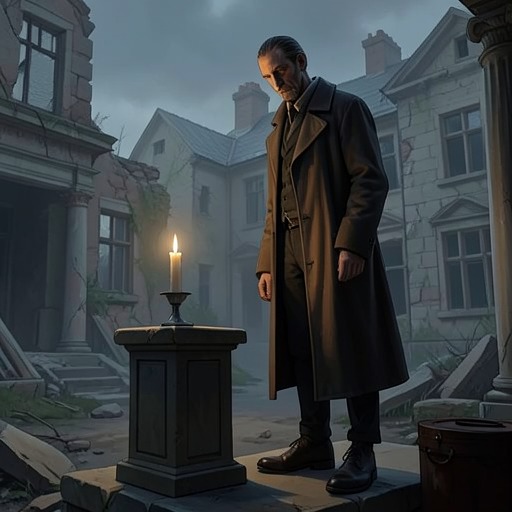
The bed is introduced through the eyes of Mr. Lockwood, the novel's frame narrator, during his first night at Wuthering Heights. Zillah, the housekeeper, warns him that her master has an odd notion about the chamber she will put him in, and never lets anybody lodge there willingly. Too stupefied to be curious, Lockwood fastens his door and glances round for the bed, finding the whole furniture to consist of a chair, a clothes-press, and the large oak case. Having approached this structure, he looks inside and perceives it to be a singular sort of old-fashioned couch, very conveniently designed to obviate the necessity for every member of the family having a room to himself. In fact, it forms a little closet, and the ledge of a window, which it encloses, serves as a table. He slides back the panelled sides, gets in with his light, pulls them together again, and feels secure against the vigilance of Heathcliff, and every one else. The bed's design, with its window ledge and panelled sides, makes it a space of both enclosure and exposure—a place where one can hide from the world but also be vulnerable to what lies beyond the glass.
Catherine's Inscriptions and the Diary
The bed's window ledge holds a secret that transforms Lockwood's stay from mere lodging into a descent into the novel's buried past. The ledge, where he places his candle, has a few mildewed books piled up in one corner, and it is covered with writing scratched on the paint. This writing, however, is nothing but a name repeated in all kinds of characters, large and small—Catherine Earnshaw, here and there varied to Catherine Heathcliff, and then again to Catherine Linton. The three names trace the arc of Catherine's life and her impossible desires: the name she was born with, the name she might have taken had she married Heathcliff, and the name she actually took as Edgar Linton's wife. In vapid listlessness, Lockwood leans his head against the window and continues spelling over Catherine Earnshaw—Heathcliff—Linton, till his eyes close. The bed thus becomes the archive of Catherine's identity, a surface upon which she has scratched her very being. The books themselves are a Testament in lean type, smelling dreadfully musty, with a fly-leaf bearing the inscription 'Catherine Earnshaw, her book,' and a date some quarter of a century back. Catherine's library is select, and its state of dilapidation proves it to have been well used, though not altogether for a legitimate purpose: scarcely one chapter has escaped a pen-and-ink commentary, covering every morsel of blank that the printer left. Some are detached sentences; other parts take the form of a regular diary, scrawled in an unformed, childish hand. At the top of an extra page, Lockwood is greatly amused to behold an excellent caricature of Joseph, rudely, yet powerfully sketched. An immediate interest kindles within him for the unknown Catherine, and he begins forthwith to decipher her faded hieroglyphics. The bed, then, is not merely furniture but a reliquary of childhood, preserving the raw, unmediated voice of Catherine before her transformation into Mrs. Linton.
Lockwood's Nightmare and the Ghost
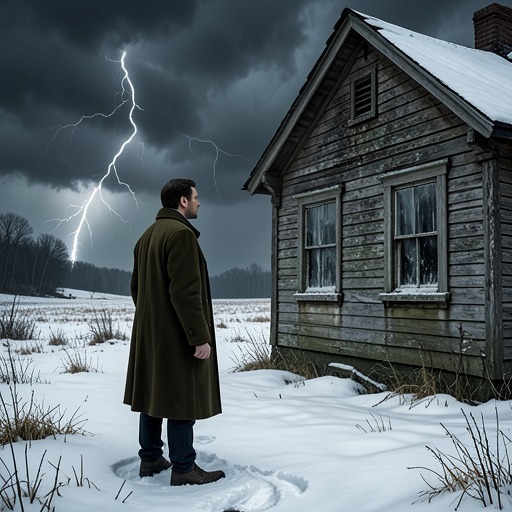
The bed becomes the stage for the novel's most famous supernatural scene, a nightmare that blurs the boundary between dream and reality. Lockwood, having fallen asleep in the oak closet, remembers he is lying there and hears distinctly the gusty wind and the driving of the snow. He hears the fir bough repeat its teasing sound against the lattice, and, annoyed, resolves to silence it. He thinks he rises and endeavours to unhasp the casement, but the hook is soldered into the staple. 'I must stop it, nevertheless!' he mutters, knocking his knuckles through the glass, and stretching an arm out to seize the importunate branch; instead of which, his fingers close on the fingers of a little, ice-cold hand. The intense horror of nightmare comes over him: he tries to draw back his arm, but the hand clings to it, and a most melancholy voice sobs, 'Let me in—let me in!' When he asks who she is, the voice replies, shiveringly, 'Catherine Linton... I'm come home: I'd lost my way on the moor!' As it speaks, he discerns, obscurely, a child's face looking through the window. Terror makes him cruel; finding it useless to attempt shaking the creature off, he pulls its wrist on to the broken pane and rubs it to and fro till the blood runs down and soaks the bedclothes. Still it wails, 'Let me in!' and maintains its tenacious grip, almost maddening him with fear. When he finally frees himself, he hurriedly piles the books up in a pyramid against the window to exclude the lamentable prayer. The voice mourns, 'It is twenty years... I've been a waif for twenty years!' The bed, with its window opening onto the moors, becomes the precise point where the dead Catherine's restless spirit seeks re-entry into the world of the living. The nightmare is so vivid that Lockwood's yell is not ideal: hasty footsteps approach his chamber door, and Heathcliff himself pushes it open, a light glimmering through the squares at the top of the bed. The bed thus serves as the conduit through which the novel's central haunting is introduced, and its window—wide enough for anybody to get through—becomes a recurring motif of intrusion and longing.
Heathcliff's Vigil and Despair
The bed's significance deepens when Heathcliff, roused by Lockwood's cry, reveals the anguish that the nightmare has provoked. After Lockwood relates his dream, Heathcliff gets on to the bed and wrenches open the lattice, bursting, as he pulls at it, into an uncontrollable passion of tears. 'Come in! come in!' he sobs. 'Cathy, do come. Oh, do—once more! Oh! my heart's darling! hear me this time, Catherine, at last!' The spectre shows a spectre's ordinary caprice: it gives no sign of being, but the snow and wind whirl wildly through, even reaching Lockwood's station and blowing out the light. There is such anguish in the gush of grief that accompanies this raving that Lockwood's compassion makes him overlook its folly. The bed, which had been a place of terror for Lockwood, becomes for Heathcliff a site of desperate supplication, a place where he begs the dead to return. This scene establishes the bed as the locus of Heathcliff's monomania, his obsessive refusal to accept Catherine's death. The window that Lockwood had tried to close against the ghost is the same window Heathcliff tears open to invite her in. The bed thus embodies the paradox of Heathcliff's grief: it is the place where he most feels Catherine's absence and where he most desperately seeks her presence.
Catherine's Memory and the Bed's Echo
The bed also functions as a psychological touchstone for Catherine herself, a symbol of the childhood self she lost when she became Mrs. Linton. During her final illness, after a quarrel with Edgar, Catherine recalls a moment of profound disorientation. She remembers being in the parlour after they had quarrelled, and Edgar being cruelly provoking, and her running into this room desperate. As soon as ever she had barred the door, utter blackness overwhelmed her, and she fell on the floor. Before she recovers sufficiently to see and hear, it begins to be dawn, and she tells Nelly what she thought, and what has kept recurring and recurring till she feared for her reason. She thought as she lay there, with her head against that table leg, and her eyes dimly discerning the grey square of the window, that she was enclosed in the oak-panelled bed at home; and her heart ached with some great grief which, just waking, she could not recollect. She pondered, and worried herself to discover what it could be, and, most strangely, the whole last seven years of her life grew a blank. She did not recall that they had been at all. She was a child; her father was just buried, and her misery arose from the separation that Hindley had ordered between her and Heathcliff. She was laid alone, for the first time; and, rousing from a dismal doze after a night of weeping, she lifted her hand to push the panels aside: it struck the table-top. The bed, in Catherine's memory, represents the last moment of her true self, before she was wrenched from the Heights and converted at a stroke into Mrs. Linton, the lady of Thrushcross Grange, and the wife of a stranger: an exile, and outcast, thenceforth, from what had been her world. The bed is thus the spatial anchor of her lost identity, the place where she was still Catherine Earnshaw, still Heathcliff's companion, still free. Her wish to be a girl again, half savage and hardy, and free, is a wish to return to the bed and the self it contains.
Heathcliff's Final Night and Death
The bed's final and most macabre function is as Heathcliff's deathbed, the place where his long torment finally ends. In his last days, Heathcliff becomes increasingly withdrawn, soliciting the society of no one more. At dusk he goes into his chamber. Through the whole night, and far into the morning, the household hears him groaning and murmuring to himself. Hareton is anxious to enter, but Nelly bids him fetch Mr. Kenneth, and he should go in and see him. When the doctor comes, and Nelly requests admittance and tries to open the door, she finds it locked; Heathcliff bids them be damned. He is better, and would be left alone; so the doctor goes away. The following evening is very wet: indeed, it pours down till day-dawn; and, as Nelly takes her morning walk round the house, she observes the master's window swinging open, and the rain driving straight in. Having succeeded in obtaining entrance with another key, she runs to unclose the panels, for the chamber is vacant; quickly pushing them aside, she peeps in. Mr. Heathcliff is there—laid on his back. His eyes meet hers so keen and fierce, she starts; and then he seems to smile. She cannot think him dead: but his face and throat are washed with rain; the bed-clothes drip, and he is perfectly still. The lattice, flapping to and fro, has grazed one hand that rested on the sill; no blood trickles from the broken skin, and when she puts her fingers to it, she can doubt no more: he is dead and stark. The bed, which had been the site of his desperate vigils and his pleas for Catherine's return, becomes the place where he finally joins her in death. Nelly hasps the window, combs his black long hair from his forehead, and tries to close his eyes: to extinguish, if possible, that frightful, life-like gaze of exultation before any one else beholds it. They will not shut: they seem to sneer at her attempts; and his parted lips and sharp white teeth sneer too. Joseph, summoned, cries out that the devil has harried off his soul, and returns thanks that the lawful master and the ancient stock are restored to their rights. The bed, with its window wide open to the storm, is the final threshold Heathcliff crosses, the place where his eighteen years of haunting and being haunted come to an end. The rain that drenches his corpse is the same rain that had blown through the lattice during his midnight supplications, and the open window suggests that, at last, he has found what he sought—or been taken by what he summoned.
The Bed's Legacy and the Quiet Earth
The Oak-panelled bed's narrative significance extends beyond the events that occur within it; it is the object that connects the novel's frame narrative to its inner tragedy. It is through the bed that Lockwood, the outsider, first encounters the ghost of Catherine and thus precipitates Heathcliff's final crisis. It is through the bed's inscriptions that the reader gains access to Catherine's childhood voice, and through its window that Heathcliff's grief is made manifest. The bed is also a reminder of the novel's central theme of the permeability between the living and the dead, the past and the present. When Lockwood, in the novel's closing pages, visits the kirkyard and discovers the three headstones on the slope next the moor—the middle one grey, and half buried in the heath; Edgar Linton's only harmonized by the turf and moss creeping up its foot; Heathcliff's still bare—he lingers round them, under that benign sky, and wonders how any one could ever imagine unquiet slumbers for the sleepers in that quiet earth. The bed, with its panelled sides and window ledge, is the architectural echo of those graves: a contained space where the dead are remembered, where their names are inscribed, and where the living may, if they dare, hear their voices. It is the novel's most intimate monument to the love that refuses to die, and the grief that will not rest.