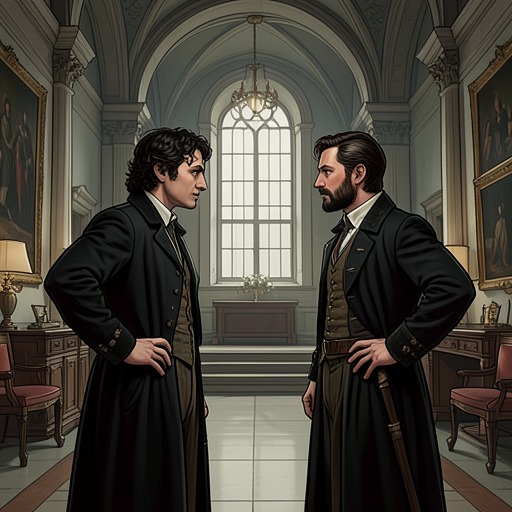
The expedition to Thrushcross Grange
Wuthering HeightsThe expedition to Thrushcross Grange is the pivotal childhood event in which Catherine Earnshaw and Heathcliff, having run off to spy on the Linton children, are discovered, leading to Catherine being attacked by the family's bulldog and taken into the Grange, while Heathcliff is scorned and ejected. This single night marks the first great rupture in Catherine and Heathcliff's wild unity, exposing them to the contrasting world of the Lintons and setting in motion the social divisions, romantic entanglements, and lifelong vendettas that drive the entire novel. Recounted by Heathcliff to Ellen Dean upon his return, the episode is a foundational scene of trespass, class encounter, and the violent enforcement of social boundaries.
Causes and Background
The expedition grows directly out of the feral liberty that Catherine and Heathcliff enjoy in their early years. After Hindley Earnshaw returns from college with his new wife Frances, he degrades Heathcliff to the status of a common labourer, depriving him of the curate's instruction and driving him to work outdoors. Yet Catherine continues to teach Heathcliff what she learns and to play with him in the fields, and the two 'promised fair to grow up as rude as savages,' running away to the moors all day and treating their punishments as a joke. One Sunday evening, banished from the sitting-room for making a noise, they escape from the wash-house for a ramble at liberty. Catching a glimpse of the lights of Thrushcross Grange, they decide to investigate whether the Linton children spend their Sunday evenings in misery, and so they run from the top of the Heights to the park without stopping, Catherine completely beaten in the race because she is barefoot, her shoes left behind in the bog.
The Scene at the Grange
Creeping through a broken hedge and planting themselves on a flower-plot under the drawing-room window, the two children look in on a scene of astonishing luxury and absurdity. The room is carpeted in crimson, with crimson-covered chairs and tables, a pure white ceiling bordered by gold, and a shower of glass-drops hanging in silver chains from the centre, shimmering with little soft tapers. Inside, the Linton children are alone: Isabella, about eleven, lies screaming at the far end of the room as if witches were running red-hot needles into her, while Edgar stands on the hearth weeping silently, and on the table sits a little dog shaking its paw and yelping, having been nearly pulled in two between them. Catherine and Heathcliff laugh outright at the 'petted things,' despising their quarrelling over a heap of warm hair. Heathcliff declares he would not exchange his condition for Edgar Linton's for a thousand lives, not even with the privilege of flinging Joseph off the highest gable and painting the house-front with Hindley's blood.
The Bulldog Attack and Discovery
The Lintons hear the laughter and rush to the door, and the two intruders make frightful noises to terrify them further before dropping off the ledge to flee. But as Heathcliff urges Catherine on, she falls, whispering that the bull-dog has been let loose and holds her. The dog has seized her ankle, and though she does not yell out—she would have scorned to do so even if spitted on the horns of a mad cow—Heathcliff vociferates curses and thrusts a stone between the beast's jaws, trying to cram it down its throat. A servant arrives with a lantern, shouting to the dog, but changes his tone when he sees the animal's game, throttling the dog off as its huge purple tongue hangs half a foot out of its mouth. The man takes up the sick Catherine—sick from pain, not fear—and carries her inside, while Heathcliff follows, grumbling execrations and vengeance. The servant, Robert, accuses the boy of being an 'out-and-outer' and a potential robber, and old Mr. Linton, mistaking the intrusion for an attempted burglary on his rent-day, threatens to hang the 'villain' at once, while Mrs. Linton raises her hands in horror and Isabella lispingly suggests putting him in the cellar, comparing him to the son of the fortune-teller who stole her tame pheasant.
Recognition and Aftermath
As the Lintons examine Heathcliff, Catherine comes round and laughs at the last speech. Edgar Linton, after an inquisitive stare, recognises her as Miss Earnshaw, noting how Skulker has bitten her and how her foot bleeds. Mrs. Linton scoffs at the idea of Miss Earnshaw scouring the country with a gipsy, though she concedes the child is in mourning and may be lamed for life. Mr. Linton blames Catherine's brother for letting her grow up in absolute heathenism, and identifies Heathcliff as the strange acquisition his late neighbour made on his journey to Liverpool—'a little Lascar, or an American or Spanish castaway.' While Catherine is taken in and cared for, Heathcliff is left outside, and he returns alone to Wuthering Heights in the rain, where Ellen Dean meets him with the lantern, startled to see him without Catherine. He tells Ellen the whole story as he undresses, warning her not to rouse the master, and the night ends with Catherine remaining at the Grange, her foot wounded, her world already beginning to shift.
Consequences and Significance
The expedition is the hinge on which the novel's tragedy turns. Catherine's five-week stay at Thrushcross Grange, where she is nursed and transformed into a lady, introduces her to the polished world of the Lintons and to Edgar's courtship, while Heathcliff is left to absorb the humiliation of being called a gipsy and a castaway. The contrast between the wild, natural landscape of Wuthering Heights and the cultivated, artificial world of the Grange is crystallised in this single scene, and the ecocritical lens reveals how the moors themselves are an active agent in the children's lives, shaping their freedom and their bond. The episode also plants the seeds of Heathcliff's lifelong resentment of Edgar and Isabella, and of Catherine's divided identity between the two houses. The image of the bulldog's attack recurs in the novel's later violence, and the social contempt Heathcliff suffers here hardens into the vengeful monomania that will consume him. The scene's echoes persist to the very end: when Heathcliff, in his final years, confesses to Ellen his obsessive haunting by Catherine's spirit, he recalls how he was 'wild after she died,' and the memory of their shared childhood trespass remains the origin of his unbreakable attachment. Even the three headstones in Gimmerton kirkyard—Edgar's harmonized by turf and moss, Heathcliff's still bare—stand as the long aftermath of the night when two moorland children first looked through a window and saw the world that would tear them apart.