The fight between Heathcliff and Hindley
Wuthering HeightsThe fight between Heathcliff and Hindley Earnshaw erupts on a stormy night at Wuthering Heights, immediately following the funeral of Catherine Earnshaw. It is the violent culmination of a hatred that has simmered since childhood, when Hindley, as the elder son, degraded and abused the orphan Heathcliff. Now, with Catherine dead, the two men's enmity reaches its breaking point in a scene of raw, brutal physicality that lays bare the savagery beneath the decaying gentility of the Earnshaw household.
The Setting and the Provocation
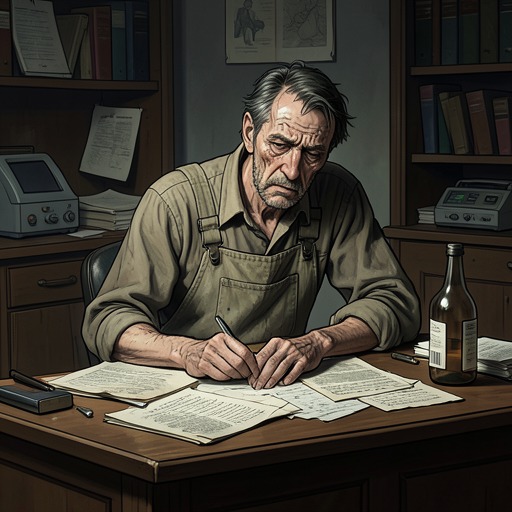
The confrontation is set in motion when Heathcliff returns to Wuthering Heights from his nightly vigil at Catherine's grave, driven indoors by a sudden storm. He finds the kitchen door fastened against him, a deliberate act of exclusion. Inside, Hindley Earnshaw, who has been sitting in a state of drunken, brooding silence for hours, sees his opportunity. He proposes to Isabella Linton, Heathcliff's wife, that they combine forces to settle their 'great debt' with the man outside. He frames the attack as a just return for treachery and violence, declaring that Heathcliff will be her death unless she overreaches him, and his ruin. He promises her freedom if she will hold her tongue and witness the conclusion of the fiend's existence.
The Attack and Its Brutal Failure
Hindley's plan fails catastrophically. He produces his knife-pistol, a weapon that combines a blade with a firearm, and prepares to ambush Heathcliff as he enters. Isabella, however, refuses to be complicit, snatching away the candle and seizing his arm, declaring she will not hold her tongue and that he must not touch him. In the ensuing struggle, Heathcliff bursts in. Seeing the weapon, he flings himself on Hindley and wrenches it from his grasp. The charge explodes, and the knife, springing back, closes into its owner's wrist. Heathcliff pulls it away by main force, slitting up the flesh as it passes, and thrusts the dripping weapon into his own pocket. He then takes a stone, strikes down the division between two windows, and springs into the room. His adversary has fallen senseless from the pain and the gushing blood. The ruffian then kicks and tramples on him, dashing his head repeatedly against the flags, while holding Isabella with one hand to prevent her summoning Joseph. He exerts a preterhuman self-denial in abstaining from finishing him completely, but, getting out of breath, he finally desists and drags the apparently inanimate body onto the settle. There he tears off the sleeve of Hindley's coat and binds up the wound with brutal roughness, spitting and cursing during the operation as energetically as he had kicked before.
The Aftermath and the Shift in Power
This fight is not merely a physical beating; it is a decisive transfer of power. After the assault, Heathcliff thunders at Joseph that his master is mad and that should he last another month, he will have him put in an asylum. He then orders the old servant to wash away the blood and mind the sparks of his candle, which is more than half brandy. The fight cements Heathcliff's dominance over the household. Hindley's failed assassination attempt leaves him utterly broken, and his subsequent death, which occurs after he deliberately fastens the doors and drinks himself to death, is a direct consequence of his defeat and despair. The event foreshadows Heathcliff's complete usurpation of Wuthering Heights, as he proves to the attorney that Earnshaw had mortgaged every yard of land he owned to supply his mania for gaming, and that he, Heathcliff, is the mortgagee. In this manner, Hareton, who should now be the first gentleman in the neighbourhood, is reduced to a state of complete dependence on his father's inveterate enemy, living in his own house as a servant.
The Character of Heathcliff's Violence
The fight reveals the core of Heathcliff's character: a man who has abandoned all pity. His muttering after the fight, 'I have no pity! I have no pity! The more the worms writhe, the more I yearn to crush out their entrails! It is a moral teething; and I grind with greater energy in proportion to the increase of pain,' is a chilling articulation of his sadistic philosophy. This is not a spontaneous act of rage but a calculated expression of his worldview, one that he has cultivated since his childhood mistreatment. His earlier declaration to Catherine that he plans his revenge while thinking of it to avoid feeling pain, and his vow to make the most of her sister-in-law's secret, show that his violence is a deliberate, planned instrument of his will. The fight is the physical manifestation of his monomaniacal drive for revenge, a force that has been building since he was a boy and that now, with Catherine gone, has no other object but the destruction of his enemies.
The Fight as a Turning Point
The fight between Heathcliff and Hindley is a crucial turning point in the novel's narrative. It marks the moment when Heathcliff's revenge ceases to be a simmering threat and becomes an active, brutal reality. It is the event that seals Hindley's doom and paves the way for Heathcliff's complete control over Wuthering Heights and the Earnshaw family. The scene's raw violence, contrasted with the earlier, more psychological torments, demonstrates the depths to which the characters have sunk. It is a scene of pure, unadulterated conflict, where the value at stake is not just physical survival but the very soul of the house, and it shifts the balance of power decisively and irrevocably in Heathcliff's favor.