Schoolteacher's Classification Rule
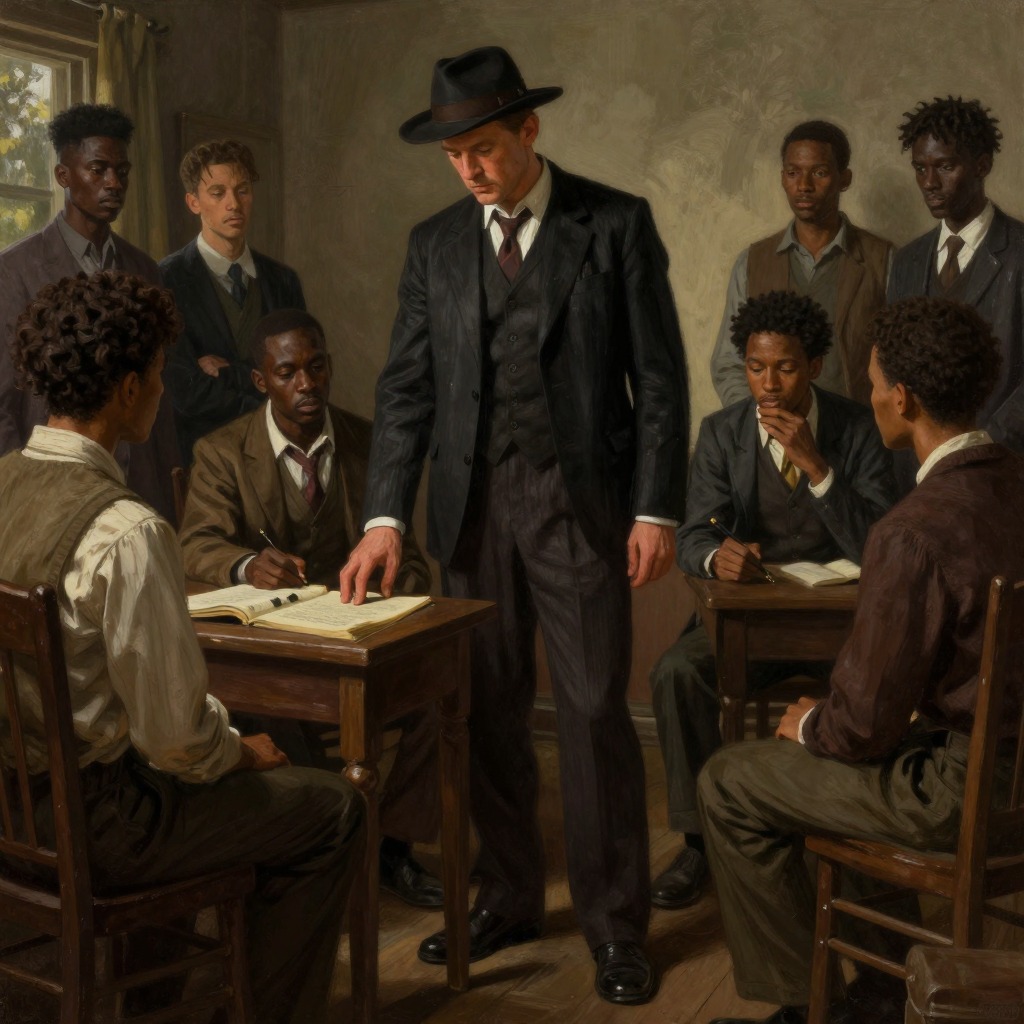
Schoolteacher's Classification Rule is the pseudoscientific doctrine by which the slaveholder schoolteacher categorizes enslaved people into human and animal characteristics, recording them in a notebook. This rule is the ideological engine of the novel's central trauma: it dehumanizes Sethe, drives her to escape Sweet Home, and ultimately leads to the infanticide that haunts 124 Bluestone Road. The rule's power lies in its claim to objective knowledge, making it a tool of white supremacy that reduces Black humanity to a ledger of animal traits.
Origin and Operation
Schoolteacher arrives at Sweet Home after Mr. Garner's death, bringing with him a notebook and a measuring string. He begins to ask the enslaved people questions and write down their answers, which they initially mistake for mere curiosity. Sethe recalls that he "commenced to carry round a notebook and write down what we said," and she later realizes that "It was a book about us but we didn't know that right away." The rule operates through a process of classification: schoolteacher instructs his pupils to list a person's "human characteristics on the left; her animal ones on the right." This is not a neutral observation but a violent act of definition, as Sethe discovers when she overhears him teaching his nephews. The measuring string is used to wrap around Sethe's head, nose, and behind, and to number her teeth, treating her body as an object to be measured and catalogued. The rule is enforced through correction: when Sixo steals a shoat, schoolteacher beats him to demonstrate that "definitions belonged to the definers--not the defined."
The Dehumanization of Sethe
Sethe becomes the primary subject of the classification rule. She overhears schoolteacher telling his pupils to list her characteristics, and the moment is a turning point in her consciousness. She describes the scene: "I heard him say, 'No, no. That's not the way. I told you to put her human characteristics on the left; her animal ones on the right. And don't forget to line them up.'" This revelation shatters her sense of self, making her realize that she is seen not as a person but as a creature to be dissected. The rule also justifies physical violence: after Sethe tells Mrs. Garner about the nephews stealing her milk, schoolteacher has one of them "open up my back" with a cowhide, leaving the chokecherry tree scar. The classification rule thus operates in tandem with corporal punishment, both serving to enforce the animal status of the enslaved. Sethe's response is to flee, and the rule becomes the catalyst for her escape from Sweet Home.
The Rule's Consequences: Infanticide and Haunting
Schoolteacher's classification rule has its most devastating consequence in the infanticide. When schoolteacher and his party arrive at 124 Bluestone Road to reclaim Sethe and her children, Sethe, recognizing his hat, decides that death is preferable to returning her children to a life under such a rule. She kills her baby daughter with a handsaw, an act that she later explains as putting her children "where they'd be safe." The rule thus drives her to a desperate, tragic assertion of maternal love, one that the community and Paul D struggle to understand. The baby's ghost, which haunts 124, is a direct result of this act, and the rule's legacy persists in the novel's present. Sethe's later obsession with Beloved, whom she believes to be her dead daughter returned, is partly an attempt to undo the classification that led to the killing. The rule also shapes the community's response: Ella, who has her own history of abuse, condemns Sethe's pride but ultimately helps in the exorcism, recognizing that the rule is a greater evil.
The Rule as a Symbol of White Supremacy
The classification rule is not merely a personal cruelty but a systemic tool of white supremacy. It is part of a broader discourse that dehumanizes Black people, as seen in the novel's epigraph from Romans 9:25, which speaks of calling "them my people, which were not my people." The rule is also connected to the "jungle" that whitepeople believe exists under every dark skin, a belief that Stamp Paid reflects on: "Whitepeople believed that whatever the manners, under every dark skin was a jungle." The rule is a way of naming and controlling that imagined jungle, of imposing order on a population that white society fears. Schoolteacher's notebook is a symbol of this power: it is a written record that claims authority over Black bodies, and it is contrasted with the oral culture of the enslaved, who "didn't want to" learn to read because "nothing important to them could be put down on paper." The rule thus represents the violence of literacy when wielded by the oppressor.
The Rule's Enduring Legacy
The classification rule does not end with schoolteacher's departure. Its effects persist in the lives of the characters. Sethe's "No-Running Rule" is a direct response to the trauma of being classified: she vows never to run from anything again, having paid too high a price for her escape. Paul D, who was sold by schoolteacher, carries the memory of being valued at $900, a price that reduces him to his "weight, his strength, his heart, his brain, his penis, and his future." The rule also haunts Denver, who is afraid that her mother might kill again, and it shapes the community's shunning of Sethe. Even after Beloved's disappearance, the rule's legacy is felt in the novel's final lines, which speak of the "disremembered and unaccounted for" who cannot be lost because no one is looking for them. The classification rule is thus a foundational evil that the novel seeks to expose and, through the act of storytelling, to resist. It is a rule that denies humanity, and the novel's entire narrative is an argument against it.