Vampire
In Sheridan Le Fanu's Carmilla, the vampire is presented not as a mere folkloric phantom but as a physically embodied, legally attested predator whose existence is sustained by a daily cycle of slumber in the grave and nightly feeding on the living. The narrative, framed by the testimony of an Imperial Commission and the scholarly research of Baron Vordenburg, grounds the vampire in a system of observable symptoms, judicial procedures, and historical records, lending it a chilling verisimilitude that transcends simple superstition.
Nature and Physical Evidence
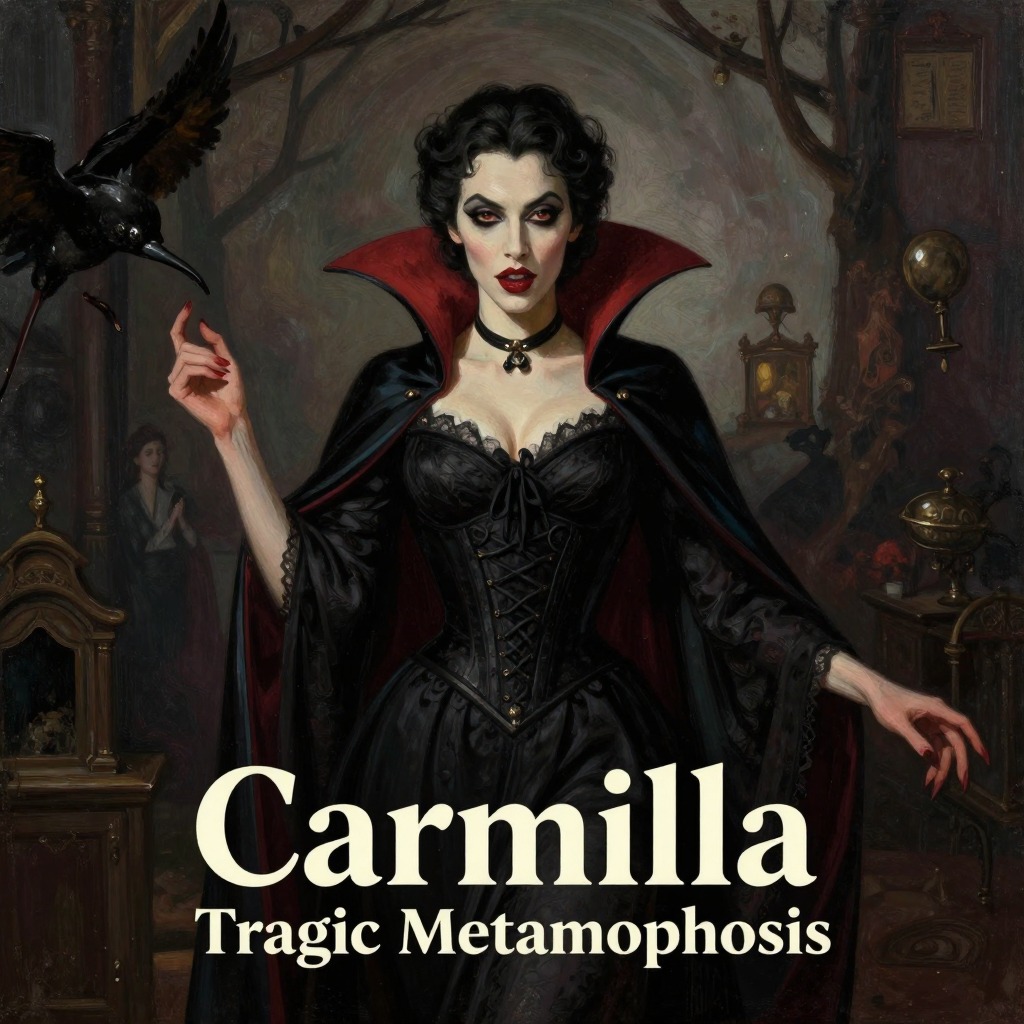
The vampire in the story is defined by a set of concrete, physical signs that distinguish it from the dead. When the grave of the Countess Mircalla Karnstein is opened a hundred and fifty years after her funeral, her features are still "tinted with the warmth of life," her eyes are open, and her limbs are "perfectly flexible, the flesh elastic." The leaden coffin is found to be "floating with blood, in which to a depth of seven inches, the body lay immersed." These signs, along with a faint but appreciable respiration and heartbeat attested to by two medical men, constitute the "admitted signs and proofs of vampirism." The vampire's deadly pallor, a common melodramatic fiction, is explicitly debunked; in the grave and in human society, the vampire presents "the appearance of healthy life." The creature's power is also physically manifest in its grip: the slender hand of Mircalla closes "like a vice of steel" on General Spielsdorf's wrist, leaving a lingering numbness.
Behavior and Feeding
The vampire's existence is described as "amphibious," sustained by "daily renewed slumber in the grave" and a "horrible lust for living blood" that supplies the vigor of its waking state. The creature is prone to an "engrossing vehemence, resembling the passion of love," for particular persons. In pursuing such a victim, it will exercise "inexhaustible patience and stratagem," husbanding and protracting its murderous enjoyment "with the refinement of an epicure" and heightening it through "the gradual approaches of an artful courtship." This is contrasted with its ordinary method of going "direct to its object, overpowers with violence, and strangles and exhausts often at a single feast." The vampire's attack leaves specific physical evidence: two small punctures near the throat, described by Doctor Spielsberg as the insertion of "those two long, thin, and sharp teeth which, it is well known, are peculiar to vampires," accompanied by a small livid mark from the demon's lips.
Origin and Propagation
The narrative provides a specific mechanism for the vampire's origin and multiplication. According to Baron Vordenburg, a person who commits suicide "under certain circumstances, becomes a vampire." This specter then visits living people in their slumbers; they die and "almost invariably, in the grave, develop into vampires." This is the process that created the beautiful Mircalla, who was herself "haunted by one of those demons." The vampire is also subject to a peculiar anagrammatic constraint on its name. In the case of Mircalla, the creature is limited to names that reproduce the same letters: Carmilla and Millarca are both anagrams of the original.
Legal and Scholarly Context
The story is steeped in a framework of legal and scholarly authority. The existence of the vampire is supported by "human testimony, taken with every care and solemnity, judicially, before commissions innumerable," producing reports more voluminous than those on any other class of cases. The final destruction of the vampire is conducted as a formal legal proceeding, with the Imperial Commission's report bearing the signatures of all present. Baron Vordenburg, a scholar who has devoted himself to the "minute and laborious investigation of the marvelously authenticated tradition of Vampirism," possesses a voluminous digest of all judicial cases from which he has extracted a system of principles governing the vampire's condition. His collection includes works such as "Magia Posthuma" and "Philosophicae et Christianae Cogitationes de Vampiris," lending an air of erudite credibility to the supernatural phenomenon.