Beklimot
Beklimot is the oldest known city on Kalgash, a cradle of civilization whose ruins on the remote Sagikan Peninsula become the site of Siferra 89's career-defining excavation and the source of archaeological evidence linking periodic fires to the recurring eclipses of Dovim. Its discovery by the pioneer archaeologist Galdo 221 a century and a half before the novel's present established it as the foundation of all human history on the planet, and its preservation beneath the sands for thousands of years made it a unique repository of the deep past. The site's vulnerability to a catastrophic sandstorm, and the subsequent revelation of the Hill of Thombo's layered ruins, transform Beklimot from a static monument into a dynamic record of cyclical destruction and rebirth that ultimately confirms the direst predictions of the Apostles of Flame.
Identity and Significance
Beklimot is the oldest known human settlement on Kalgash, regarded by archaeologists as the foundation of civilization. Located on the Sagikan Peninsula, it was first discovered by Galdo 221, the greatest of all Kalgashian archaeologists, and subsequently worked by a glorious roster of successors including Marpin, Stinnupad, Shelbik, and Numoin. The site consists of extensive ruins including a monumental cyclopean city wall, the six-sided brick building called the Temple of the Suns, the Octagon House with its stunning mosaics, and vast sprawling foundations of a residential zone. For generations, each archaeologist who worked there took care to expose only small sections and to put up screens and sand-fences against the unlikely but serious danger of a sandstorm, preserving the site as it had been on the day when its last inhabitants finally yielded to the harshness of the changing climate and abandoned the place.
The Sandstorm and the Discovery of Thombo
Siferra 89, conducting excavations at Beklimot for a year and a half, faces a killer sandstorm that threatens to destroy the entire site. The storm, the worst in a century, sweeps over the excavation zone with ferocious heat and a tremendous thundering sound of myriad sand particles. Siferra fears that her negligence in leaving the sanctuary area uncovered will result in the destruction of Beklimot, the most famous archaeological site in the world, and the ruination of her career. However, the storm passes without burying the city, and instead reveals a stunning new discovery: the Hill of Thombo, a middling-high mound some fifteen minutes' walk south of the main city, has been slit open by the storm's violence, exposing a series of layered settlements. Siferra and her chief stratigrapher Balik 338 immediately recognize the importance of what is now visible: a town site under the midden, and possibly more than one, including a wall in crosshatch style under a cyclopean foundation. This discovery transforms the apparent calamity of the sandstorm into serendipitous good fortune, turning the apparent ruination of Siferra's career into its making.
The Thombo Excavation and the Evidence of Periodic Fires
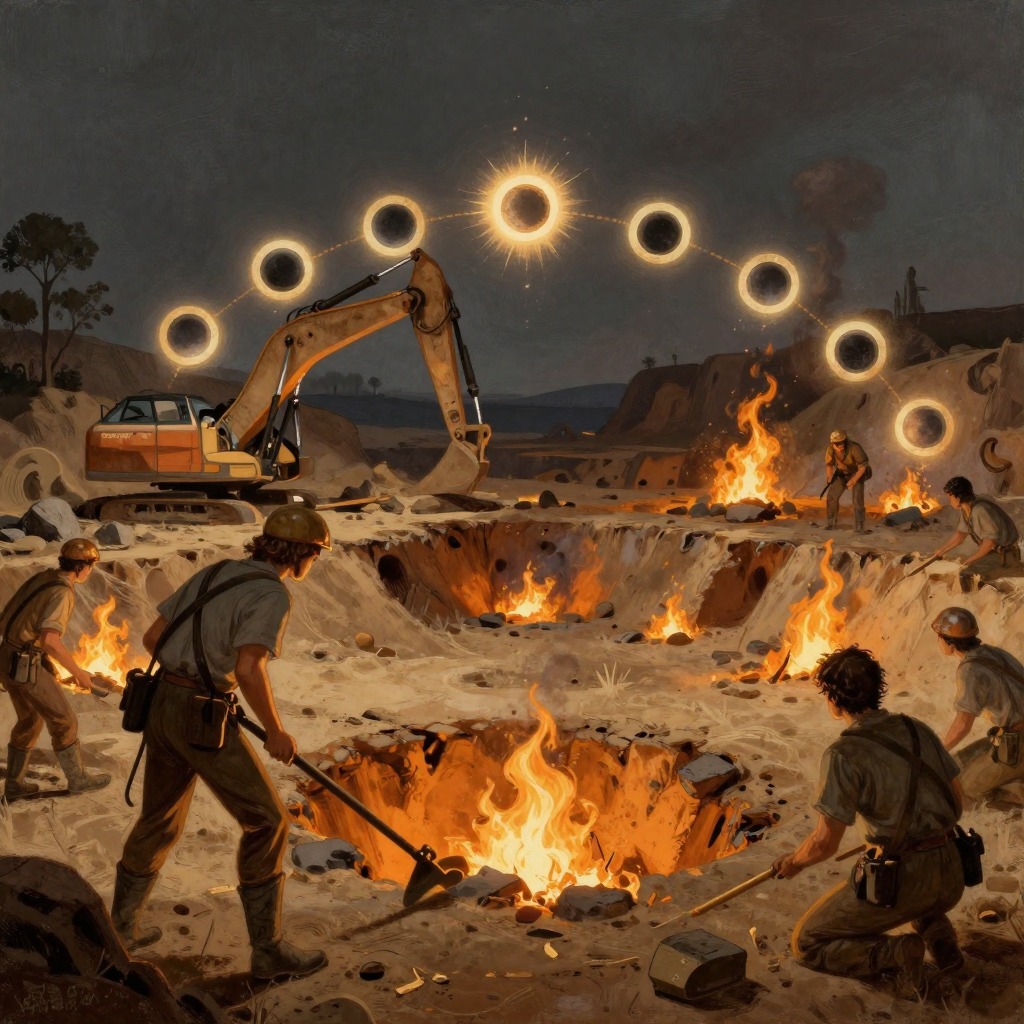
Siferra's excavation of the Hill of Thombo reveals a layer cake of ancient settlements, each built upon its immediate predecessor, with the youngest at the top. The excavation shows a charred layer at the foundation level of the cyclopean city, indicating a widespread conflagration. Below that, a crosshatch-style town sits under the fire line, and below that, another dark line of charcoal near the foundations of the crosshatch-style building, indicating a second fire. Siferra identifies at least seven, possibly nine, distinct periods of settlement, each separated by a burn line. The layers of occupation are extraordinarily similar in thickness, suggesting that each settlement flourished for approximately the same length of time before being destroyed by fire. Siferra's initial estimate, based on an intuitive sense of how long it might have taken for these cities to arise, flourish, decay, and crumble, is that each of these great fires happened something like two thousand years apart, with the most recent taking place about two thousand years ago, just prior to the unfolding of the Beklimot culture. Radiocarbon analysis later confirms this pattern: the youngest settlement was destroyed by fire 2,050 years ago, the next 4,100 years ago, the third 6,200 years ago, the fourth 8,300 years ago, and so on, with fires occurring at intervals of a little more than twenty centuries, precisely matching the 2,049-year frequency of the eclipses of Dovim.
The Thombo Tablets and the Apostles of Flame
Siferra discovers six inscribed clay tablets in the third and fifth levels of the Hill of Thombo. The square tablets from the third level are written in a very primitive form of the Beklimot script, while the oblong tablets from the fifth level are in a completely unfamiliar script, very likely a syllabic one. Mudrin 505, the paleographer, is able to tentatively puzzle out a couple of dozen words from the Level Three tablets, which appear to be an account of the destruction of a city by fire—the work of angry gods who periodically find it necessary to punish mankind for wickedness. The tablets are stolen from Siferra's safe just before the eclipse, an act she attributes to the Apostles of Flame, who have long sought them. Folimun 66 later admits to the theft, justifying it as necessary to place the irreplaceable relics in safekeeping during the chaos. The Apostles, using their own ancient textual material, translate the tablets fully and find them to be straightforward historical accounts of two separate advents of the Stars thousands of years ago, and of the attempts made by the priesthoods of the time to warn the populace. The tablets provide an accurate and convincing version, uncorrupted by centuries of textual alteration and error, of the chronicles that have come down to the present under the name of the Book of Revelations.
Narrative and Thematic Significance
Beklimot and the Hill of Thombo serve as the archaeological linchpin that transforms the astronomers' theoretical prediction of an eclipse into a terrifying historical pattern. The evidence of repeated fiery destruction at two-thousand-year intervals provides a solid rational underpinning for the mythology of the Apostles of Flame, confirming that the world has been through such a cataclysm at least once before. The site becomes a holy place to the Apostles, the sacred site where the gods formerly made themselves manifest to humanity, and the place where the gods are perhaps making themselves manifest once more by providing evidence of the fires of past epochs. For Siferra, the discovery is both a professional triumph and a source of profound anxiety, as she fears being known as the scientist who provided the Apostles with proof of their absurd claims. The Thombo tablets, once translated by the Apostles, become part of their historical record, demonstrating that throughout history and prehistory on Kalgash, small groups of dedicated people have struggled again and again to prepare the world for the disruption that repeatedly falls upon it.