
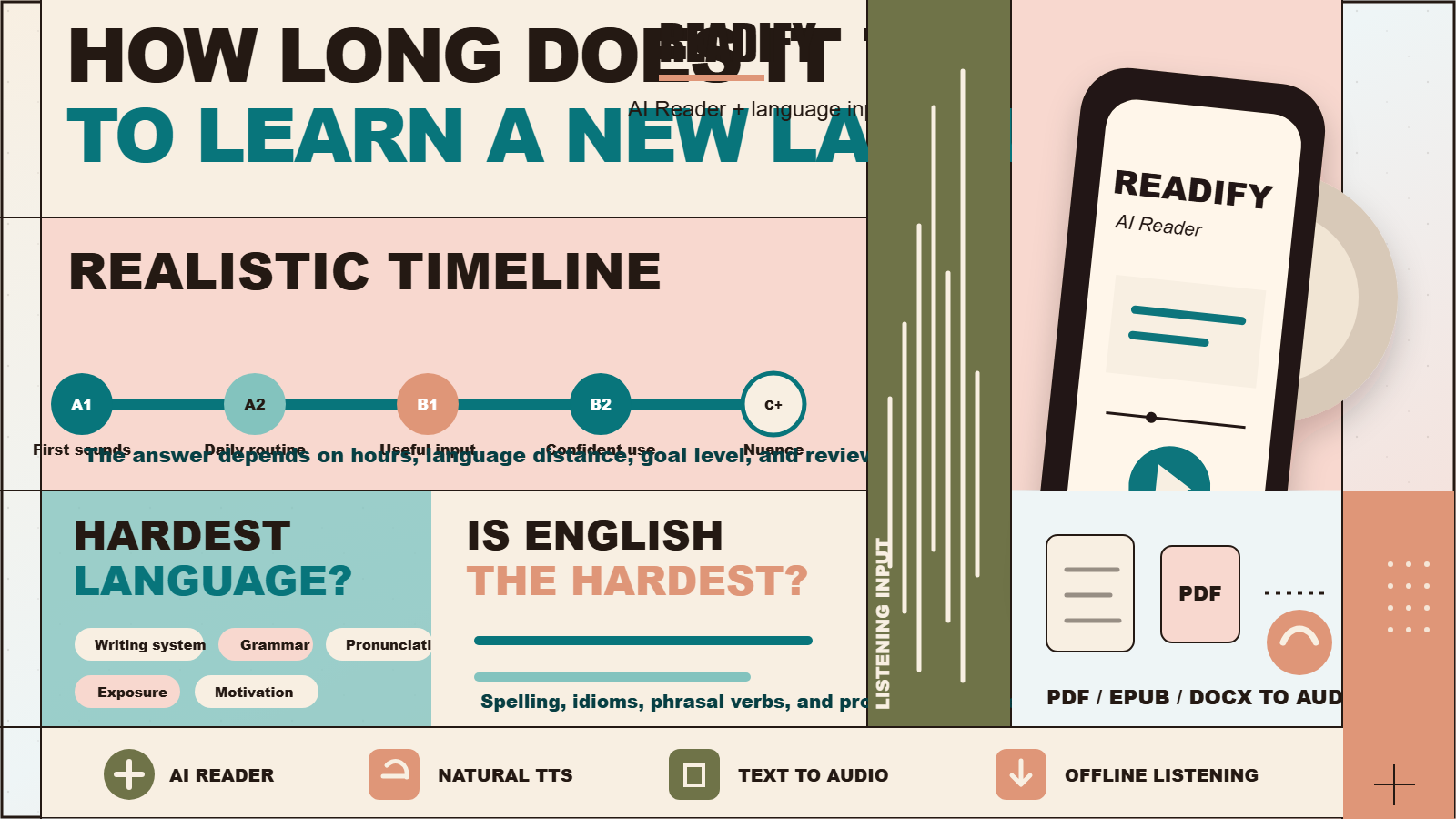
How long does it take to learn a new language?
The honest answer is: long enough to build hundreds of useful encounters with the language, but not so long that progress has to feel mysterious. A learner who studies ten minutes a day will have a very different timeline from someone who reads, listens, speaks, and reviews for an hour daily. Your native language, target language, goals, materials, and consistency all change the answer.
Readify cannot magically teach grammar or replace real conversation. What it can do is support a stronger input routine. With Readify AI Reader, natural sounding TTS, listen to text, PDF to audio, EPUB to audio, DOCX to audio, and offline listening, learners can turn permitted reading materials into repeated listening practice. Use Readify only with content you own, have permission to process, hold an appropriate license for, or that is in the public domain.
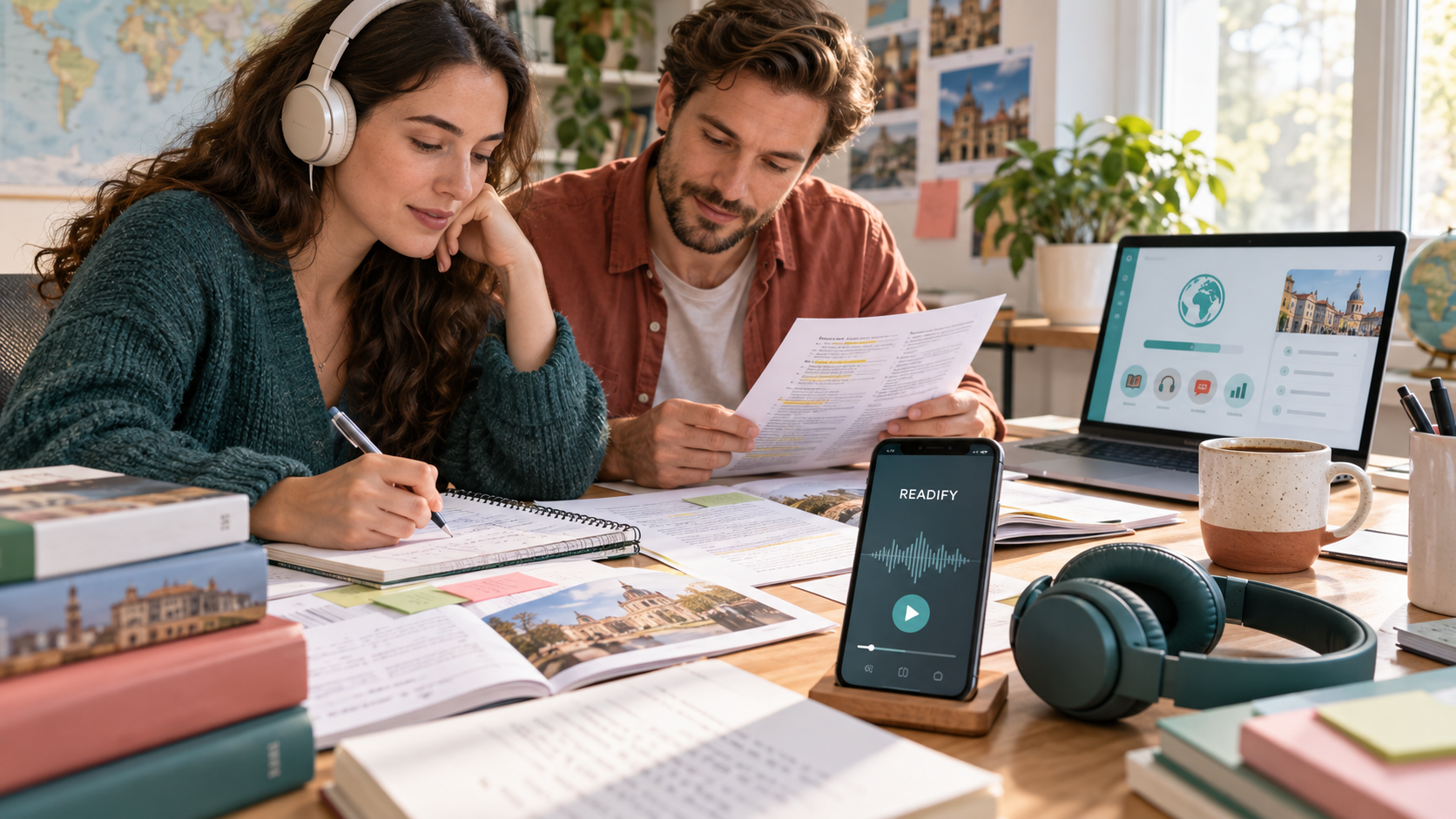
What Learners Really Mean by Learning a Language
Before answering how long does it take to learn a new language, define the finish line. Do you want to order food while traveling, read novels, pass an exam, hold business calls, watch shows without subtitles, or think comfortably in the language? Each goal requires a different amount of vocabulary, listening speed, grammar control, and cultural knowledge.
For many adults, beginner survival ability may arrive after a few months of steady practice. Comfortable everyday conversation often takes much longer. Reading nonfiction, understanding fast native speech, writing clearly, and handling humor or dialect can take years. That is not failure; it is how language depth works.
The Foreign Service Institute groups languages by estimated classroom hours for English-speaking learners. Those estimates are useful because they remind us that languages are not equally distant from every learner. You can compare the broad categories through the FSI language training categories, but treat them as orientation, not destiny.
The Main Factors That Change the Timeline
The first factor is language distance. A Spanish speaker learning Portuguese faces a different path from an English speaker learning Japanese. Shared vocabulary, familiar grammar, and similar sounds reduce friction. A new writing system, unfamiliar word order, tones, or complex case systems add time.
The second factor is frequency. Ten hours in one weekend is not the same as twenty minutes every day for a month. Languages fade when they are not revisited. A daily routine matters because it keeps sounds, phrases, and patterns active in memory. Readify can support that routine by letting you turn graded readers, saved notes, public-domain stories, or teacher-approved documents into audio for short review sessions.
The third factor is balanced practice. Listening helps you recognize rhythm. Reading builds vocabulary. Speaking forces retrieval. Writing reveals gaps. A learner who only memorizes word lists may know many definitions but still freeze during real input. A learner who only listens passively may understand familiar topics but struggle to produce sentences. A durable plan combines multiple modes.
Frameworks such as CEFR are helpful because they describe ability levels rather than vague labels like fluent. The CEFR language proficiency framework can help you translate your goal into a level such as A2, B1, or B2.
A useful estimate also separates recognition from production. You may recognize a word in a story weeks before you can use it smoothly in speech. That gap is normal. Reading and listening build the recognition layer first; speaking and writing turn that layer into active control. For more ways to combine reading and audio, browse the Readify blog.
What Is the Hardest Language to Learn?
Searches like what is the hardest language to learn are common because people want a clear ranking. The better answer is that difficulty depends on your starting point. Mandarin, Arabic, Japanese, Korean, Hungarian, Finnish, and Russian are often described as hard for English-speaking learners, but each is hard for different reasons.
The hardest language to learn for one person may not be the hardest for another. A learner who grew up hearing tonal languages may find Mandarin pronunciation less intimidating than an English speaker does. A learner who already knows Spanish may find Italian much faster than German. Someone who reads a new script every day may move past that barrier faster than someone who avoids it.
So when people ask what's the hardest language to learn, the practical reply is: the hardest language is the one that combines high distance from your native language with low motivation, poor materials, and inconsistent exposure. Difficulty is real, but routine can soften it.

Is English the Hardest Language to Learn?
Is english the hardest language to learn? For most learners, English is not usually ranked as the single hardest language, but it can be frustrating. English spelling is inconsistent. Phrasal verbs are unpredictable. Stress patterns can change meaning. A sentence may be grammatically correct but still sound unnatural because collocation matters.
At the same time, English has huge advantages. It has abundant learning materials, global media, dictionaries, subtitles, podcasts, graded readers, and communities. Exposure reduces difficulty. A learner who hears English every day may progress faster than someone studying a language with fewer accessible resources, even if English has messy rules.
This is where Readify's accessible reading and hands-free reading features can help. If you are learning English or another language, you can listen to allowed materials while following the text. Hearing and seeing language together can support pronunciation, sentence rhythm, and word recognition.
How Readify Can Support Language Learning
Readify is not a full language course, and it should not be described as one. Its value is different: it helps learners create more exposure from reading materials they are allowed to use. That makes it useful for people who already have lesson notes, teacher-approved PDFs, public-domain stories, vocabulary examples, or personal writing drafts.
With Readify, a learner can convert selected files into audio, review them while commuting, replay difficult sections, and return to visual reading when details matter. This makes the question how long does it take to learn a new language more actionable. Instead of waiting for a perfect study block, you can turn small daily moments into useful input.
For pronunciation and spoken comprehension, audio repetition is especially valuable. The ACTFL guidelines describe proficiency as what learners can actually do with language. You can explore that perspective through the ACTFL proficiency guidelines. Readify supports that broader goal by helping learners hear more input, not by replacing real interaction.
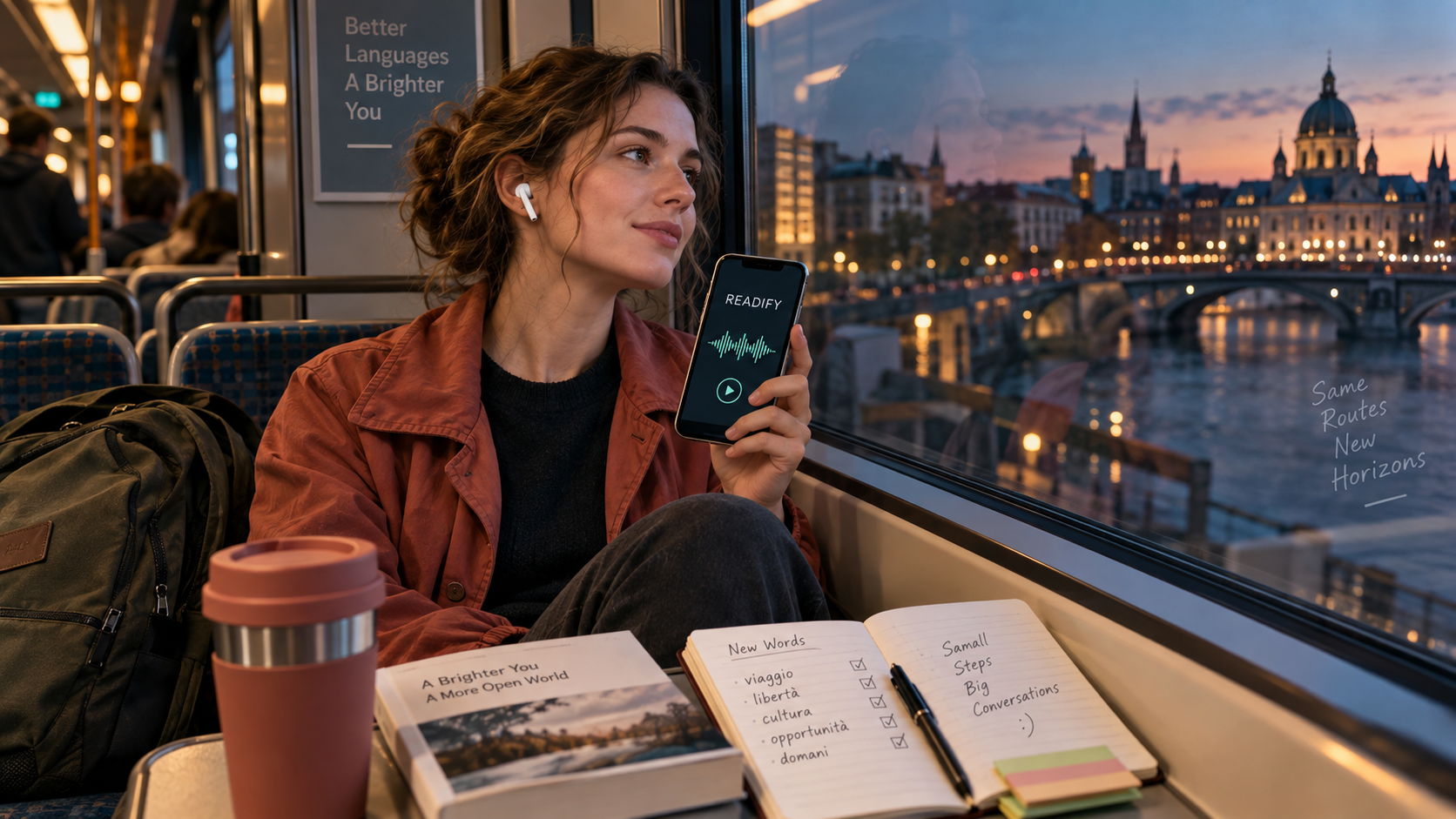
A Practical Study Method
Start with a realistic goal for the next 90 days. Do not promise yourself fluency if your schedule only allows fifteen minutes a day. Instead, define a useful milestone: finish a beginner reader, understand slow podcast episodes, hold a simple conversation, or read short articles with fewer dictionary lookups.
Next, build a loop. Choose one short text. Read it once visually. Listen to it with Readify. Mark five phrases worth remembering. Listen again without looking. Then use the phrases in your own sentences. This process turns passive input into active memory.
Third, vary difficulty. If everything is too easy, you stop growing. If everything is too hard, you quit. Mix comfortable review with slightly challenging material. Public-domain stories, graded readers, course handouts, and your own notes can all become useful listening material when you have permission to process them.
Language apps can also be part of the broader system. For audio-first practice, compare the category with Pimsleur audio language lessons. Readify's role is different: it helps turn your selected reading material into an audio-supported routine.
A 30-Day Readify Routine
If you want a concrete starting point, try a 30-day input plan. In week one, choose one short beginner text and listen to it every day. Do not chase too many resources. The goal is to make the sound of the language feel less distant. In week two, add visual reading before audio playback. Underline phrases that repeat, then listen again without looking. In week three, create a small phrase bank from the text and say those phrases aloud after listening. In week four, choose a slightly harder text and repeat the cycle.
This routine will not answer how long does it take to learn a new language for every learner, but it gives you a measurable habit. You can track minutes listened, pages read, phrases reviewed, and sections replayed. That is more useful than counting calendar days without knowing what happened inside them.
Readify works best here as a bridge between reading and listening. Use AI Reader for text playback, use natural sounding TTS to hear rhythm, and use offline listening when you are away from a stable connection. When you want to reuse the same material in different formats, Readify text to audio tools can keep your study flow centered on the content rather than on file management.
FAQ
How long does it take to learn a new language for travel?
For basic travel needs, many learners can make progress in a few months with consistent practice. You may not understand everything, but you can learn greetings, directions, food vocabulary, numbers, and common questions quickly if you practice daily.
How long does it take to become fluent?
How long does it take to learn a new language to a fluent level depends on the language and goal. Conversational comfort may take one to two years for some learners; advanced professional use can take much longer. Fluency is a range, not one finish line.
What is the hardest language to learn for English speakers?
What is the hardest language to learn for English speakers often points to languages with very different writing systems, grammar, and sound patterns. Mandarin, Arabic, Japanese, and Korean are common examples, but personal motivation and exposure still matter.
Is English the hardest language to learn?
Is english the hardest language to learn? Usually no, but it has hard features: spelling, idioms, phrasal verbs, and pronunciation. Its advantage is massive exposure, which can make practice easier to sustain.
Can Readify help me learn a language?
Readify can support language learning by helping you read and listen to permitted materials. Use AI Reader, natural sounding TTS, and offline listening for review, repetition, and accessibility. It does not replace teachers, courses, conversation, or grammar study.
Can I turn language PDFs into audio?
Yes, if you have the right to process the file. Readify can support PDF to audio, EPUB to audio, and DOCX to audio workflows for personal study materials, licensed resources, your own writing, or public-domain texts.
