Opening of the novel
The Salinas Valley Described
The novel opens with a lyrical description of the Salinas Valley in Northern California, its geography, climate, and the narrator's personal memories of the land. The valley is a long swale between the Gabilan and Santa Lucia mountains, with the Salinas River winding through it. The narrator recalls the rich years of plentiful rain and the dry years that brought terror, establishing the cyclical nature of the land and the lives of its people. This opening sets the stage for the epic family saga that follows, grounding the story in a specific, vivid place.
About thirty years before the turn of the century
The Hamilton Family Arrives
Samuel Hamilton, a young Irish immigrant, arrives in the Salinas Valley with his wife Liza. Samuel is a man of great energy, invention, and charm, but he has no talent for making money. He homesteads a barren, rocky quarter-section of land east of King City, which will never provide a good living. Over the years, Liza gives birth to nine children, and Samuel supports his growing family by working as a blacksmith, well-digger, and inventor. The Hamiltons are poor but respected, and Samuel becomes a beloved figure in the valley for his wisdom, humor, and kindness.
During and after the American Civil War
Cyrus Trask's Military Career
Cyrus Trask, a Connecticut farmer, enlists in the Union Army in 1862. He is wounded in his first skirmish, losing his right leg, and is discharged. Despite his brief and undistinguished service, Cyrus develops a powerful fantasy life, embellishing his war record until he believes his own lies. He becomes an expert on military history and strategy, writing articles and letters that gain him influence in the Grand Army of the Republic. He eventually becomes a paid secretary for the G.A.R. and a respected figure in Washington, D.C., living a life of fabricated glory.
Shortly after Adam's birth, 1862
Cyrus's First Wife Dies
Cyrus's first wife, a pale and religious woman, drowns herself in a shallow pond after contracting a venereal disease from him. She sees the disease as a punishment from God for her imagined sins and sacrifices herself. Cyrus mourns her with a keg of whisky and his army friends, getting the infant Adam drunk on a whisky-soaked rag. He then quickly marries a seventeen-year-old neighbor, Alice, to have a woman to care for the baby and the household.
Adam's childhood and adolescence, 1860s-1870s
Cyrus Raises His Sons
Cyrus raises his sons, Adam and his half-brother Charles, with a harsh, military discipline. He drills them in the manual of arms, forces them on long marches with weighted packs, and instills in them a hatred of soldiering. Adam is obedient and retiring, while Charles is assertive and athletic. Adam eventually sees through his father's pretensions, realizing that the discipline is not for the boys' benefit but to make Cyrus feel like a great man. This realization causes Adam to retreat into a secret inner world.
Late adolescence, before Adam enters the army
Charles Beats Adam
After Adam accidentally beats Charles at a game of peewee, Charles flies into a jealous rage and beats him severely. Later, Charles returns with a hatchet, intending to kill Adam, but Adam hides in a ditch. The attack is driven by Charles's desperate love for their father, Cyrus, and his belief that Cyrus loves Adam more. This event establishes the deep, violent rivalry between the brothers and Adam's lifelong fear of Charles.
Shortly after the beating, 1880
Adam Enlists in the Army
Cyrus, using his military connections, arranges for Adam to be enlisted in the cavalry while he is still recovering from Charles's beating. A captain and two sergeants come to the house, and Adam signs the Articles of War. Cyrus tells Adam he has put him in the cavalry because there is action coming in the Indian country. Adam, who hates violence, is forced into a military career against his will.
1880-1885
Adam Serves in the Indian Wars
Adam serves five years in the cavalry, fighting in the Indian Wars. He is a good soldier but develops a deep revulsion for violence. He deliberately misses his targets and is commended for bravery for bringing in wounded men. He feels a growing nonviolence that becomes a prejudice. His experiences in the army, particularly the killing and the piles of bodies, leave him traumatized and haunted.
During Adam's army service, 1880-1885
Charles Writes to Adam
Charles writes regularly to Adam, revealing his loneliness and his troubled thoughts about their father. In one letter, he confesses his confusion over Cyrus's rejection of a gift and his own violent impulses. The letter ends with a sense of unfinished business and a strange, pre-dawn restlessness. Adam saves this letter, sensing a hidden meaning he cannot grasp.
1885
Adam is Discharged and Re-enlists
Adam is discharged from the army in 1885 and starts to make his way home. He feels like he is sleepwalking and is reluctant to return to the unpleasant memories of his childhood. In Chicago, he re-enlists in the army, unable to face going home. He is assigned to his old regiment and sent west.
1885
Adam Meets Cyrus in Washington
While waiting to change trains in Kansas City, Adam receives orders to report to the Secretary of War's office in Washington. There, he meets his father, Cyrus, who has become a great and influential man. Cyrus tries to persuade Adam to stay in Washington and use his influence, but Adam refuses and asks to return to his regiment. Adam sees through his father's play-acting and feels a faint distaste for him.
1885-1890
Adam's Second Enlistment and Wandering
Adam serves another five years in the army, a period of dull routine. After his discharge in 1890, he does not go home but instead wanders across the country as a bindlestiff. He travels through California, the Southwest, and the South, learning to beg and living among other wandering men. He experiences both the kindness of poor people and the brutality of the law, including a stint on a chain gang in Florida from which he escapes.
February 1894
Cyrus Trask Dies
Cyrus Trask dies of pneumonia in Washington, D.C. His funeral is a grand affair, attended by the Vice President and other dignitaries. His will leaves an estate of over one hundred thousand dollars to be divided equally between his sons, Adam and Charles. The source of this fortune is a mystery, and Charles suspects their father may have been dishonest.
Shortly after Cyrus's death, 1894
Adam Returns to the Farm
Adam, having escaped from the chain gang and robbed a store, sends a telegram to Charles asking for money to come home. Charles sends the money, and Adam returns to the Connecticut farm. The brothers are reunited, and Adam learns of their father's death and the mysterious fortune. Charles is tormented by the possibility that Cyrus was a thief, but Adam chooses to have faith in their father and accepts the money.
1894-1900
The Brothers Live Together
Adam and Charles live together on the farm, but their relationship is tense and fraught with conflict. They argue over work, money, and their different temperaments. Adam becomes restless and talks of going to California. Charles, who loves the farm, resents Adam's discontent. Their relationship follows a pattern of growing irritation, a blow-up, and then a period of guarded peace.
1860s-1870s
Cathy Ames's Childhood
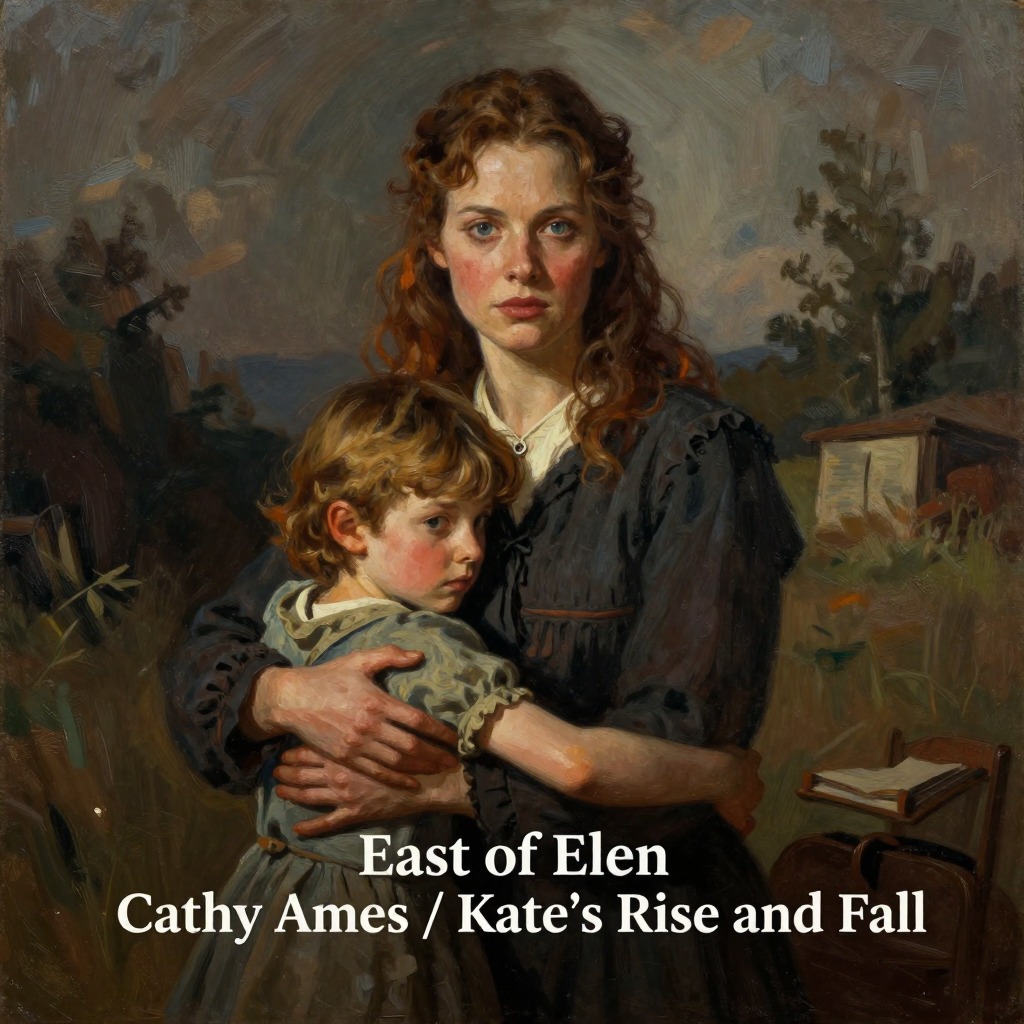
Cathy Ames is born in a small town in Massachusetts, the only child of a tanner. From a very young age, she is a monster, lacking kindness, conscience, and any normal human emotion. She has a face of innocence but uses her sexuality and understanding of human weakness to manipulate others. She is a liar and a thief, and she feels contempt for the people she easily controls.
Cathy at age ten
Cathy's Childhood Incident
Cathy's mother finds her in the carriage house with two fourteen-year-old boys, her skirts pulled up. Cathy claims she was tied up and assaulted, and the boys are severely punished and sent to a house of correction. However, the boys insist Cathy instigated the encounter and tied her own hands. This event establishes Cathy's pattern of using false victimhood to destroy others.
Cathy at age fourteen
James Grew's Suicide
Cathy's Latin teacher, James Grew, becomes infatuated with her. He visits the Ames house late one night, desperate to speak to Mr. Ames, but is turned away. The next morning, he is found dead in the church, having shot himself. Cathy subtly plants a rumor that Grew had been in trouble in Boston, deflecting suspicion from herself. This is the first death directly caused by Cathy's manipulation.
Shortly after her sixteenth birthday
Cathy Runs Away
Cathy refuses to go to school and tells her parents she is going to run away. Her father whips her, but she feigns repentance. After a period of apparent reform, during which she helps her mother and shows interest in her father's business, she sets fire to the family home, killing her parents. She then escapes with stolen money, leaving behind a scene that suggests she was murdered by a vagrant.
Shortly after the fire, early 1880s
Cathy Meets Mr. Edwards
Cathy, now calling herself Catherine Amesbury, goes to Boston and presents herself to Mr. Edwards, a whoremaster. She is too pretty for his usual business, but he falls hopelessly in love with her. He sets her up in a house and gives her money and presents. Cathy manipulates him, steals from him, and drives him to the brink of madness.
After a period of time in Boston
Mr. Edwards Attacks Cathy
Mr. Edwards discovers Cathy's true nature and her past, including the fire. He takes her to a small town in Connecticut, intending to punish her. He beats her savagely with a quirt and a stone, leaving her for dead. He then flees in panic. Cathy, though badly injured, drags herself to a farmhouse, where she is found at dawn.
Late 1890s or early 1900s
Cathy is Found by Adam and Charles
A badly beaten and bloody Cathy crawls to the porch of the Trask farm in Connecticut. Adam finds her and insists on taking her in, despite Charles's objections. A doctor is called, and Cathy is nursed back to health. She claims to have lost her memory, but Charles is immediately suspicious of her.
A few weeks after Cathy's arrival
Adam and Cathy Marry
Adam, deeply in love with Cathy, asks her to marry him. She accepts, seeing him as a source of protection and money. They are married by a justice of the peace. Charles is furious and accuses Cathy of being a whore. Adam, believing Charles is jealous, decides to take Cathy and leave the farm. He sells his share to Charles and prepares to move to California.
The night of the marriage
Cathy Seduces Charles
On the night of her marriage to Adam, Cathy drugs Adam's tea with his own sleeping medicine. While Adam is in a deep sleep, she goes to Charles's room and seduces him. Charles, though suspicious, succumbs. This act of betrayal is the foundation of the twins' ambiguous paternity and deepens the Cain-and-Abel parallel between the brothers.
Shortly after the marriage, around 1900
The Trasks Move to California
Adam and Cathy travel to the Salinas Valley in California. Adam is captivated by the region's promise and buys the old Sanchez ranch, a beautiful piece of land with a spring. He plans to build a garden, a dynasty, and a home for his family. Cathy is pregnant and unhappy, but she conceals her feelings, waiting for an opportunity to escape.
Shortly after the Trasks' arrival in the valley
Samuel Hamilton Meets Adam Trask
Adam seeks advice on water for his new land and is directed to Samuel Hamilton. Samuel, a well-digger and water witch, visits the Trask ranch. He is immediately struck by Adam's adoration of Cathy and senses something deeply wrong with her. He feels a strange, inhuman quality in her eyes, a memory that disturbs him.
October 1900
The Twins are Born
Cathy gives birth to twin sons, Caleb and Aron. The birth is unnaturally quick and easy. Samuel Hamilton, who delivers the babies, is bitten by Cathy when he tries to help her. Cathy shows no interest in her sons and refuses to see them. She demands the room be kept dark. Samuel is deeply disturbed by her behavior and sends for his wife, Liza, to help care for the newborns.
Two weeks after the birth, October 1900
Cathy Shoots Adam and Abandons the Twins
Cathy, having recovered her strength, prepares to leave. She sends Lee away on an errand, then shoots Adam in the shoulder with his own .44 Colt revolver. She walks out of the house, leaving Adam bleeding on the floor and the twins crying. Adam survives but is left emotionally shattered and physically scarred.
The year following Cathy's departure, 1901
Adam's Despair and Samuel's Intervention
Adam falls into a deep depression, neglecting his land, his house, and his sons. He refuses to name the twins, calling them only 'they.' Samuel Hamilton visits him and, in a fit of rage, physically assaults Adam, shaking him out of his stupor. Samuel forces Adam to confront his responsibilities and to give his sons names.
A year after the birth, 1901
The Naming of the Twins
Samuel Hamilton returns to the Trask ranch to help name the twins. The three men—Adam, Samuel, and Lee—discuss the story of Cain and Abel. Lee reveals his years-long study of the Hebrew word 'timshel,' which he translates as 'Thou mayest,' signifying that man has the choice to triumph over sin. This concept becomes a central philosophical theme of the novel. The twins are named Caleb and Aaron.
1900s-1911
Samuel Hamilton's Decline and Death
Samuel Hamilton ages and his health declines after the death of his beloved daughter, Una. He loses his vitality and his joy. His children, concerned, arrange for him and Liza to visit them. Samuel knows he is going away to die. He visits Adam one last time, telling him the truth about Cathy: that she is living in Salinas as a whore named Kate. This revelation is intended to shock Adam out of his passive grief.
The night of his last visit to Adam, 1911
Samuel's Farewell to Lee
After telling Adam about Cathy, Samuel rides away with Lee. On the road, they have a profound conversation about life, death, and the meaning of 'timshel.' Samuel, accepting his own mortality, feels a new sense of peace and purpose. He tells Lee that by telling Adam the truth, he has forced him to live or die. Lee says goodbye, knowing he will never see Samuel again.
March 1911
Samuel Hamilton's Funeral
Samuel Hamilton dies. His funeral is a large, well-attended event in Salinas. Adam Trask attends, and the experience, combined with Samuel's final revelation, begins to stir him from his long stupor. He decides to visit Cathy, now known as Kate, to confront his past.
After Samuel's funeral, 1911
Adam Visits Kate
Adam goes to Kate's brothel in Salinas. He sees her as she really is: a cold, cruel, and twisted woman. He tells her he no longer loves her and that he is free. Kate, enraged, tries to seduce him and then has her pimp beat him. Adam leaves, finally free from the ghost of Cathy. This encounter marks his true emotional recovery.
After the visit to Kate, 1911
Adam's Renewal and Lee's Decision
Adam returns to the ranch a changed man. He is free from the past and feels a new energy. He tells Lee he wants to get to know his sons. Lee, who had planned to leave and open a bookstore, decides to stay, realizing he is needed. Adam begins to engage with life again, buying a Ford and planning for the future.
1911
The Trasks Move to Salinas
Adam decides to move to Salinas for the sake of his sons' education. He buys Dessie Hamilton's house. Lee helps the family settle in. The move marks a new beginning for the Trasks, leaving behind the isolated ranch and the memories of Cathy.
Shortly after moving to Salinas, 1911
Cal and Aron Meet Abra Bacon
The Bacon family, including their daughter Abra, is caught in a rainstorm and takes shelter at the Trask house. The twins meet Abra, a confident and intelligent girl. Aron is immediately smitten, while Cal is more calculating. Abra becomes a central figure in the lives of both brothers.
October 1911
Charles Trask Dies
Adam receives a letter from his brother's lawyers informing him that Charles has died of a lung ailment. Charles's will leaves his entire fortune, over one hundred thousand dollars, to be divided equally between Adam and his wife. Adam is now a wealthy man, but the inheritance is complicated by the fact that Cathy is still legally his wife.
Shortly after Charles's death, 1911
Adam Offers the Inheritance to Kate
Adam goes to Kate and shows her the letter about Charles's will. He tells her the money is hers, as Charles intended. Kate is suspicious and cannot understand his honesty. Adam tells her he is not a thief and that he doesn't want her money. This act of integrity confounds Kate and leaves her feeling a strange sense of loss.
After Dessie's death, 1912
Tom Hamilton's Despair and Suicide
Tom Hamilton, Samuel's son, is consumed by guilt after his sister Dessie dies from a misdiagnosed illness. He blames himself for giving her salts, which he believes caused her death. Unable to bear the guilt, he writes farewell letters, stages his death as a horse-riding accident, and shoots himself. His suicide devastates the Hamilton family.
1915
Adam's Lettuce Venture Fails
Adam, seeking a purpose, invests heavily in a scheme to ship lettuce from the Salinas Valley to New York in refrigerated train cars. The venture is a disaster due to a series of accidents: a snow slide, unseasonable warm weather, and a shipping mix-up. The lettuce arrives as a rotten slop, and Adam loses most of his fortune. The failure brings public ridicule upon the family.
1916-1917
Cal's Bean Speculation
Cal, wanting to restore his father's lost fortune, partners with Will Hamilton. Using a loan from Lee, he speculates on the bean market, correctly predicting that the war in Europe will drive up prices. He makes a profit of fifteen thousand dollars. He plans to give this money to his father as a gift to make up for the lettuce failure.
Thanksgiving, 1917
Adam Rejects Cal's Gift
At a Thanksgiving dinner, Cal presents his father with the fifteen thousand dollars. Adam, who has been serving on the draft board and is haunted by the young men he sends to war, rejects the gift. He tells Cal the money is tainted by war profiteering and that he would rather have a good son than money. Cal is devastated and humiliated.
Thanksgiving night, 1917
Cal Takes Aron to See Kate
After Adam's rejection, a vengeful Cal takes his brother Aron to Kate's brothel and reveals that she is their mother. Aron is horrified and confronts Kate, who cruelly confirms the truth. Aron, his world shattered, runs away. Cal, having achieved his revenge, feels only emptiness and guilt.
Shortly after seeing Kate, late 1917
Aron Enlists in the Army
Aron, unable to cope with the revelation about his mother, runs away from home. He lies about his age and enlists in the army. He sends a postcard to his father, telling him not to worry. Adam is puzzled and hurt by Aron's abrupt departure, not understanding the reason behind it.
Late November 1917
Kate's Suicide
Kate, haunted by her past and the confrontation with her sons, decides to end her life. She writes a will leaving everything to Aron. She then takes a morphine capsule in her gray room, a small, windowless space she had built as a refuge. She dies alone, having finally 'disappeared' as she had always wished.
Shortly after Kate's suicide, late 1917
Joe Valery's Death
Joe Valery, Kate's pimp, discovers her body and steals her safe-deposit keys and a packet of blackmail photographs. He is picked up by the sheriff for questioning. Fearing exposure, he tries to escape and is shot and killed by a deputy. The sheriff, Horace Quinn, retrieves the photographs and burns them, protecting the reputations of the men involved.
May 28, 1918
Aron is Killed in Action
Aron, serving in the 28th Infantry, is killed in the Battle of Cantigny, the first major American offensive of World War I. The news is delivered to the Trask house by telegram. The shock of Aron's death causes Adam to suffer a massive stroke, leaving him partially paralyzed and unable to speak clearly.
The day of Aron's death, May 1918
Adam's Stroke and Final Blessing
Adam Trask suffers a severe stroke upon learning of Aron's death. He is bedridden, partially paralyzed, and his mind is clouded. Lee, Cal, and Abra gather at his bedside. Lee, understanding the depth of Cal's guilt, begs Adam to give Cal his blessing. With great effort, Adam whispers the word 'Timshel,' affirming Cal's freedom to choose his own path. He then falls into a peaceful sleep.