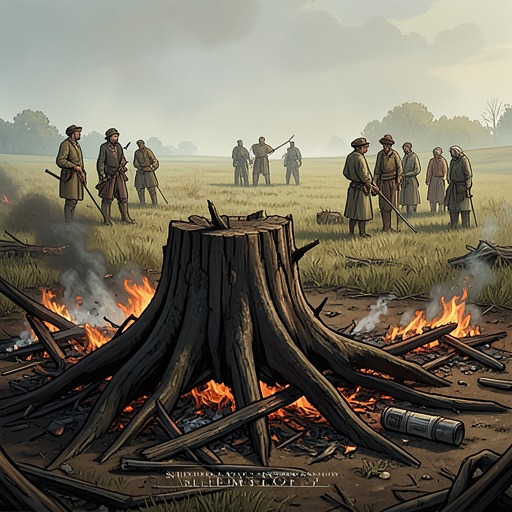
1951 fire
'Salem's Lot: A NovelThe 1951 fire was the blaze that burned up half of Jerusalem’s Lot in September 1951. It stands as both a recorded civic disaster and a concealed crime: the town remembered the destruction, but did not know that the fire had been deliberately set, or that its young perpetrator later achieved financial success while remaining inwardly consumed by the act. The event therefore belongs to the town’s history in two forms at once—public catastrophe and private secret—and its legacy helps establish the atmosphere in which later horrors can appear impossible in “such a nice little town.”
Place in the Town’s History
Jerusalem’s Lot had already cultivated a strong sense of local continuity by the time of the fire. The town was incorporated in 1765, celebrated its bicentennial two centuries later, and preserved older stories through gossip, family memory, and repeated communal retelling. Its physical arrangement reinforced that sense of a bounded world: Brock Street and Jointner Avenue crossed at right angles through an almost circular township, while the Royal River marked much of the eastern boundary. The fire entered this seemingly stable civic map as a rupture, burning through half the settlement while leaving the town’s basic identity intact.
The destruction was not treated as an event that permanently disqualified the town from its self-image as an orderly rural community. By the 1970s, residents still remembered what had happened, especially in relation to autumn field burnings. From Schoolyard Hill, people could see the local volunteer fire truck waiting in case a controlled burning escaped, and the narrative explicitly connects this caution to “the lesson of 1951.” The fire thus became institutional memory in practical form: a reason to watch flames closely, even though the deeper truth about the original blaze remained unrecognized.
The Public Record and the Hidden Cause
The public version of the event was simple. A fire burned up half of Jerusalem’s Lot during the smoke-hazed September of 1951. The town knew the scale of the loss, but not its origin. Its residents did not know that the blaze had been set deliberately, and they did not know that the boy responsible later graduated as valedictorian of his class and went on to make one hundred thousand dollars on Wall Street.
That contrast gives the fire its distinctive moral shape. The perpetrator was not publicly marked as an arsonist or expelled from the town’s respectable narrative. Instead, he moved into the future as a successful man, while the crime remained folded into the anonymous history of the community. His prosperity did not resolve the act; it sharpened the irony. The same person who could be recognized for academic achievement and financial success remained privately governed by the destructive impulse that had produced the fire.
The concealment also matches a broader pattern in Jerusalem’s Lot. Residents know fragments of one another’s scandals, but rarely possess the full truth behind them. They believe they understand abandoned marriages, violent deaths, old crimes, and the history of the Marsten House, yet the decisive motives and private circumstances remain inaccessible. The fire is one of the clearest examples of this divided knowledge: the visible fact is communal, while the cause is individual and hidden.
Psychological Afterlife
The fire did not end when the flames went out. According to the town’s retrospective account, the boy who set it remained tormented by the compulsion that had driven him and by the memory of what he had done. The guilt ate at his mind for twenty years, until a brain embolism killed him at the age of forty-six. His later death closes the known arc of the act, but it does not expose the secret to the town or transform the event into public justice.
This private aftermath makes the fire more than a historical marker. It is an instance of violence continuing after its physical damage has become part of the landscape. The town rebuilds, conducts its ordinary business, and converts the disaster into a cautionary lesson; the perpetrator carries the event as an inward, corrosive burden. Public recovery and private ruin proceed on separate tracks, neither correcting the other.
Recurrence, Memory, and Omen
The 1951 fire is positioned among earlier and later layers of Jerusalem’s Lot’s concealed history. The town’s surviving records and stories reach back to the 1789 disappearance associated with the earlier Jerusalem’s Lot, while the disappearances of four children between 1928 and 1939 remain unexplained. The Marsten House preserves another concentrated history of violence, and the town’s later vampire crisis turns its accumulated secrets into an open supernatural catastrophe. Against that chronology, the 1951 fire appears as a modern, human-made disaster that anticipates the novel’s larger pattern: evil is not introduced into an innocent place so much as revealed within a place already trained to hide it.
The event also prepares the contrast between what the community thinks it knows and what the narrative later discloses. Residents can remember the burned half of town, trace roads around the settlement, and recognize the precautions taken during field burnings. Yet memory does not automatically produce understanding. Jerusalem’s Lot remembers consequences more reliably than causes, and its civic knowledge remains vulnerable to omission, rumor, and inherited distortion.
Narrative Significance
The fire defines the town as a landscape where catastrophe can be both enormous and normalized. Half of Jerusalem’s Lot was destroyed, but the community continued to imagine itself as protected by its smallness and decency. The narrative repeatedly stresses that the town’s knowledge of national wars and political crises was largely mediated through television and that its own sense of danger remained provincial and abstract. “Nothing too nasty could happen in such a nice little town.” The 1951 fire quietly disproves that confidence before the supernatural outbreak makes the contradiction impossible to ignore.
Its deepest significance lies in the union of physical scar and moral concealment. The blaze leaves an observable civic lesson, yet its deliberate cause disappears into the town’s private darkness. In that respect, the fire is a miniature of Jerusalem’s Lot itself: apparently familiar, historically continuous, and socially interconnected, but sustained by secrets that outlast individual lives. When later events make the town’s hidden evil visible, the 1951 fire already stands as evidence that the community’s most dangerous history did not begin with the vampires.