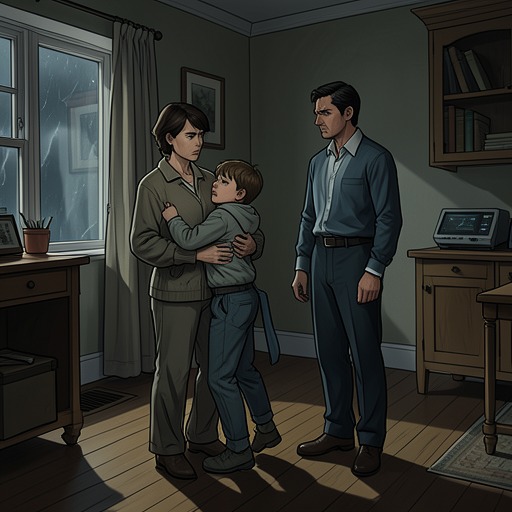
Ann Norton and Susan Norton
'Salem's Lot: A NovelAnn Norton and Susan Norton are defined by a mother-daughter relationship in which care repeatedly becomes surveillance and protection becomes control. Ann’s distrust of Ben Mears is not merely personal dislike: she fears that Susan’s attachment to an itinerant, creative man may expose her daughter to emotional injury and instability. Susan, meanwhile, is old enough to recognize the pressure and increasingly willing to resist it, making their relationship a quiet domestic conflict within the wider unease surrounding Jerusalem’s Lot.
Maternal Suspicion and Social Judgment
Ann’s attitude toward Susan’s relationship with Ben is shaped by a small-town preference for recognizable stability. Susan has told Ben that her mother assumes the daughter’s romantic future could be settled neatly through Floyd Tibbits, whom Ann regards as a known quantity and as “Steady.” Ben, by contrast, has appeared from nowhere and might disappear just as quickly, perhaps carrying Susan’s heart with him. Ann therefore treats his presence as a threat to the orderly future she imagines for her daughter.
Her suspicion is intensified by Ben’s profession and by his involvement in the search for Ralphie Glick. The narrative presents Ann as instinctively hostile toward the creative male, associating unconventional men with danger, instability, and even violence. Ben suspects that his participation in the search has increased rather than relieved her distrust. Her concern thus mixes genuine maternal anxiety with the normative judgments of the town: Susan must be protected not only from harm but from a man who does not fit the local definition of respectable predictability.
The Dinner-Table Conflict
At dinner with the Nortons on September 25, Ann remains cool while Susan’s liking for Ben is described as frank, clear, and natural. The emotional imbalance is important. Susan’s feeling is direct; Ann’s response is guarded and evaluative. Even Bill Norton’s growing liking for Ben is constrained by the awkward fact that Ben is present because of Susan rather than because of an independent friendship with her father. Ann’s reserve is sharper still because she sees the relationship through the lens of maternal responsibility and possible sexual danger.
Ann’s watchfulness turns the household into a monitored space. When Susan prepares to leave with Ben, Susan goes up the back walk to fetch a jacket, and Ben notices that Ann is watching him watch her. The moment makes the mother’s control visible without requiring an open accusation: Susan’s body, Ben’s gaze, and Ann’s judgment are all caught in the same field of observation. Ann’s authority operates through the possibility of being watched, compelling Ben to remain formally restrained and reminding Susan that her choices are still subject to maternal inspection.
Susan’s Assertion of Independence
The clearest confrontation occurs when Ben invites Susan to walk down the hill to Spencer’s for a soda. Ann intervenes immediately, saying that after Ralphie Glick’s disappearance she would feel better if they did not go. Her appeal is framed as safety, but it also extends her authority over Susan’s movements and over the relationship itself. Susan answers, “Momma, I’m a big girl,” and points out that streetlights run all the way up Brock Hill. Her reply is brief but decisive: she accepts the reality of danger while rejecting the conclusion that danger gives her mother the right to decide for her.
The exchange shows Susan negotiating adulthood rather than simply rebelling. She does not deny Ann’s fear or insult her judgment; she supplies a practical reason for leaving and insists that she can manage the outing. Bill supports Susan by telling Ann that she worries too much, while Ann retreats into a thinly smiling resignation about young people believing they know best. The family’s surface civility therefore conceals a struggle over who has the authority to define Susan’s safety and maturity.
Ann’s control also affects the way Susan’s intimacy is staged. Susan gets a jacket before leaving, while Ben promises in almost formal language that he will walk her back. The formality is not incidental: it is a visible concession to the parental gaze. Ben’s decision to stay in Jerusalem’s Lot until his book is written, and perhaps longer because he finds the place lovely, gives Ann another reason to regard him as uncertain. He offers no fixed promise beyond the book, while Ann fears that Susan may invest her future in a man whose own future remains open.
Silence, Absence, and Emotional Pressure
Ann’s anxiety continues beyond direct supervision. At one point she watches from the window after calling the drugstore and learning that Susan has not been there. Her thoughts become an anguished repetition of where Susan might have gone, followed by an inward command for Ben Mears to leave Susan alone. The sequence reveals the emotional intensity beneath Ann’s cool manner: she is not indifferent to her daughter’s choices but frightened by her inability to control them.
That fear produces a damaging form of emotional pressure. Ann’s concern is expressed through suspicion, checking, and imagined catastrophe rather than through an open conversation with Susan. The mother’s authority depends on treating Susan as vulnerable and Ben as potentially contaminating. Yet Susan’s own conduct, including her willingness to leave with Ben despite the objection, demonstrates that the maternal model of permanent dependence is already failing.
Relationship Significance
The Ann–Susan relationship gives the novel’s supernatural crisis a domestic counterpart. Before the vampire threat fully dominates the town, Susan is already caught between an adult bond she chooses and a maternal structure that seeks to regulate that choice. Ann’s fear of Ben is partly conventional and partly perceptive: he is an outsider whose presence may indeed draw Susan into danger, although Ann’s methods cannot distinguish ordinary romantic uncertainty from the larger darkness gathering around Jerusalem’s Lot.
The relationship also exposes how protection can become a form of possession. Ann wants to preserve Susan from heartbreak, sexual risk, and the instability associated with Ben, but her surveillance treats Susan’s independence as evidence of danger. Susan’s insistence that she is a “big girl” is consequently more than a line in a family quarrel; it marks the boundary between being loved as a daughter and being managed as someone who cannot yet govern her own life. Their conflict remains emotionally credible because both positions contain recognizable motives: Ann fears loss, while Susan claims the freedom required to become an adult.