Barlow and Straker Furniture Shop
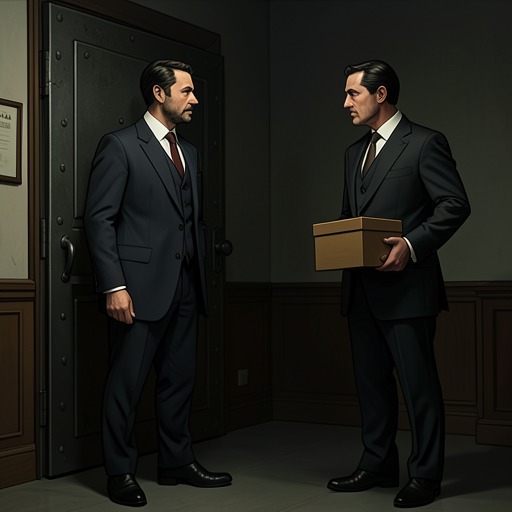
'Salem's Lot: A NovelBarlow and Straker Furniture Shop is the commercial face of the new presence in Jerusalem’s Lot: a furniture establishment whose polished public identity conceals the fear gathering around Richard Straker and Kurt Barlow. Positioned within the town’s ordinary business landscape, it becomes an unusually visible marker of secrecy, absence, and possible supernatural danger.
Setting and Public Appearance
The shop belongs to the built center of Jerusalem’s Lot, a town organized around the right-angled crossing of Brock Street and Jointner Avenue. The crossing gives the township, viewed on a map, the appearance of a telescopic sight, while the surrounding quadrants divide the community into wooded high ground, river country, farms, and the trailer district known as the Bend. Against that mapped order, the furniture shop presents itself as a new and legible commercial object within the town’s established routines. The evidence identifies its public sign as “Barlow and Straker—Fine Furnishings.” The gold-faced letters above the show window give the business a finished, respectable appearance, while the wording places Barlow and Straker together as a partnership before the town. The shop therefore functions not merely as a place of trade but as a named installation of the newcomers’ identity, planted in the visible life of the community.
From New Business to Suspicious Site
The shop’s importance emerges when Ben Mears, Matthew Burke, Jimmy Cody, Mark Petrie, and Father Donald Callahan begin assembling a case around the strange events in Jerusalem’s Lot. Father Donald Callahan agrees to accompany the investigation only on the condition that the group first visit the shop and speak frankly with Richard Straker about the allegations. He wants Richard Straker’s reactions observed and wants the man given an opportunity to dismiss the accusations openly. The proposed visit makes the shop a test site: the investigators intend to compare the public behavior of the proprietor with the disturbing testimony that has accumulated elsewhere. This condition also gives the shop a strategic role in the investigation. The group is not simply seeking information from a shopkeeper; it is trying to bring a hidden danger into a social and commercial setting where it might be seen, questioned, and judged. Matthew Burke worries that such a visit would warn Richard Straker, but Father Donald Callahan maintains that a warning would not matter if Ben Mears, Jimmy Cody, and the priest still agreed that the investigation had to proceed. The shop thus stands at the boundary between evidence gathering and confrontation.
Closure and the Failure of Ordinary Access
By the time Father Donald Callahan acts on the plan, the business has become inaccessible. He goes to the shop at nine o’clock in the morning to discuss Matthew Burke’s allegations with Richard Straker, but finds the front and back doors locked. A sign in the window reads, “Closed Until Further Notice.” The closure confirms nothing by itself, yet it fits Mark Petrie’s account closely enough to deepen the investigators’ unease. The ordinary explanation—a temporary business shutdown—remains possible, but the timing makes the absence part of the pattern. The same sign is still displayed when the group later reaches the shop. Other places in town are closed as well: Foreman’s Mortuary has its “Closed” sign posted, and Spencer’s is locked and dark, while the diner remains open. In that wider atmosphere, the furniture shop’s closure is both ordinary and ominous. Jerusalem’s Lot is beginning to look like a town whose visible routines are failing unevenly, with selected buildings lit, shuttered, or abandoned while the deeper cause remains unknown to most residents.
Threshold of the Hidden Threat
The investigators stop outside the shop partly because Richard Straker might be hiding inside. Jimmy Cody considers the obviousness of that possibility a reason it might be overlooked. He also notices the practical details of the building and its surroundings, including boxes that may have passed through customs inspection, marked with chalk. Such details place the suspected supernatural conspiracy alongside mundane systems of shipment, trade, and commercial handling; the shop’s menace is not detached from modern infrastructure but appears to use it. Inside, the group encounters silence rather than explanation. Mark Petrie knows they are not alone, even though the stillness offers no visible confirmation. Holding a stake tightly, he moves with Susan Norton toward the hall and picks up a book from a small end table outside the door. The shop therefore becomes a threshold in the fullest sense: a public storefront opens onto a private interior, and that interior leads toward concealed objects, withheld knowledge, and the danger associated with Barlow and Straker.
Narrative and Thematic Significance
The furniture shop gains power through contrast. Jerusalem’s Lot is portrayed as a place where scandal circulates through party telephone lines, where the Bend supplies much of the gossip, and where the community assumes that nothing truly terrible can happen in such a pleasant little town. The shop enters that world as a respectable sign, a new business, and a point on the town’s commercial map. Its meaning changes only as the town’s confidence in ordinary explanations collapses. Its repeated visual presence—gold lettering over the window and the hand-lettered notice on the door—makes the shop an object that cannot be ignored even when it yields no information. The sign promises furnishings, order, and domestic comfort; the locked doors and the investigators’ suspicion turn those promises into an emblem of concealment. In a town whose residents sometimes turn on every light without looking out their windows, the shop embodies the danger of visible surfaces that reveal almost nothing. The shop’s decisive significance is therefore not that it is merely a place where events occur, but that it concentrates the novel’s movement from civic normality to supernatural occupation. It is where Father Donald Callahan demands a direct test, where Richard Straker’s absence becomes meaningful, where the investigators confront a silence that confirms their isolation, and where commercial respectability is recast as the public mask of a threat reaching into the town’s homes, streets, and collective memory.