Ben Mears
'Salem's Lot: A NovelBen Mears is the novel’s returning protagonist, a writer whose journey to Jerusalem’s Lot turns a private act of memory into a public confrontation with supernatural evil. He comes back to the town where he lived for four years as a boy, carrying the unresolved trauma of his childhood encounter with the Marsten House and the later death of his wife, Miranda. What begins as an effort to reclaim a lost past becomes an investigation of the house, a defense of the town’s endangered residents, and ultimately a struggle to survive a catastrophe that consumes the community around him.
Identity and Return
Ben’s identity is inseparable from the tension between the writer he has become and the child he once was. He returns to roads that he remembers from boyhood, but the landscape has been altered: roads have been asphalted and straightened, woods have been logged, and tourist beer cans have replaced the signs of the earlier world. The physical changes confirm his fear that the childhood magic he seeks cannot simply be recovered. The loss is not merely nostalgic. It is bound to the motorcycle accident that killed Miranda, whose scream ended with sudden finality when the yellow moving van filled his vision. His adult life therefore contains two forms of bereavement: the vanished imaginative world of childhood and the actual death of his wife.
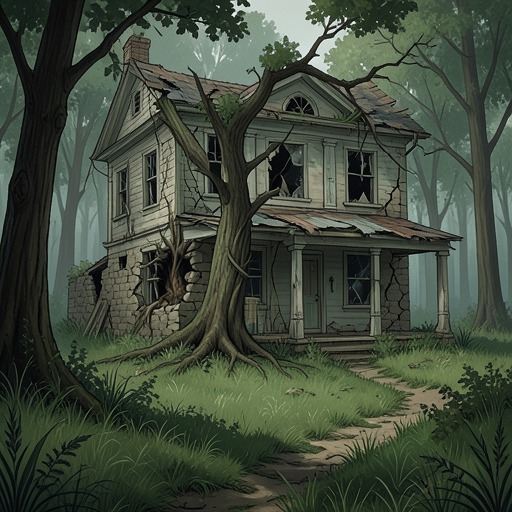
His return is also a deliberate approach to the source of that wound. After looking toward the Marsten House, Ben tells himself that he will investigate who is handling it and perhaps lease it. He imagines using the kitchen as a writing room and sleeping in the front parlor, but he refuses to go upstairs. That qualification reveals how closely his professional purpose is tied to fear. The house is not simply useful material for a novel; it is the place he has avoided, and his proposed return tests whether writing can master an experience that memory has left unfinished.
The Writer and the Marsten House
Ben’s book gradually discloses its real subject. He explains that he had thought it would be about the town, but his research into Hubert Marsten has drawn the Marsten House to the center. He discovers that Marsten was a mobster and that the trucking company associated with him was only a front. The research transforms the house from a childhood image into a historical object with a documented criminal past, while preserving the more disturbing possibility that its evil exceeds ordinary biography.
The town itself becomes part of Ben’s method. Jerusalem’s Lot is nearly circular, bounded on the east by the meandering Royal River, with Brock Street and Jointner Avenue crossing at right angles like the sight of a telescopic weapon. Its social geography is equally revealing. In the southwest, the Bend is crowded with trailers, junked cars, frayed tire swings, beer cans, makeshift washing lines, hastily laid septic tanks, children, toys, pickup trucks, snowmobiles, and motorbikes. These details give Ben a town divided by class, mobility, and visibility rather than an idyllic rural unity. Yet the Lot treats the country’s larger torments as something merely academic and assumes that nothing truly terrible can happen in such a pleasant place. Ben’s return places him inside that complacency just as the town’s hidden history begins to surface.
His writing is repeatedly interrupted by events that make fiction inadequate as a refuge. On Wednesday, September 24, rain prevents further searching for Ralphie Glick, and the consensus is that the boy is gone. Ben is writing when a knock comes at the door, so the scene joins his manuscript to the town’s emergency: the novelist’s work continues, but reality keeps forcing itself into the room. Later, when someone asks whether his book is set in a town like Jerusalem’s Lot, the question exposes the unstable boundary between invention and testimony. Ben’s imagined subject is no longer safely fictional because the town is supplying experiences that his book can only follow.
Relationships and Recognition
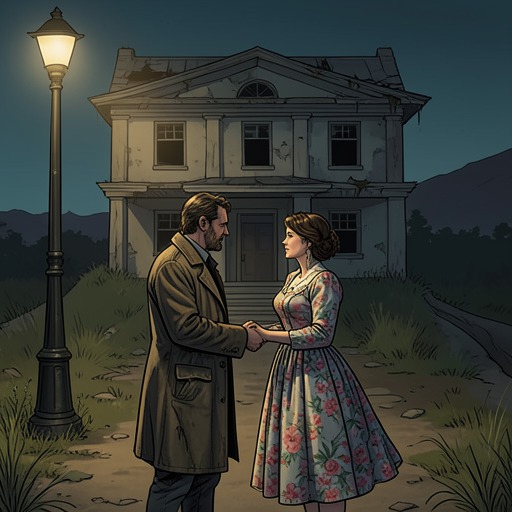
Ben’s connections with other people are shaped by recognition, disclosure, and shared danger. He tells Susan Norton’s parents that he has had dinner with Susan and played badminton with her father, placing his relationship with Susan within ordinary social rituals before the supernatural crisis overwhelms them. Susan, in turn, identifies Ben as the person she wants when her mother asks what she wants, a choice that confirms the emotional force of their bond even as Ann Norton attempts to control the situation.
His relationship with Matt Burke becomes more consequential as evidence accumulates. Ben speaks with Matt by telephone, answers simply as Ben, and gradually entrusts him with facts he has not told Susan, including the precarious state of his finances. That disclosure shows that their alliance is not limited to the vampire investigation; Matt becomes a confidant to whom Ben can admit both practical insecurity and moral fear. Ben also comes to depend on Matt’s judgment when rational explanations begin to collapse. Susan initially tries to explain Mike Ryerson’s death through murder, deception, and staged effects, but Ben witnesses how those explanations fail. The pair’s movement from skepticism to shared recognition parallels Ben’s own movement from writerly speculation to direct action.
Ben’s first meeting with Mark Petrie carries an unusually heavy sense of destiny. Mark physically reminds Ben of the boy he himself had been, and the encounter feels like a chance convergence of their lives. Ben associates it with the earlier moment when he met Susan in the park, a seemingly light conversation that already seemed charged with intimations of the future. Mark therefore becomes more than a child in danger. He is a reflection of Ben’s lost childhood and a living counterpart to the younger self Ben cannot recover.
From Witness to Combatant
Mark tells Ben the story beginning with Danny Glick’s appearance at his window and ending with Mark’s own nocturnal visitor. Ben listens while driving aimlessly, allowing the boy’s account to establish a coherent pattern from incidents that adults have treated separately. Once the story is complete, Ben states his intention to go to the Marsten House and confront the person responsible. His objective changes from understanding the past to stopping its present violence.
That resolve repeatedly encounters the limits of courage. At one point Ben quietly says that he cannot proceed, speaking not as someone making an argument but as a man acknowledging a fact. The refusal does not end his resistance; it clarifies the cost of the next decision. When the group realizes that they have been mocked and manipulated, Ben participates in exposing the deception and has Jimmy Cody produce the letter. He is no longer merely collecting material for a book. He is helping interpret evidence, coordinate allies, and answer an enemy who uses both violence and theatrical ridicule.
The investigation moves through houses, bodies, hospitals, and morgues, forcing Ben to work against institutions that can recognize symptoms but not their cause. Parkins Gillespie circles a body and asks whether the dead man has really been checked, while the theft of bodies from the Cumberland County Morgue is described through the grotesque image of a creation associated with Boris Karloff and Mary Shelley. Ben examines Mrs Glick’s body and finds his attention repeatedly drawn to an ordinary Band-Aid on her shin. The small medical detail becomes horrifying because it remains stubbornly human amid the larger evidence of bodily violation. Ben’s role is to hold these incompatible registers together: the clinical fact, the supernatural explanation, and the emotional knowledge that the dead were neighbors.
Ordeal and Ending
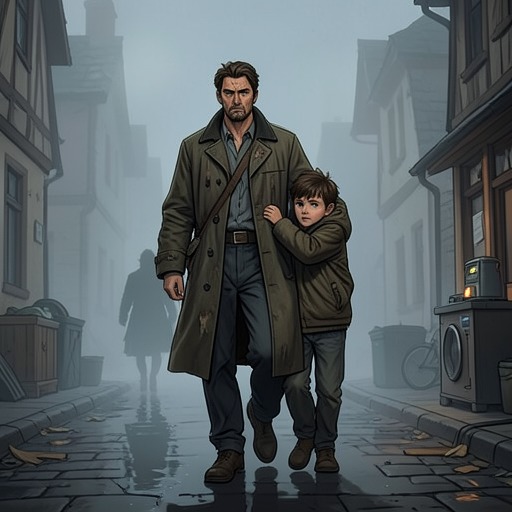
As the crisis deepens, Ben recognizes that action may lead directly to death. The possibility of Matt’s death appears to him as a long shadow, and later he thinks with stark simplicity that he is going to his death. His fear is not abstract heroism but an awareness that every ally can disappear and every rescue can become another burial. Even so, he continues to act. When Mark appears to have fainted, Ben checks that the boy’s pulse is strong and regular, gathers him into his arms, and carries him to the Citroën. The gesture gives physical form to his relation with Mark: the older survivor assumes responsibility for the endangered child who resembles his younger self.
Ben’s caretaking continues after the violence has shattered the remaining group. He gets Jimmy, still bundled in Eva Miller’s drapes, out of the cellar, places him in the trunk of Jimmy’s Buick, and drives to the Petrie house. Near Taggart Stream, he digs a grave four feet deep and places Jimmy’s body and the Petries inside, wrapped in the sofa dustcover. The improvised burial is both practical and ceremonial. It records the collapse of ordinary protections while preserving a final obligation to the dead.
The journey away from the Lot carries memory into a changed future rather than restoring the past. As Ben and Jimmy approach Momson, Ben remembers that he and Susan had taken the same route after their first date, when she wanted to see a car chase. He had told her then about the childhood experience that eventually gave rise to his book; now the book seems pale beside what has happened. This contrast defines Ben’s ending. Writing began as an attempt to convert trauma into art, but the lived catastrophe exceeds the imaginative premise. His return does not recover the old magic, white or black. It leaves him with knowledge, grief, and the burden of having witnessed what the town preferred to believe could never happen.
Narrative Role and Significance
Ben functions as a bridge between incompatible forms of knowledge. He is a novelist trained to interpret patterns, a widower carrying an unclosed trauma, a returning resident who understands the town’s remembered geography, and an investigator forced to accept that supernatural rules operate within apparently ordinary spaces. His financial instability further prevents him from standing outside the world he studies; he is not a detached chronicler with unlimited security, but a vulnerable adult whose livelihood and emotional life are both unsettled.
His character arc also reverses the conventional return home. The journey begins with the hope that familiar roads might restore childhood meaning, yet each familiar place instead reveals historical damage, social blindness, or supernatural occupation. The Marsten House promises material for a book but demands confrontation. Susan offers intimacy but becomes part of the vampire crisis. Mark offers an image of the boy Ben was, but protecting him requires Ben to abandon the fantasy of recovering that boy. The town’s geometry, its social margins, its bright televisions, its cemeteries, and its suddenly illuminated houses all become stages on which private memory turns into collective emergency.
Ben’s decisive significance lies in this conversion of memory into responsibility. He cannot redeem Jerusalem’s Lot by understanding it, and he cannot make the dead human again through language. What he can do is recognize the pattern, believe the endangered, act despite terror, protect Mark when the adults and institutions fail, and bury the dead when civic order has collapsed. His return therefore produces no sentimental homecoming. It produces a witness who has entered the darkness he once approached as a child and has learned that survival requires more than recovering the past: it requires answering what the past has made present.