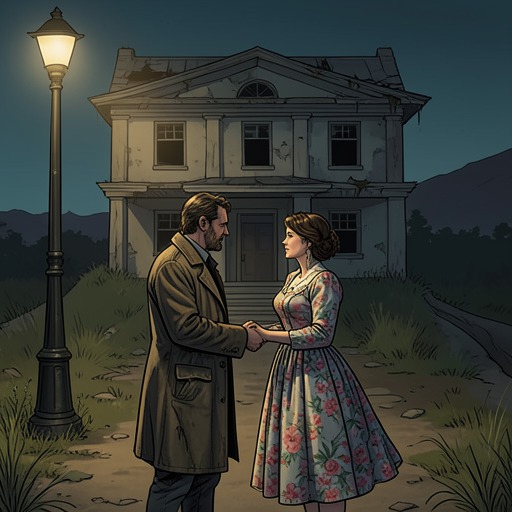
Ben Mears and Susan Norton
'Salem's Lot: A NovelBen Mears and Susan Norton are joined by a relationship that begins in the ordinary intimacy of a first meeting and ends in supernatural violence. Their romance gives Ben a reason to remain in Jerusalem’s Lot, but it also makes the town’s darkness personal: Susan becomes at once his beloved, his investigative ally, and the vampire he must destroy. The relationship therefore supplies the novel’s emotional center, turning the fight against evil into an ordeal of recognition, grief, and release.
Meeting and Recognition
Susan first appears on Tuesday, September 16, the first day of school, sitting beneath a gnarled old elm in the town park. She is reading while a sketch pad and what appears to be a charcoal pencil lie beside her; a silk scarf is tied over her light blond hair. Ben notices her while sitting on a bench, in a park temporarily emptied of its rowdier element and occupied instead by mothers with infants and old men near the war memorial. The quiet setting gives their meeting a suspended, almost enchanted quality, but the encounter remains grounded in specific acts of attention: she is studying a book, and Ben is watching the stranger who is watching him.
The book immediately creates a private bridge between them. Susan holds up a copy of Jerusalem’s Lot Public Library’s stamped novel, and Ben discovers that it is Air Dance, his second novel. She tells him, “I thought I was seeing a ghost,” after recognizing him from the four-year-old photograph on the back jacket. The photograph shows a boyish, frighteningly serious face, with eyes described as black diamonds; Susan’s recognition thus joins the public image of the author to the living man in front of her. Ben answers the opening with a mechanical pencil from his sweater pocket, signs the flyleaf, and asks her name. Their relationship begins through reading, authorship, and the movement from an image preserved in a book to an actual exchange between two people.
Susan’s attraction is not presented as effortless certainty. She checks Ben’s eyes a third time before smiling warmly and agreeing to have a soda with him, noting that the drinks are good at Spencer’s. That small act of examination makes the first approach a moment of testing as well as welcome. Ben, meanwhile, is drawn to her while carrying the memory of Miranda, his dead wife. After returning to his room, he thinks Susan is the first nice girl since Miranda died and worries that he may be trying to turn her into a replacement. His awareness of that danger gives the new relationship a moral complication from its beginning: affection is possible, but grief may distort what he sees in Susan and what he asks her to become.
Courtship and Intimacy
Ben and Susan’s first date develops through a series of invitations, hesitations, and changes of setting. While driving back from Portland on 295, Ben drives the Citroën smoothly through the darkness, and the couple continues talking after their drinks are gone and midnight has passed. Susan then invites him to dinner at her house, saying that her parents would like to meet him. The invitation also serves her relationship with her mother, since Susan can offer the proposed dinner as a gesture of family accommodation. Romance and family pressure are therefore present in the same moment rather than separated into different plotlines.
Susan pauses before entering her home and looks up at the Marsten House. The gesture places the relationship under the shadow of the house before Ben and Susan have fully defined it. Later, when Ben asks whether she would like to walk down the hill for a soda at Spencer’s, she declines and proposes the park instead. Her choice returns them to the setting of their first encounter, but the park now becomes a place of deliberate closeness rather than accidental observation. The relationship advances by revisiting its beginning and making that beginning mutual.
Their intimacy accelerates in the park. Susan holds Ben’s hand, tells him that her dislike of Floyd Tibbits was a case of dislike at first sight, and apologizes for it. She then asks him to kiss her while she thinks, lies back on the grass, and asks whether he wants to make love to her. The exchange makes Susan an active participant rather than a passive object of Ben’s courtship. Her direct questions and physical initiative change the relation from tentative conversation to chosen sexual intimacy. When Ben later asks whether she is sorry, the question reveals his concern that the speed and intensity of the encounter may have exposed her to regret; the answer, as represented by the continued bond between them, is not a retreat from intimacy.
Afterward Susan asks Ben to do something important for her: she tells him to start locking his door and to think of himself as under suspicion. The request is both practical and relational. She recognizes that Ben’s return to Jerusalem’s Lot has placed him in danger, and she tries to make him behave as someone being watched. Her concern anticipates the later collapse of ordinary safety. The couple’s tenderness thus does not remain private; it becomes a channel through which Susan perceives the town’s threat and attempts to protect Ben from it.
Shared Investigation and the Marsten House
As the crisis deepens, Ben and Susan’s relationship becomes part of the resistance to the vampire outbreak. Ben participates in the search for Ralphie Glick, beating the bushes with other volunteers and suffering cockleburs in his trouser cuffs and severe hay fever from late-summer goldenrod. Susan is not merely the person waiting for him at home: the surrounding danger enters their romance through missing children, unexplained violence, and the suspicion attached to Ben’s return. Later, when Matt Burke reports that Ben has left the hospital with James Cody and that Susan has also disappeared after promising her parents she would return by five, their simultaneous absence marks them as linked participants in the unfolding catastrophe.
Their relationship also provides the emotional justification for the assault on the Marsten House. After Ben’s disappearance and Susan’s disappearance, Matt declares that the group will go up to the house and get the person responsible. When Matt asks Ben whether he has slept with Susan, Ben answers yes. Matt then tells him that he must drive the stake first into Kurt Barlow and then into Susan, because Ben is the only member of the party who has been personally wounded and must act as her husband. The relationship is thereby translated into an obligation: love does not exempt Susan from destruction, but it determines who must perform the act and why it will be understood as liberation rather than mere killing.
Before the final attack, Ben and Susan also share a different discussion in the park after making love. Susan asks about the book Ben had intended to explain before they were interrupted. The conversation turns toward the Marsten House and the nature of evil, making their romance a setting for intellectual as well as physical intimacy. Ben looks toward the house and sees its shutters, normally closed all day, pulled back while light shines from the downstairs windows. When they reach Susan’s home, the downstairs lights illuminate the lawn, and Ben sees Ann Norton rocking and knitting in the front bay window. The familiar domestic scene cannot dispel the house’s presence; instead, the ordinary home and the supernatural house stand in visual tension around the couple.
The intimacy of that conversation is broken by Susan’s fear. She tells Ben, “Ben, you’re like a stranger to me. Do you know that? I’m scared of you.” She asks whether Jamie lives, and Ben’s situation becomes inseparable from the danger surrounding the people connected to him. Her words show that the relationship has entered a phase in which knowledge no longer guarantees trust. Ben remains emotionally committed, but Susan’s fear registers the way the supernatural crisis has made familiar identities unstable.
Transformation, Sacrifice, and Release
Susan is eventually taken by Kurt Barlow and transformed into a vampire. Her conversion changes the relationship without erasing its previous history. To Ben, she remains the woman he met reading Air Dance in the park, the woman who held his hand, invited him into intimacy, and warned him to lock his door. To the vampire colony, she is part of the enemy’s expansion. The horror lies in the coexistence of those two identities: the person Ben loves survives visibly within the creature he must oppose, but that survival cannot restore the relationship to its earlier form.
The assault on the Marsten House finds Susan lying motionless at the center of a raised dais, illuminated by Jimmy Cody’s flashlight and covered from shoulders to feet in simple white linen. The scene makes her resemble both a beloved person laid out for mourning and a body prepared for ritual. No one speaks when the group reaches her; wonder swallows their words. Father Callahan steps forward, presses his fingers against her left breast, and identifies the heart. The physical specificity of the gesture strips away the possibility of treating Susan’s destruction as an abstraction: the target is the heart of the woman Ben loves.
Callahan tells Ben to be her lover, or better, her husband, insisting that Ben will not hurt her but free her, and that Ben alone will suffer. The language converts the stake into a distorted marital act. Ben’s earlier uncertainty about replacing Miranda is now answered by an even harsher demand: he must occupy the role of husband not as a promise of shared life but as the person capable of ending Susan’s undead existence. Their love becomes the reason for the violence and the standard by which the violence is judged.
Ben raises the hammer and brings it down. Susan settles back, her mouth relaxing and closing; a final pulse of air passes through her mangled lips. For a moment, Ben sees, or imagines he sees, the Susan from the park reading his book. That fleeting image restores the beginning at the instant of ending. The remembered reader, the woman under the elm, and the vampire on the dais are held together in one painful perception. Her destruction is consequently framed not as the annihilation of an enemy but as the release of the beloved person still glimpsed within the monster.
Narrative and Thematic Significance
Ben and Susan’s relationship follows a movement from recognition to mutual desire, from desire to shared danger, and from shared danger to an impossible act of fidelity. It does not receive a conventional romantic resolution. The plot refuses the promise that love will preserve the beloved from transformation or that defeating evil will return the couple to ordinary life. Instead, the relationship’s final proof is Ben’s willingness to destroy what Susan has become, even though that act leaves him with the memory of what she was.
The relationship also links private attachment to the novel’s larger pattern of returning evil. Susan first encounters Ben through a book and a photograph, forms a bond with the living author, and later becomes part of the supernatural world centered on the Marsten House. The book, the park, the family home, the hospital, and the house of evil are not isolated backdrops; they mark successive stages in how intimacy is exposed to public danger. Susan’s warning that Ben must think of himself as under suspicion becomes tragically prophetic, while her later fear that he is a stranger shows how the town’s corruption reaches into the most intimate recognition between two people.
For Ben, Susan is both a new love and a test of whether love can escape the claims of grief. His fear of turning her into a new Miranda is not resolved by replacing one woman with another; it is answered by the recognition that Susan is irreducibly herself, first as the reader who approaches him, then as the woman who chooses intimacy, and finally as the person whose release he must grant. The closing image of the Susan from the park preserves that distinct identity even as the relationship ends. Love cannot defeat death in the story, but it can determine how the dead are faced and whether the final act is understood as vengeance or freedom.