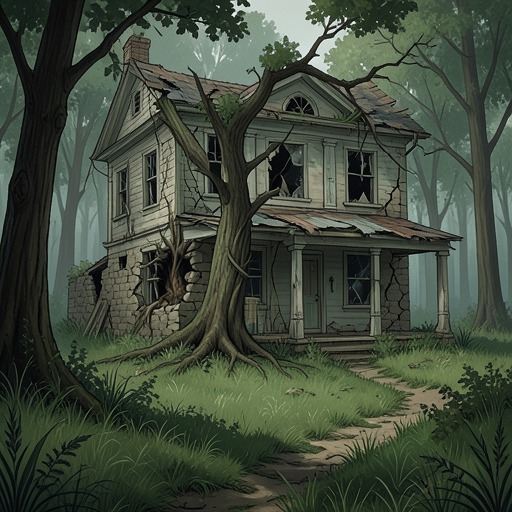
Ben Mears's Marsten House encounter
'Salem's Lot: A NovelBen Mears's Marsten House encounter is the formative childhood event behind his later return to Jerusalem’s Lot. What begins as an initiation dare becomes a direct confrontation with apparent death inside the town's most dreaded building, leaving a wound that persists for twenty-four years and turns the Marsten House from a local legend into the central object of his adult investigation.
The Dare and the Threshold
Ben entered the Marsten House as a boy because he wanted to join a club, and the initiation required him to go inside and bring something out. The task was framed as a test of belonging, but the house transformed an ordinary piece of childish bravado into a threshold crossing. Ben was not merely approaching an abandoned or scandal-marked residence; he was stepping into the physical repository of the town's suppressed history, a place whose violence had occurred before his birth but whose memory Jerusalem’s Lot continued to transmit from one generation to the next.
He did complete the required task, but before leaving he went upstairs to the second-floor bedroom where Hubert Marsten had hanged himself. That choice brought him into the house's most charged interior space. The bedroom was not simply part of the building's architecture: it was the room where the town's most persistent secret had become visible, and where Ben's curiosity exposed him to an experience he could neither explain nor assimilate.
The Encounter with Hubert Marsten
Inside the bedroom, Ben saw Hubert Marsten hanging there. The decisive horror was not the discovery of a corpse alone. When Ben opened the door, Marsten opened his eyes. The apparent dead therefore became an active, witnessing presence, collapsing the boundary on which Ben's understanding of the world depended. Ben ran from the house, but escape did not end the encounter; it converted the scene into a memory that continued to exert power long after the immediate danger had passed.
The event acquires additional force from what the town already knows and does not know about the Marsten household. Hubert and Birdie Marsten had retired wealthy to Jerusalem’s Lot in 1928, and the town remembered their scandal and violence as its closest equivalent to a skeleton in the closet. Later investigation also identifies four children who disappeared between 1928 and 1939, during the eleven years Hubert and Birdie lived in the house, without any of their bodies ever being found. Ben's childhood vision thus stands at the intersection of personal terror and an older pattern of unexplained disappearance.
Delayed Trauma and Adult Return
The encounter remains psychologically active for twenty-four years. Ben returns to Jerusalem’s Lot in part to write the experience out of his system, and his new book is connected with the Marsten House. The impulse is both literary and confrontational: he attempts to convert a scene that has remained lodged in memory into a narrative he can control, while also returning to the physical site that produced it. His writing is therefore not detached research. It is a delayed response to an image of death that never became safely past.
The memory also returns in relation to Ben's later grief. After dark, when he is thinking about the Marsten House, he suddenly recalls Miranda's death: the motorcycle striking a wet patch, skidding, her scream, his panic, and the truck growing larger as they approach it broadside. The recollection links the childhood encounter with a later traumatic loss. Both memories are organized around helpless witnessing and the sudden approach of death; the Marsten House remains the older image through which Ben's adult fear and bereavement continue to reverberate.
Revelation and Narrative Significance
Ben's experience becomes crucial evidence when Matthew Burke learns what happened to him as a boy. Until then, Matthew knows only that Ben's book is somehow connected with the Marsten House. The disclosure that Ben entered the building on a dare, saw Hubert hanging, and watched him open his eyes explains why Ben's interest in the house is unusually personal and why his theory about it cannot be reduced to antiquarian curiosity. His research into Hubert Marsten grows from a private encounter that the town's inherited gossip can neither confirm nor dispel.
The event also establishes the Marsten House as a Gothic space in which architecture preserves violence. The town's collective memory carries the house's scandal ceremonially across generations, while the building itself supplies the enclosed room, the upstairs threshold, and the suspended body through which the past becomes immediate. Ben's flight marks a reversal in value: the dare that promised social acceptance ends in terror, and the house that should have been a site of childish proof becomes the source of an adult obligation to return.
In this sense, Ben Mears's Marsten House encounter is not an isolated flash of childhood horror. It is the initiating wound of his plot trajectory, the reason the house commands his attention, and the psychological bridge between private trauma, historical research, and the supernatural danger later threatening Jerusalem’s Lot. The sight of Hubert Marsten opening his eyes turns death from a settled fact into an unresolved possibility, and Ben's return begins as an attempt to face that possibility rather than leave it sealed inside the room where it first appeared.