Ben Mears’s Childhood Marsten House Encounter
'Salem's Lot: A NovelBen Mears’s Childhood Marsten House Encounter is the formative confrontation that binds Ben Mears to the Marsten House long before his adult return to Jerusalem’s Lot. What begins as a childhood dare becomes an experience he cannot classify: a nine-year-old boy enters the notorious house to prove himself, sees Hubert Marsten’s hanging body apparently open its eyes, escapes with a stolen snow globe, and spends the rest of his life revisiting the scene in dreams. The event is therefore both a remembered ordeal and a possible supernatural manifestation, preserving the novel’s central uncertainty about whether terror originates in the mind, in a place, or in something alive within the place.
Initiation and the Abandoned House
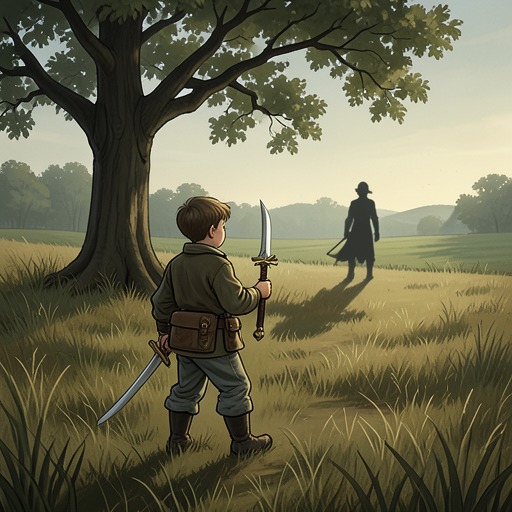
The encounter occurred when Ben was nine and wanted desperately to join the Bloody Pirates, an older boys’ club that required references and an initiation. The boys were going to the Marsten House, and Ben was told to enter and bring something out as booty. The test converted the house’s reputation into a form of adolescent theater, but it also placed Ben alone inside a building whose history had already become the town’s inherited skeleton in the closet.
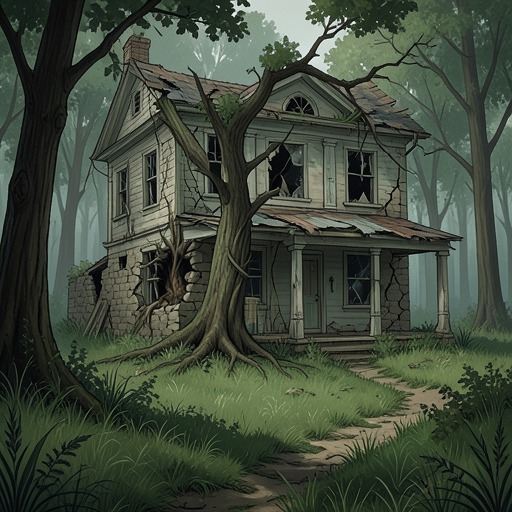
Ben entered through a window. The house remained crowded with abandoned objects even twelve years after Hubert Marsten’s death; wartime newspapers had apparently been removed, while the rest of the contents had been left behind. In the front hall Ben found a glass snow globe containing a miniature house and placed it in his pocket. He could have left then, having fulfilled the literal requirement, but the desire to prove himself drove him farther into the building. He went upstairs toward the room where Hubert had hanged himself, transforming a prank into a deliberate descent toward the source of the town’s horror.
The Vision of Hubert Marsten
The house assaulted Ben through its physical decay before the decisive vision occurred. He remembered mildew, rotting upholstery, a rancid odor like spoiled butter, and the smell of living things nesting in the walls or cellar. As he climbed, the house creaked and settled around him, while unseen animals seemed to scuttle on the other side of the plaster. He repeatedly imagined footsteps behind him and feared turning to find Hubert Marsten shambling after him with a noose in one hand and a blackened face.
At the top of the stairs, Ben gathered his courage and ran toward the room. The closed door seemed to draw nearer as he approached. Its hinges had settled, its lower edge rested against the jamb, and its tarnished knob bore the imagined trace of the palms that had gripped it. When Ben pulled with both hands, the door scraped open with a sound he remembered as a woman’s scream. Hubert Marsten was hanging from the beam, silhouetted against the window light.
The corpse was not black-faced as Ben had expected. He remembered a green face, swollen-shut eyes, and livid, ghastly hands. Then Hubert opened his eyes. The moment is the encounter’s decisive revelation and its enduring problem: Ben presents it as what a child saw, but also distinguishes that perception from what the adult remembers twenty-four years later. The narrative never reduces the sight to a simple ghost story. Ben himself allows that fear and adrenaline may have produced a hallucination, while still entertaining the possibility that the house generated an active manifestation.
Ben screamed loudly enough, he believed, to be heard for two miles. He fled, fell halfway down the stairs, recovered, and ran through the front door and down the road toward the waiting boys. Only after escaping did he notice that he still held the snow globe. He kept it into adulthood, making the object a material remnant of an event that might otherwise be dismissed as a child’s frightened invention.
Trauma, Memory, and the House’s Charge
The encounter did not end when Ben reached safety. He slept with the light on for weeks afterward, and he continued to dream intermittently about opening the door. The dream returned whenever he was under stress, so the remembered room became an internal threshold that could reopen without warning. Ben treats this recurrence as part of ordinary human bad dreams, yet its persistence shows that the house has remained an active structure in his imagination rather than a closed episode of childhood.
As an adult, Ben develops a theory that complicates the distinction between haunting and psychology. He suggests that houses may absorb the emotions spent within them and retain a kind of dry charge. An imaginative child could act as a catalyst, producing a three-dimensional psychic manifestation, perhaps even something alive. This theory gives architectural space a memory-like agency without proving that Hubert’s corpse literally moved. It also explains why Ben’s relationship with the Marsten House is not merely historical: the building has become a reservoir in which the violence associated with it can be reactivated by perception, fear, and attention.
The town reinforces that interpretation through collective memory. The scandal and violence connected with the Marsten House occurred before the births of many residents, yet small towns preserve such horrors ceremonially across generations. Hubert and Birdie Marsten’s history remains the town’s central concealed shame, and later inquiry finds that four children disappeared between 1928 and 1939 while the couple lived there, none ever being found. These records do not prove what Ben saw, but they enlarge the house’s field of menace and make his childhood vision part of a pattern the town has never fully understood.
Historical Darkness and Narrative Significance
The encounter gains force from Jerusalem’s Lot itself, a place whose public normality conceals layered violence. The town was incorporated in 1765 and celebrated its bicentennial with fireworks and a pageant, yet its local identity is also built from old warnings, buried scandals, and inherited stories. Its roads divide a nearly circular settlement into wooded high ground, open river land, farms, and the trailer-filled Bend; the Marsten House stands on the last of the wooded hills, physically elevated above the town and narratively set apart from its ordinary routines.
That contrast matters because the town believes that nothing truly terrible can happen in such a nice little place. Its knowledge of national wars and crises is largely distant and televised, while local catastrophes are treated as exceptions to a reassuring civic order. The Marsten House punctures that confidence. Ben’s private memory reveals that the town’s supposedly sealed past can still look back, and later events show that the house’s history is not exhausted by rumor. Even the town’s ordinary network of gossip and telephone connections becomes an archive of partial knowledge: residents know that Hubert killed Birdie, but not the full circumstances; older women remember charred papers, but not the correspondence and occult history behind them.
As a recalled event, Ben’s childhood entry functions as the emotional prehistory of his adult return. It explains why the Marsten House is not simply a haunted landmark for him, why the sight of its door remains inseparable from stress and fear, and why his later investigations carry the force of personal repetition. The child entered to win acceptance from other boys; the adult returns to a place that has become both psychological wound and possible supernatural beacon. The encounter’s lasting significance lies in that unresolved doubleness: whether Hubert’s eyes truly opened or the house’s accumulated evil found form in a terrified child’s perception, Ben never escapes the room, and the room never entirely releases him.