Ben, Matt, and Susan begin the vampire investigation
'Salem's Lot: A NovelBen Mears, Matt Burke, and Susan Norton begin the vampire investigation when rumor, bodily evidence, and witnessed violence have accumulated beyond the reach of ordinary disbelief. The decisive change is methodological as much as emotional: instead of treating the strange deaths and returns as isolated nightmares, the three agree to proceed as though the vampire threat were real until it can be disproved. Their inquiry therefore becomes the first organized attempt to connect Jerusalem’s Lot’s scattered signs into a single, testable pattern.
From Testimony to a Working Premise
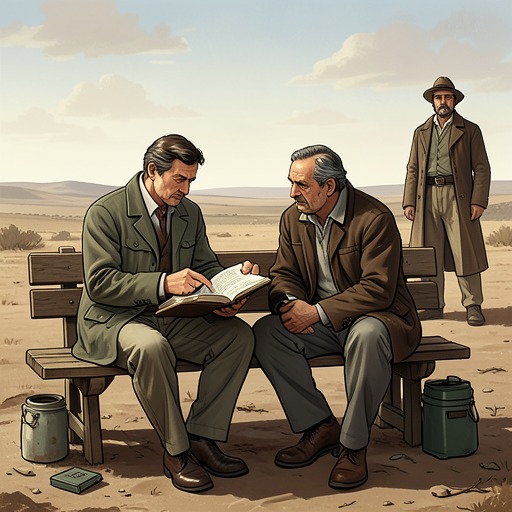
Matt Burke’s decision follows his account of Mike Ryerson’s attack and apparent return. He has not merely heard a story; he has described what he saw, including Mike going backward through the window, and his controlled manner gives the testimony unusual force. When Matt asks what Ben and Susan make of hearsay, the conversation moves from private shock to a shared epistemological problem. Susan has not witnessed the events directly, while Ben has already discussed ways of testing the vampire hypothesis with Matt, so the group must act before certainty is available.
Matt proposes that the three proceed on the premise that everything is real, keeping that premise before them as fact only until it is disproved. He presents this not as surrender to superstition but as an application of the scientific method. The distinction matters: belief is temporarily converted into a working hypothesis, and the investigation is defined by the possibility that evidence might still overturn it. Yet Matt admits that, after a long conversation with himself, he believes what he saw. The value shift is from baffled uncertainty to purposeful danger; the question is no longer whether the impossible can be imagined, but how it can be examined.
Division of Investigative Labor
Ben assigns Matt the role of “Researcher General,” using his background, his knowledge of the town, and his enforced inactivity while recovering to turn him into the group’s archival center. Matt immediately plans to contact Loretta Starcher at the Jerusalem’s Lot Public Library and jokes that she will need a wheelbarrow for the books. The detail gives the investigation a material shape: its first weapons are records, histories, medical accounts, and myths, not merely courage or weapons.
Ben specifies that the research must include everything bearing on the subject, psychological, pathological, and mythic alike. This breadth prevents the inquiry from being trapped inside one explanatory system. The vampire threat may appear in folklore, manifest through the body, and operate through fear or mental influence; the group therefore seeks a complete pattern rather than a single convenient diagnosis. Matt promises to start a notebook and declares that this work is the first time since waking in the hospital that he feels like a man. Research restores him a form of agency that illness and terror had taken away.
Ben and Susan take responsibility for the active investigation. Their immediate plan is to speak with James Cody, who examined both Mike Ryerson and Floyd Tibbits, and to persuade him to exhume Danny Glick. The proposed exhumation would place the suspected first case under medical scrutiny, converting rumor about a dead child into a physical test. Matt recognizes that the Jimmy Cody he once taught was imaginative, open-minded, and resistant to cant, but he cannot know whether medical training has made Cody a narrower empiricist. The uncertainty reveals one of the investigation’s central obstacles: the evidence must pass through institutions whose ordinary categories may reject it.
Tests, Precautions, and Expanding Evidence
The group’s first field test is scheduled for sunset, when Ben and Susan will go to Danny Glick’s grave and watch it. Matt insists that Ben promise to be careful, and Susan answers that they will be protected by crosses. Matt rejects the joking tone and directs them to Father Callahan for holy water and, if possible, a consecrated wafer. The plan thus joins observation to ritual defense: the investigators will watch the grave as witnesses, but they will also enter the encounter equipped with objects whose power depends on religious faith.
The surrounding evidence makes the graveyard test more than an abstract experiment. In Harmony Hill Cemetery, a dark figure has already stood inside the gate, waiting for the turn of time, and has invoked the Lord of Flies while offering spoiled meat and reeking flesh as a sacrifice. At Danny’s grave, Mike Ryerson later pulls himself out of the burial place and opens the coffin. The lid reveals Danny in his communion suit, his eyes open and sparkling with hideous life; the cheeks appear rosy rather than deathly pale. The investigation’s premise is therefore supported by a pattern in which burial does not end the subject’s agency and apparent vitality becomes evidence of something other than life.
The group also learns that the bodies of the dead cannot be treated as stable evidence. When Matt, Ben, and Susan encounter Marjorie Glick’s corpse in Green’s workroom, James Cody notes the absence of surface lividity and rigor, a condition strikingly similar to Mike Ryerson’s. He refuses to commit himself before more time has passed, preserving the language of clinical uncertainty even as the resemblance accumulates. Later, Jimmy prepares makeshift crossed tongue depressors with Red Cross tape and asks Ben to bless them, forcing the writer to act as metaphysician when formal religious resources are not immediately at hand. Medical examination and improvised ritual meet in the same room because neither alone seems sufficient.
The Investigation Becomes a Campaign
As the evidence widens, the inquiry shifts from a private conversation into a campaign against an organized supernatural presence. The report that bodies have been stolen from the Cumberland County Morgue in Portland makes the threat regional rather than local and gives the suspected vampires access to fresh corpses. The group’s concern is no longer limited to Danny Glick, Mike Ryerson, or Floyd Tibbits; the dead themselves have become vulnerable to removal and reuse.
That escalation leads the investigators toward the Marsten House. When Father Callahan approaches it with Ben, Mark Petrie, and Jimmy Cody, his old eagerness returns with unexpected force. The house seems to exude evil through the cracked paint, and Callahan is impelled toward the entrance rather than cautiously reasoning his way there. He commands the evil to depart in the name of God and strikes the door with his crucifix. A flash, the smell of ozone, an explosive collapse of the fanlight and bay window, and a Yale lock welded into an unrecognizable mass transform religious authority into observable physical force. The investigation has reached a stage where the supernatural can no longer be confined to testimony.
The campaign also produces direct evidence of the vampire body. Ben and Jimmy pull Roy McDougall from a crawl space into the weakening daylight. Roy’s body steams and sags, his skin yellows, his eyes move beneath closed lids, and his respiration begins a Cheyne-Stokes rhythm that stops when he retreats into shadow. The scene supplies a controlled contrast between light and darkness: daylight does not simply symbolize danger but causes measurable bodily changes. At the same time, the investigators confront the limits of rescue, since Roy immediately struggles back into concealment.
Consequences and Narrative Significance
The investigation creates a disciplined alliance among people who differ in temperament, training, and faith. Ben supplies initiative and field judgment; Susan accepts the working premise while resisting empty certainty; Matt supplies historical and theoretical research; James Cody offers clinical scrutiny; and Father Callahan supplies religious knowledge and ritual force. Their cooperation does not erase disagreement or fear, but it prevents each fragment of evidence from remaining isolated.
The campaign culminates in direct confrontation with the source of the outbreak. Ben and Mark Petrie stand before the coffin of Kurt Barlow, and its locks and seals split when they touch them. Barlow appears not as a decayed corpse but as a young man with vibrant black hair, wine-ruddy cheeks, and teeth marked by strong yellow streaks. The image completes the investigation’s movement from hearsay to proof: the group has traced anomalous deaths, unnatural returns, stolen bodies, ritual signs, and bodily reactions to a living-looking vampire at the center of the threat. What began as an attempt to test an unlikely premise becomes the organized resistance on which Jerusalem’s Lot’s survival depends.