Bill Norton
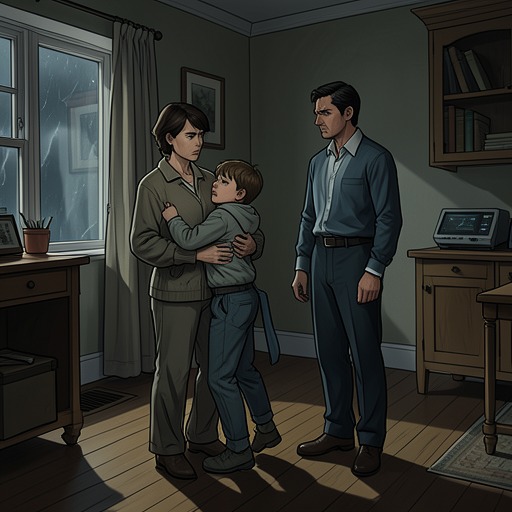
'Salem's Lot: A NovelBill Norton is Susan Norton’s father, Ann Norton’s husband, Jerusalem’s Lot’s first selectman, and a union official on the Portland docks. His decisive significance lies in the way he measures people through practical conduct rather than credentials: although he is a workingman who left high school for the Navy, he is neither anti-intellectual nor hostile to learning. Instead, he distrusts people who seem unserious, and his judgment helps establish Ben Mears as someone who can enter the Norton family’s confidence.
Identity and Background
Bill is described as a big, tough man with black hair, built powerfully but not fat even after the age of fifty. His physical presence is matched by a life shaped through effort. He left high school during the eleventh grade, entering the Navy with his father’s permission, then worked his way upward and obtained his diploma at twenty-four through a high-school equivalency examination. His background gives him no patience for condescension, but it does not make him intellectually narrow. He is specifically distinguished from a blind, bullish anti-intellectual. What he rejects are the “art farts” among Susan’s former school acquaintances: not their hair or clothing, but their apparent lack of seriousness.
Bill’s standards are therefore moral and practical before they are social. He can tolerate unconventional appearance when it is joined to purpose, while dismissing fashionable self-presentation that seems empty. His position on the Portland docks, where he has worked his way into a union role, reinforces this image of earned authority. He is a local institution not because the narrative presents him as polished or formally cultivated, but because he has built a life through labor, persistence, and judgment.
Meeting Ben Mears
When Susan brings Ben home, Bill and Ann Norton receive him as a potential presence in their daughter’s life. Bill is initially attentive to the question of what kind of man Ben is. Ben’s clothing—new blue jeans and a white shirt rolled to the elbows—impresses him, but appearance alone is not enough. Bill’s handshake becomes a physical test: after announcing the hard strength of his own grip, he notices that Ben’s hand does not crimp and collapse like that of the stereotypical “art fart.” Bill is pleased because Ben has passed the first criterion of practical competence.
The second test is equally ordinary and equally revealing. Bill asks whether Ben wants a beer and gestures toward the back patio he built himself. He expects the supposedly artistic young men Susan has known to refuse, imagining them as people too absorbed in drugs or cultivated self-consciousness to share an unpretentious drink. Ben answers that he would gladly have two or three beers, and his response turns Bill’s guarded approval into a grin. The exchange does not erase the generational or familial tension surrounding Susan, but it establishes a language in which Bill can recognize Ben: the language of appetite, labor, humor, and directness.
Family Relations and Social Judgment
Bill’s relationship with Susan is protective without being wholly restrictive. He does not share Ann’s liking for Floyd Tibbits, the hometown boy Susan had dated most consistently since graduation, although he does not actively dislike Floyd. Floyd has a good executive-level job at Falmouth Grant’s and seems moderately serious-minded, while his local identity counts in his favor. Even so, Bill can regard Ben as “a hometown boy” in a broader, more complicated sense, despite Ben’s career as an author and his recent return to Jerusalem’s Lot.
Bill’s growing regard for Ben remains constrained by his role as Susan’s father. Ben senses that a man may like another man, talk freely over beer, and discuss women or politics, yet still hesitate when that man’s presence is connected to his daughter’s sexuality. The potential friendship between Bill and Ben is consequently real but awkwardly suspended. Bill’s evaluation is not merely a private opinion; it is filtered through paternal vigilance, even as Susan’s affection for Ben becomes increasingly clear.
At the Nortons’ dinner on September 25, Bill grills franks outdoors while Ann’s kidney beans simmer in molasses, and the four sit at a picnic table afterward, smoking and talking about Boston’s fading pennant chances. This domestic scene places Bill within the Lot’s ordinary social fabric. His authority is not abstract: it is expressed through food, sport, the patio he built, the work he has done, and the conversations that bind a small town together.
Conduct, Protection, and Narrative Role
Bill’s protectiveness appears in his response to the disappearance of Daniel Francis Glick. When the conversation turns to the missing child and the suspected offender, Bill says that the culprit ought to be hung up by the thumbs. The harshness of the formulation reflects his direct and punitive moral instinct, especially when a vulnerable child has been harmed or placed in danger. It also shows how the community’s fear is translated into familiar language of punishment before the supernatural nature of the crisis is fully understood.
His treatment of Susan’s movements is more measured than Ann’s. When Ann worries about Susan walking back with Ben, Bill tells her that the young people will be fine and says that she worries too much. He does not deny the risks of the world, but he resists excessive supervision and allows Susan a degree of adult independence. His stance places him between paternal authority and trust: he remains watchful, yet he does not treat his daughter as incapable of judgment.
Bill’s final recorded exchange with Ben deepens their tentative bond. He invites Ben to come over with a six-pack the following night so they can make fun of Yastrzemski. Ben accepts the spirit of the invitation while joking about what they would do after the second inning, and his hearty laughter follows him and Susan around the house. The scene gives Bill a modest but important narrative function. Before the Lot’s darkness overwhelms its domestic world, he represents the sturdy, humorous, socially rooted life that Ben is beginning to enter. His tests of Ben are comic on the surface, but they also define the values the threatened community stands to lose: seriousness without pretension, affection expressed through teasing, and trust earned by conduct rather than reputation.