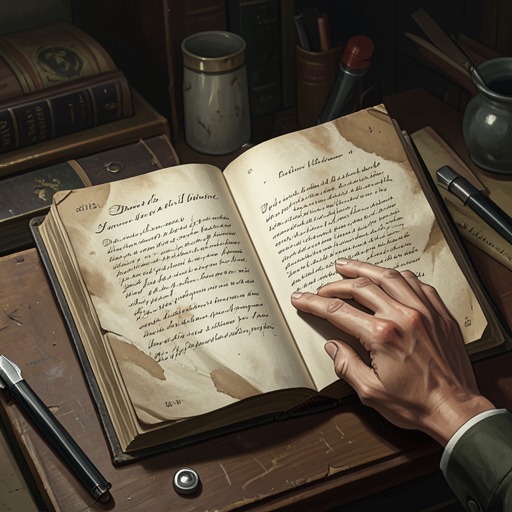
Book of the Worm
'Salem's Lot: A NovelBook of the Worm is an occult book associated with the ancient evil beneath Jerusalem’s Lot and Chapelwaite. Its importance lies not simply in what it contains, but in its persistence: Charles Boone burns one copy, yet concludes that other copies exist and that the force connected with the book remains alive. The object therefore turns forbidden knowledge into an active, recurring threat rather than a danger that can be ended by destroying a single artifact.
Identity and Occult Function
Book of the Worm belongs to the hidden history surrounding Chapelwaite and the Boone bloodline. In Charles Boone’s account, the book is connected with James Boon, identified as the “Keeper of the Worm,” whose rotted, animated likeness appears after Charles encounters the supernatural presence beneath the house. The title transforms the family archive from a record of the past into evidence of an enduring relationship with the Worm and the darkness beneath Jerusalem’s Lot.
The book also belongs to a larger pattern of dangerous texts and explanations in the novel. The story’s horror repeatedly presses against ordinary systems of knowledge: medical examination finds bodies without expected signs of death, the Cumberland County Morgue loses corpses, and observers struggle to interpret physical evidence that does not fit familiar categories. Against that background, Book of the Worm represents a more direct but more perilous form of knowledge. It offers access to the hidden order behind the disturbances, but possession of that knowledge also places its reader within the chain of contamination.
Connection to James Boon and the Boone Bloodline
Charles’s final revelation gives the book a genealogical and supernatural significance. After seeing the dead-yet-animated figure, he recognizes the family resemblance not as a likeness to Philip or Robert, whose portraits hang in the upstairs gallery, but as the face of James Boon. James is remembered as the Keeper of the Worm, making the book a tangible sign of an inherited office or burden rather than an isolated curiosity.
Charles then identifies himself as both “the gateway” and the last of the Boone blood. His conclusion is that his death is necessary to break the chain. The book thus mediates between family history and cosmic menace: it preserves the name of the earlier keeper, reveals the continuing reach of the Worm, and helps Charles understand that his own existence has become part of the mechanism through which the force may return.
Destruction and Persistence
The book is burned in an attempt to stop the evil attached to it. Charles states that destroying it thwarted the force, but he immediately qualifies that victory by acknowledging that other copies exist. Burning the known volume therefore produces interruption rather than eradication. The threat is delayed, not eliminated, because the book’s contents and power are reproducible.
This persistence gives the object a distinctive material logic. Unlike a single monster whose body can be destroyed, the book can survive through duplication and transmission. Its physical destruction matters, yet it cannot guarantee the destruction of the knowledge or entity associated with it. The novel consequently makes the book both artifact and network: one copy can be consumed by fire while the danger remains elsewhere, waiting for another material form.
Narrative Significance and Ending
Book of the Worm is most fully explained at the end of Charles Boone’s written account, where the revelation arrives alongside the discovery that the supernatural presence still lives in the lightless passages beneath Jerusalem’s Lot and Chapelwaite. The book’s destruction has prevented an immediate continuation of the evil, but Charles insists that the entity itself remains. His recognition of himself as the gateway leads directly to his decision that he must die.
The object therefore governs the ending without appearing as a simple talisman or weapon. It organizes the final movement from investigation to sacrifice: Charles learns what the book has connected, understands that the threat has not been permanently extinguished, and chooses self-destruction as the only means left to break the inherited chain. Book of the Worm embodies the novel’s recurrent fear that evil can survive damaged houses, dead bodies, burned pages, and vanished generations. Its deepest power is not that it preserves a secret, but that the secret can continue after the object believed to contain it has been destroyed.