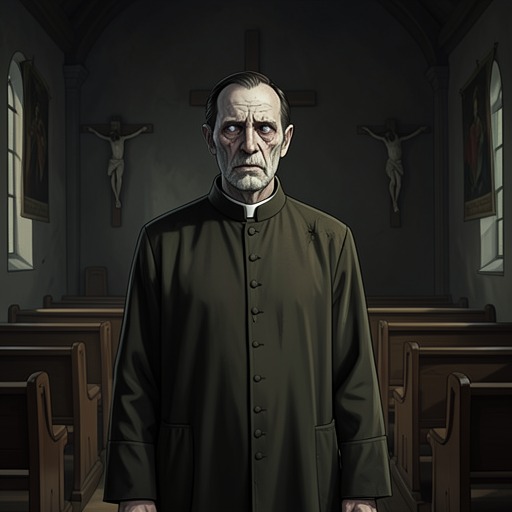
Crisis of faith
'Salem's Lot: A NovelCrisis of faith is the spiritual crisis of Father Donald Callahan, whose confrontation with Kurt Barlow turns religious conviction from an assumed defense into a painfully uncertain act. The crisis does not mean that Callahan simply stops believing. It is a fracture between doctrine and lived spiritual power: he knows what the cross should signify, remembers the force that once moved through it, and still finds himself unable to summon that force when terror and self-doubt have hollowed out his prayer. Its decisive consequence is paradoxical. Callahan’s faith appears to fail, but some portion of it returns at the moment when he must choose whether to surrender his soul to the Undead or resist through self-destruction.
The Challenge to Callahan’s Faith
Kurt Barlow attacks Callahan intellectually as well as physically. Speaking through a disembodied voice, Barlow presents himself as an ancient adversary of the Catholic Church, older than the institution whose antiquity its members venerate. He insists that he has studied Callahan as a chess player studies an opponent, and distinguishes him from the other people around him: Callahan is the only opponent Barlow fears because he is joined to the Church and possesses what Barlow calls courage, thought, coolness, and white magic. The admission of fear makes the exchange more dangerous, not less, because Barlow uses it to imply that Callahan’s apparent spiritual advantage is already unstable.
Callahan privately acknowledges that he knows fear with an intensity unlike anything he has experienced before. Barlow turns that admission into a weapon, arguing that fear is wisdom in an opponent but also proof that Callahan is vulnerable. The vampire’s confidence rests on age and cunning: he claims to have lived longer, to be crafty, and to be not merely a serpent but the father of serpents. Against such an enemy, Callahan cannot rely on moral superiority as an automatic fact. The confrontation therefore shifts the question from whether evil exists to whether Callahan can still embody the goodness he has preached.
Love, Goodness, and Spiritual Exhaustion
Barlow’s central attack concerns the meaning of faith itself. He declares that Callahan’s faith is weak, soft, and rotten, and that it can no longer defend the world against evil. More cruelly, he identifies Callahan as the acolyte and preserver of a flame who doubts the worth of the flame he guards. Barlow dismisses love, the supposed talisman of White, as words, physical intimacy, and presumption, then treats its apparent failure as evidence that evil has already won the argument.
The vampire sets goodness and evil against different temporal demands. Goodness requires an act of faith; evil requires only waiting. That contrast makes the crisis structural rather than merely emotional. Callahan is not being asked simply to feel courageous. He must act without the certainty that action will be answered, while evil can remain passive, pervasive, and patient. Barlow’s image of the chessboard intensifies the threat: the coming move will be check against the king, with black winning everything. The language is theatrical and possibly counterfeit, but its effect is real because Callahan cannot determine whether the voice’s triumph is genuine or a performance designed to make him surrender before the final attack.
The Cross and the Loss of Certainty
The crisis becomes tangible through Callahan’s cross. At first it has carried extraordinary power, a force that seemed capable of smashing walls and shattering stones. Then its light abruptly disappears. In his hand it becomes only a piece of plaster bought by his mother in a Dublin souvenir shop, while his muscles remember the earlier thrum without being able to reproduce it. The object has not changed materially; what has changed is Callahan’s access to the faith that made it more than material.
Callahan begs God to save him, insisting inwardly that the plea is not for himself but for others. Yet he recognizes no intensity in the prayer and no sensation that the words are traveling beyond the cage of his skull. This is the most intimate form of spiritual abandonment in the episode: prayer survives as language, but the felt connection that once made prayer an act of transmission has vanished. Barlow’s physical concealment compounds the crisis. Moving silently and shifting position in the darkness, he turns the encounter into a cat-and-mouse game in which Callahan cannot even locate the enemy precisely, much less confront him with settled confidence.
When Callahan drops the cross, Barlow explains the doctrine that Callahan already knows: the cross, the flag, the bread and wine, and other sacred or communal objects are only symbols without faith. Without faith, the cross is merely wood, the flag merely cloth, the bread merely baked wheat, and the wine merely sour grapes. Barlow even suggests that Callahan would have defeated him another night had he not previously lost hold of that doctrine. The vampire’s recognition of the rule makes the failure more humiliating, because Callahan is defeated not by ignorance of his Church’s teaching but by his inability to inhabit it.
The Final Denial of the Undead
The crisis reaches its extreme when Callahan’s ordinary means of resistance have failed and Barlow threatens to claim him. Callahan finds a knife on the table, the same household object used to cut sandwiches, and plunges it into his own chest rather than allow the vampire to come near. The act is immediate and instinctive, not presented as a carefully reasoned theological solution. Its force comes from the fact that Callahan chooses an irreversible bodily denial when his spiritual defenses appear unusable.
As his thoughts ebb, Callahan realizes that some of his faith has returned. That recognition changes the meaning of the act. He may have cheated himself of a victory that could have been won through renewed belief, but he has also made a final effort to save his soul from the Undead. The realization itself becomes the most serious denial of faith: he recognizes both the return of belief and the possibility that fear and doubt prevented him from relying on it. He dies without recovering simple certainty, closing his eyes and yielding to whatever gods may exist rather than accepting Barlow’s spiritual ownership.
Narrative Meaning and Later Reframing
Callahan’s crisis embodies the novel’s reversal of the optimistic vampire story associated with Dracula. The modern world of electric light, technological invention, and rational disbelief does not automatically dispel ancient evil; instead, those conditions can help the vampire by making belief in him nearly impossible. Even Father Callahan, a man of God, cannot fully believe in Kurt Barlow when evidence stands before him. His crisis therefore links personal spiritual weakness to a broader cultural condition in which modern habits of thought have made supernatural evil harder to recognize and resist.
The episode also complicates any simple division between victory and defeat. Barlow appears to win the contest, silencing Callahan’s faith and driving him toward death. Yet Callahan’s final act prevents the vampire from receiving the complete triumph he seeks. The cross’s failure is real, prayer’s emptiness is real, and doubt is not erased; nevertheless, the recovered fragment of faith produces resistance at the threshold of damnation. Crisis of faith is consequently not a neat restoration of belief but a damaged, costly form of spiritual agency: faith becomes meaningful precisely because it must be chosen after certainty has disappeared.