Danny Glick and Ralphie Glick
'Salem's Lot: A NovelDanny Glick and Ralphie Glick are brothers whose relationship carries the story from ordinary childhood rivalry into the first unmistakable rupture caused by the vampire menace. Their trip to visit Mark Petrie is initially a domestic obligation and a childish adventure, but the disappearance of one brother and the altered condition of the other make their bond the first human relationship through which the town’s hidden darkness becomes visible.
Family Structure and Everyday Bond
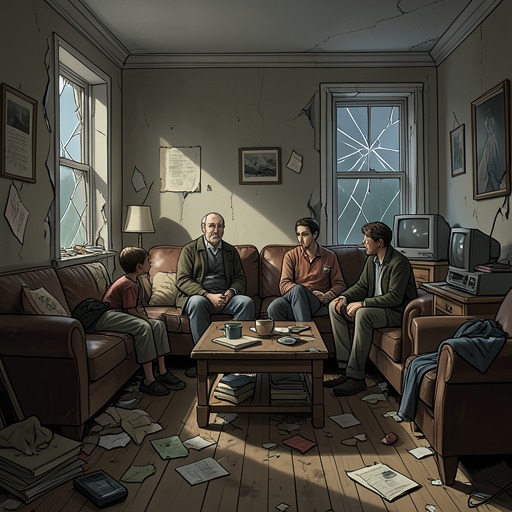
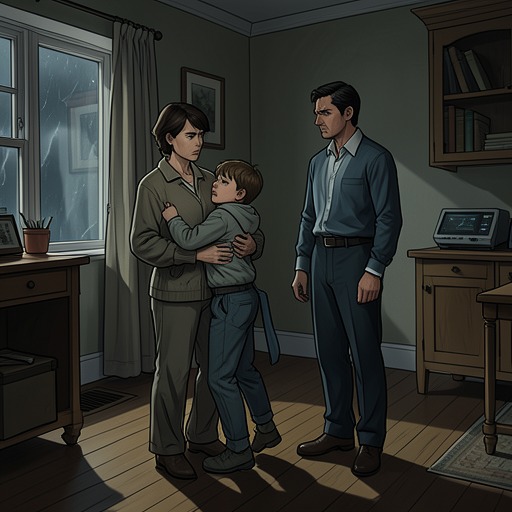
Danny is the elder brother, while Ralphie is the younger child whose mother, Marjorie Glick, places Danny in charge of taking him out and getting him home before bedtime. At 7:30 PM, Marjorie reminds Danny that school is the next day and insists that Ralphie be in bed by a quarter past nine. Danny objects to the responsibility, but her pleasantly threatening reply makes clear that accompanying Ralphie is not optional. The exchange establishes a familiar family hierarchy: Danny is old enough to resent supervision, while Ralphie is young enough to require it.
Their father, Tony Glick, is less attentive to the details of the outing. Sitting before the television and watching the Red Sox and the Yankees, he asks where the boys are going. Danny explains that they are visiting Mark Petrie, while Ralphie adds that they are going to see Mark’s electric trains. Danny’s pause and emphasis reveal that Ralphie knows there is another reason for the trip and is prepared to expose it. The brothers therefore share not only affection and obligation but also the private knowledge and petty leverage characteristic of children living closely together.
Teasing, Blackmail, and Unequal Courage
Ralphie’s knowledge concerns Mark Petrie’s collection of Aurora plastic monsters, including the wolfman, mummy, Dracula, Frankenstein, the mad doctor, and the Chamber of Horrors. Danny had made the mistake of telling him about the collection, and Ralphie immediately turns the information into blackmail. Danny calls him a creep and later tells him that he is “putrid,” while Ralphie answers with an equally dismissive “Get bent.” Their insults are not signs of estrangement; they are the language of a relationship secure enough to withstand mockery and competitive enough to turn shared secrets into weapons.
The brothers travel by a beaten path from the Glick house on Brock Street toward Mark Petrie’s home on South Jointner Avenue. The shortcut crosses Crockett Brook by stepping-stones and saves considerable time for children willing to make the crossing. Their movement through the woods retains the texture of a familiar youthful escapade: pine needles and twigs crackle underfoot, the brook moves over gravel, and a whippoorwill calls among the trees. Yet Danny also uses his greater age to stage fear. He tells Ralphie about Jerry Kingfield, a child who disappeared in the Marshes six years earlier, and solemnly claims that the boy’s ghost still haunts the woods, while withholding that the Marshes lie three miles south. Ralphie is genuinely frightened, and Danny’s teasing reveals both his authority over his younger brother and the irresponsibility that accompanies it.
The power balance shifts as darkness gathers. Danny tries to appear rational, insisting that there is no ghost and urging Ralphie onward, but he privately counts the steps to Jointner Avenue and promises himself that they will use the road on the return trip so Ralphie will not be afraid. When Ralphie cries that he sees the ghost, Danny experiences terror himself. He tells Ralphie to run, but Ralphie is paralyzed and grips Danny’s hand tightly. The scene turns their earlier antagonism into dependence: the younger brother needs the elder to interpret danger, while the elder is forced to act despite sharing the fear he had helped create.
The Disappearance in the Woods
The brothers’ disappearance begins when they fail to return by ten past nine. Marjorie calls the Petrie house, only to learn that neither boy has arrived. Tony Glick and Henry Petrie discuss the woods path and the shallow condition of Crockett Brook, then arrange to search from opposite ends. Tony intends to punish the boys when he finds them, a parental response that momentarily frames the incident as misbehavior rather than catastrophe.
Danny emerges first, stumbling from the trees and collapsing beside the backyard barbecue. He is dazed, slow to answer, and not always sensible; grass clings to his cuffs and autumn leaves are caught in his hair. He can recount the beginning of the journey with considerable clarity. He remembers crossing Crockett Brook, Ralphie’s talk about a ghost, and his own growing fear. He remembers that the brothers were holding hands and that Ralphie was whimpering while Danny promised that the streetlights were only two hundred steps away.
The crucial moment has vanished from Danny’s memory. He cannot explain what happened, does not remember falling, and can only say that everything became very dark before he found himself lying alone on the path. Ralphie was gone. Danny’s inability to narrate the central event turns the sibling relationship into an evidentiary gap: the surviving brother is the only witness, but trauma has erased precisely the knowledge that could explain the loss. The story consequently makes the brothers’ shared experience both intimate and inaccessible.
The town responds with an increasingly extensive search. Parkins Gillespie, Nolly Gardener, Tony Glick, and Henry Petrie search the path and the shoulders of South Jointner and Brock streets, calling through battery-powered bullhorns. The following morning, the Cumberland and state police coordinate a search of the wood lot. For four days, searchers beat the bushes while Mr and Mrs Glick move through fields and around deadfalls left by the ancient fire, calling Ralphie’s name. When the woods yield nothing, Taggart Stream and the Royal River are dragged as well. Ralphie’s disappearance thus expands from a family emergency into a collective crisis, while Danny’s survival offers no relief because it provides neither an explanation nor a recovered brother.
Trauma and the Supernatural Turning Point
On the fifth morning, at 4:00 AM, Marjorie finds Danny collapsed in the upstairs hallway on his way to the bathroom. An ambulance carries him to Central Maine General Hospital, where the preliminary diagnosis is severe and delayed emotional shock. The delay matters: Danny does not collapse at the instant of the disappearance but only after the search has continued and the immediate crisis has been displaced into waiting, uncertainty, and failed reconstruction.
Danny’s brotherly responsibility therefore becomes inseparable from guilt and helplessness, although the narrative does not give him a complete conscious account of either. He had teased Ralphie, frightened him with a ghost story, and then been unable to protect or even remember what happened to him. His fragmented testimony preserves the emotional fact of separation while concealing its cause. The brothers’ relationship is consequently not merely background for the plot; it is the mechanism by which the supernatural enters the social world of Jerusalem’s Lot as a question about a missing child.
The later encounter with Danny makes the earlier disappearance retrospectively more terrible. Mark Petrie sees Danny staring through his bedroom window with grave-pale skin, reddish feral eyes, dark matter smeared around his lips and chin, and teeth that have become unnaturally long and sharp. Danny asks to be let in, and Mark understands that the child who vanished from the woods has returned in a predatory form. The image converts the lost younger brother into a threat to another child, linking Ralphie’s disappearance, Danny’s transformation, and Mark’s first direct confrontation with the vampire danger.
Narrative Significance
Danny and Ralphie’s sibling relationship is built from ordinary contrasts: elder and younger, guardian and burden, teaser and frightened child, keeper of secrets and threatened informant. The woods journey intensifies each contrast until the brothers’ handclasp replaces their earlier insults as the dominant image. What begins as Danny’s reluctant supervision becomes a failed act of protection, and what appears to be Ralphie’s childish fear becomes the threshold of an actual supernatural encounter.
Their relationship also gives the opening crisis its human scale. The disappearance is not presented first as an abstract outbreak but as a mother’s bedtime instruction, a father distracted by baseball, two boys arguing over electric trains and toy monsters, and a shortcut taken across Crockett Brook. The later police search, river dragging, hospitalization, and vampire manifestation all grow from that modest family scene. In this structure, the Glick brothers embody the story’s movement from the recognizable rules of childhood into a world where the missing may return, memory may fail, and familial intimacy can become the route by which evil reaches the living.