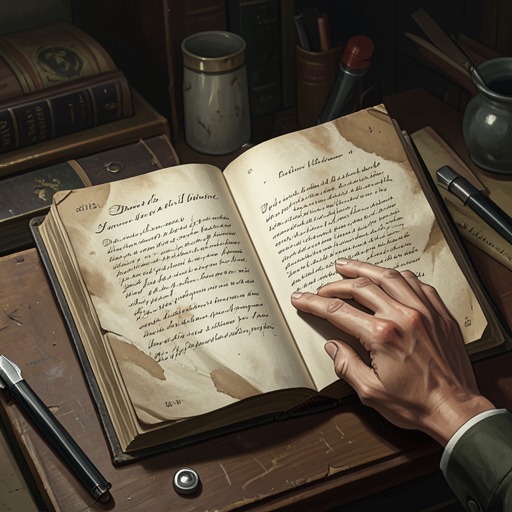
De Vermis Mysteriis
'Salem's Lot: A NovelDe Vermis Mysteriis is the forbidden book whose presence binds the history of Jerusalem’s Lot to religious fanaticism, family bloodline, occult ambition, and the subterranean Worm. Known in translation as “The Mysteries of the Worm,” it first appears as an object of inquiry in Robert Boone’s encoded diary and later as a physical volume discovered in the desecrated church. The book is not merely evidence of an earlier crime: its pages become the instrument and apparent focus of a supernatural eruption, and its destruction leaves Charles Boone and Calvin McCann psychologically shattered while reducing the volume itself to ashes.
Appearance and Names
The book is presented as a huge volume lying open on the pulpit of the corrupt church. It is written in Latin and in “crabbed runes” that Charles Boone cannot confidently identify, seeming to him either Druidic or pre-Celtic. The leather bears the Latin title De Vermis Mysteriis, which Charles translates as “The Mysteries of the Worm.” The coexistence of Latin and older-looking script gives the object a deliberately layered identity: it belongs at once to learned religious culture, archaic ritual, and a knowledge that respectable religious language cannot contain.
The title also establishes the book’s connection with the Worm as something more than a casual literary reference. The volume is treated as a “hell-book,” a profane Bible written in old tongues, and a repository of unholy incantation. Its meaning is therefore disclosed through several competing descriptions—Latin title, family testimony, diary record, and direct supernatural experience—before the final scene makes its physical danger unmistakable.
Family History and Jerusalem’s Lot
The book’s history is reconstructed through Robert Boone’s diary, which Calvin McCann deciphers and Charles Boone reads. The diary begins on June 1, 1789, and ends on October 27, 1789, four days before the catastrophic disappearance associated with Jerusalem’s Lot. Its entries reveal that the book is part of a deepening obsession involving Robert’s brother Philip Boone, the town, and the church where the volume eventually rests.
Robert’s account places Jerusalem’s Lot within a deliberately sinister genealogy. The settlement predates Chapelwaite, built in 1782, and Preacher’s Corners, founded in 1741; it was established in 1710 by a splinter group of the Puritan faith led by James Boon. The community grew around the church where Boon preached—or held court—and was marked by religious fanaticism, regular exorcism rites, incest, interbreeding, insanity, and physical defects. Robert’s account suggests that familial bloodline is crucial to the town’s history, making the book part of an inherited structure of corruption rather than an isolated curiosity.
Philip’s involvement begins when he becomes fascinated with James Boon. Robert records that Philip was baptized into Boon’s church on September 1, 1789, and that he seemed to change physically and spiritually, even beginning to resemble the “wretched Man.” The first diary reference to the book occurs on July 23, when Philip returns from the smaller village and reports that Boon has asked about a book titled Mysteries of the Worm. Robert agrees to write to Johns & Goodfellow in Boston, despite his unease, and later learns that only five copies are known to exist in the country.
Acquisition and Corruption
The volume arrives on September 16 through Goodfellow, who sends it with a warning that he wants no further business with Robert. Philip reacts with unnatural excitement, nearly snatching the book away. Robert notes its bastard Latin and Runic script, but also records that the object seems warm and appears to vibrate in his hands as if it contains enormous power. Philip has promised to recant his baptism, yet the book causes him to abandon that promise; he laughs in a crazed fashion and repeatedly cries, “We have it! We have it! The Worm! The Secret of the Worm!” before fleeing, presumably toward his mad benefactor.
Robert concludes that the book caused the quarrel between the brothers and may contain Druidic or other forbidden blood rituals preserved in written form. He believes that Boon and Philip intended to use it for their own purposes and may already have bound themselves to faceless powers beyond the limits of the universe and even beyond time. The book consequently functions as both material possession and moral test: Philip’s desire to possess it marks the point at which religious conversion becomes submission to a darker authority.
Discovery in the Desecrated Church
Decades later, Charles Boone finds the volume on the pulpit of the corrupt church in Jerusalem’s Lot while investigating the history connected with Calvin McCann. When Charles touches it, the church seems to swim before him, chanting voices appear to rise around him, and a real turning motion shakes the building beneath his feet. The pulpit and the desecrated cross tremble, linking the book’s presence to the architecture itself and suggesting that the church has become a sealed chamber for the history it contains.
The discovery also completes the chain of recognition begun in Robert’s diary. Charles hears from Mrs Cloris that Philip Boone was a man who trafficked with the unholy and that the object Robert tried to remove was a profane Bible. When Charles names De Vermis Mysteriis, she recoils because he has seen and touched it in the desecrated church. The book therefore confirms that the family testimony, the diary, and the haunted site refer to one continuing threat.
Destruction and Aftermath
Charles resolves to destroy the book, declaring that this is what should have been done sixty years earlier. He and Calvin roll a lamb’s corpse away from the volume, whose blood-stained pages seem to possess their own scarlet glow. As they approach the act of destruction, the church responds as if protecting the book: the walls chant, the floor trembles, space and time appear to twist, and Charles sees visions of James Boon conducting a grotesque rite while Philip stands behind him as an acolyte with a knife and bowl.
The supernatural resistance becomes physically catastrophic. Calvin screams as the pulpit rends and rises, revealing a huge black maw beneath it. Charles strikes a sulphur match and touches the flame to the book just as the pulpit explodes upward. A gray, vibrating mass surges from the opening, first appearing as an enormous outpouring of viscid, pustulant flesh and then becoming recognizable as one ring or segment of an eyeless monster worm that has existed in the darkness beneath the church for years.
The burning book appears to injure or provoke the creature. It flares in Charles’s hands while the Thing seems to scream, and the monster finally subsides, leaving a shattered hole, black slime, and a fading sound. Charles looks down and finds that De Vermis Mysteriis has become ashes. The immediate consequence is therefore double-edged: the physical volume is destroyed, but the encounter does not restore order. Charles loses his sanity, bleeding from the temple and screaming in the shadows, while Calvin lies across the church staring at him with horror-struck eyes.
The book’s ending settles the narrative’s earlier uncertainty in favor of the supernatural. At first, the volume could be treated as a historical artifact, a corrupted religious text, or the focus of family madness. Its vibration, the church’s convulsions, the opening beneath the pulpit, and the emergence of the Worm make natural explanation impossible within the scene. Yet the ashes do not erase the history attached to the object: De Vermis Mysteriis remains the material record of Jerusalem’s Lot’s occult past and the trigger through which that buried past breaks into the present.