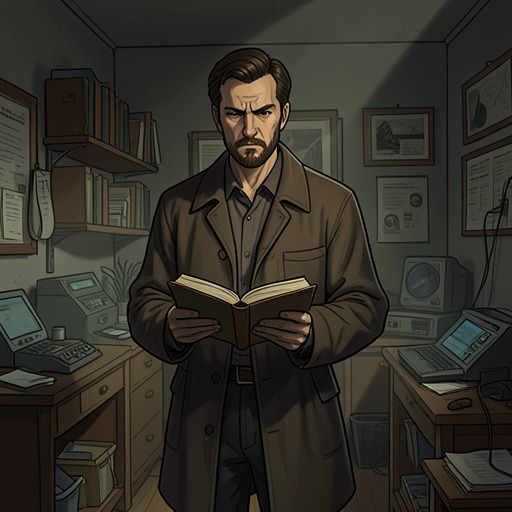
Don’t look in his eyes
'Salem's Lot: A Novel“Don’t look in his eyes” is the central survival instruction Matt Burke gives the vampire hunters before they confront Kurt Barlow and Susan Norton. The warning turns a simple precaution into a rule governing the entire attack: Barlow’s gaze is not merely frightening but an active means of capture, capable of converting an opponent into an instrument against the remaining group.
Meaning and Immediate Context
Matt Burke states the command while assigning the party’s roles and reviewing the dangers of the assault. He stresses that Barlow can “catch you and turn you against the others, even at the expense of your own life.” The danger therefore lies not only in personal death. A person who meets Barlow’s eyes may lose allegiance, agency, and judgment, becoming a weapon directed at friends who are relying on mutual discipline.
The warning is addressed to the entire group rather than to a single designated fighter. That breadth matters because every participant is vulnerable to the same mechanism, regardless of courage or purpose. Matt specifically connects the danger to Floyd Tibbits, whose fate serves as a remembered example of what Barlow’s influence can do. The recollection converts an abstract supernatural rule into operational knowledge acquired through loss.
Rule of Conduct During the Assault
The injunction determines how the group must handle weapons and inspections. Matt explains that carrying a gun is dangerous even when a firearm is necessary, because Barlow’s gaze could compromise the person holding it. Jimmy Cody is therefore told to carry the gun while hanging back, and to pass it to Mark Petrie if either Barlow or Susan Norton must be examined. Physical distance, delegated handling, and restricted eye contact become parts of the same defensive protocol.
Matt repeats the command after giving these instructions, making repetition itself a form of protection. His second insistence comes alongside practical preparations to buy garlic and roses. Each member is to wear a white rose in the hair or around the neck, while the group also relies on prayer and other religious defenses. The phrase thus stands between material preparation and spiritual resistance: it is a behavioral discipline that helps the hunters preserve their freedom before supernatural force can override it.
Power, Choice, and the Face of the Enemy
The expression reverses the ordinary assumption that seeing an enemy clearly is useful. In this confrontation, the eye is an opening through which the enemy can enter the self. Looking becomes an act with immediate consequences, while refusal to look is not cowardice but an intentional preservation of responsibility toward the others. The hunters must fight without surrendering the perceptual channel through which Barlow exercises control.
The command also gives the scene a stark ethical structure. Barlow’s power isolates individuals from the group by turning recognition into submission; Matt’s warning restores the group as a network of obligations. The instruction to avoid the eyes is therefore both tactical and communal. It asks each person to restrain a natural impulse—to meet the threat directly—in order to remain answerable to the people beside them.
Repetition and Narrative Function
As a repeated imperative, “Don’t look in his eyes” condenses the larger conflict between Barlow’s domination and the hunters’ deliberate resistance. Matt’s glance sweeps across the party before he repeats the warning, visually binding the members together while directing them away from the gaze that would bind them to Barlow. The line is memorable because it names the danger in the simplest possible terms and attaches survival to obedience rather than bravado.
Its force is heightened by the surrounding uncertainty. Matt admits that he could offer many more instructions, yet the hour is already late and the group must leave. The warning consequently functions as the indispensable remainder of a larger body of knowledge: among all the precautions that might be given, preserving the will against Barlow’s eyes is the condition that allows the others to matter. If that condition fails, weapons, roses, garlic, prayer, and solidarity may all be turned against the people they were meant to protect.