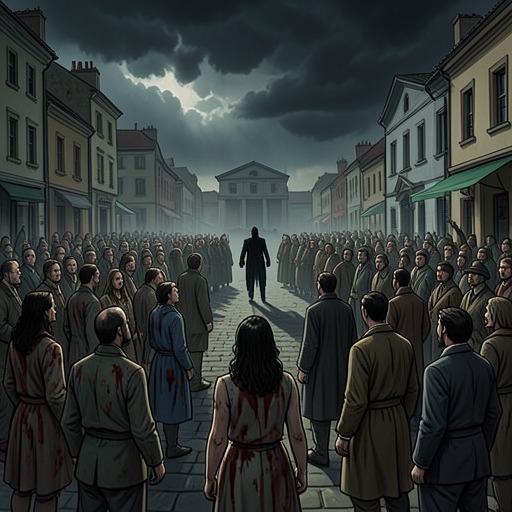
Dud Rogers Encounters Barlow
'Salem's Lot: A NovelDud Rogers Encounters Barlow is the scene in which Dud Rogers, the isolated custodian of the Jerusalem’s Lot dump, meets Kurt Barlow without yet possessing the knowledge or defenses needed to recognize him as a vampire. The encounter turns the town dump into a threshold between ordinary civic life and supernatural occupation: amid fire, ash, exploding refuse, and an abnormal infestation of rats, Barlow approaches as a polished stranger, speaks with controlled politeness, and uses Dud’s private appetites to make submission feel like fulfillment.
Setting and Immediate Circumstances
The meeting takes place at the Jerusalem’s Lot Town Dump, a former gravel pit at the end of a spur off Burns Road, two miles beyond Harmony Hill Cemetery. The pit had struck clay in 1945, and Dud Rogers had served as its custodian since 1956, living permanently in a neat tarpaper lean-to marked “Dump Custodian.” His annual reappointment was routine, and the job placed him at the physical and social edge of the town. On this morning, the dump is still smoldering after Dud has set it alight. Powdery ash rises underfoot, bottles break beneath his steps, aerosol cans and lightbulbs explode in the coals, and the fire’s broad bed resembles a giant eye opening and closing.
The fire also drives an unusually large number of rats from hiding. Dud has shot fully three dozen, enough to heat his pistol, and notices that some rats measure two feet from nose to tail. Their fluctuating numbers appear to him as a matter of weather, but the scene makes the infestation feel less like a routine nuisance than a warning. The dump, already a repository for the town’s discarded material, becomes a landscape of combustion and unchecked animal life just as the town’s concealed danger begins to surface.
The Stranger at the Fire
While throwing a rat into the dump, Dud sees a tall, extremely thin silhouette about fifty paces away. He wipes his hands on his green pants, walks over, and tells the stranger that the dump is closed. The man answers with perfect speech and a faint accent, saying that he is a recent resident of the town and has come to watch the fire because it is beautiful. Dud suspects that he may be the person who bought the Marsten House, and the stranger’s formal clothing—suit and vest—makes him conspicuous in a place inhabited by ash, refuse, and gun smoke.
Barlow’s conversation immediately joins the fire to the language of predation. Asked whether he shoots many rats, he calls rats, owls, and wolves “predators of the night” and asks whether wolves live in the area. His interest is presented as cultivated and almost philosophical, but it also identifies him with the animals he admires. Dud sees a well-dressed visitor; the reader sees a predator studying another predator’s habitat. The contrast between Barlow’s manners and his subject matter makes his civility threatening rather than reassuring.
Hypnosis and Seduction
Dud attempts to end the conversation, but Barlow turns his full face toward him and looks into his eyes. The gaze becomes physically compelling: Dud cannot look away, and the eyes seem to expand into dark pits ringed with fire. His voice grows distant, and the conversation shifts from the dump’s rats to the hump on his back, exposing Barlow’s ability to enter the humiliations Dud carries about himself.
Barlow then reaches the more decisive vulnerability. Dud’s thoughts have already centered on Ruthie Crockett, and Barlow identifies the desire directly, insisting that Dud wants her. When Dud agrees, Barlow promises, “You shall have her. I am sure of it.” The promise does not function as ordinary persuasion. It enters Dud’s mind through the hypnotic gaze, blending distant singing, erotic images, and the sensation of drowning. The encounter’s violence therefore begins before the bite: Barlow rearranges Dud’s perception so that fear, desire, and surrender become indistinguishable.
The final approach is described as a revelation rather than a struggle. As Barlow comes closer, Dud understands everything and welcomes it; when pain arrives, he experiences it as sweet. The transformation of anticipated terror into pleasure marks the scene’s central reversal. Dud is not defeated through a contest of strength. He is made to accept destruction as the answer to his loneliness, shame, and desire, and the vampire’s power lies precisely in converting inward weakness into outward consent.
Consequences and Narrative Function
Dud’s death at the dump is one of the first concrete manifestations of Barlow’s occupation of Jerusalem’s Lot. Barlow has recently become a resident and is associated with the reoccupation of the Marsten House, while Dud is a long-serving municipal functionary whose life has been narrowed to the dump and its refuse. Their meeting brings the new supernatural power into contact with the town’s neglected margins. The vampire does not begin by attacking a protected household or confronting an organized enemy; he finds a solitary man in a place where discarded objects, rats, and smoldering waste already make abandonment visible.
The scene also establishes Barlow’s methods. He observes before striking, adopts impeccable manners, asks apparently casual questions, and uses the victim’s own desire as an instrument. His fascination with nocturnal predators foreshadows the broader vampire epidemic, while the hypnotic eyes anticipate the warning that one must not look into a vampire’s eyes. Dud’s inability to turn away dramatizes the danger before the town has a name for it.
In the novel’s larger pattern, the dump’s fire belongs to the same damaged landscape as the polluted regional river system, the power pylons that cut a wide gash through the timberland near the Marsten House, and the remembered 1951 fire. The human community treats these conditions as ordinary infrastructure, local history, or routine maintenance; Barlow’s arrival reveals how easily such neglected spaces can become staging grounds for predation. The encounter thus joins environmental residue, social isolation, and supernatural violence without claiming that any one of them alone causes the other.
Significance of the Encounter
Dud Rogers Encounters Barlow is a temptation plot compressed into a death scene. The agent is Barlow, the victim is Dud, and the immediate objective is not merely blood but access: Barlow must overcome the victim’s capacity to refuse. He does so by making the promise of Ruthie Crockett more persuasive than Dud’s instinct for self-preservation. The result is an encounter in which the vampire’s supernatural force appears through psychological precision rather than spectacle.
The scene also embodies the novel’s darker answer to the technological optimism associated with Dracula. The modern world’s systems—roads, electricity, municipal government, and the dump itself—do not protect Dud. Nor does ordinary conversation or social etiquette. The well-dressed stranger enters through the town’s familiar routines, and the community’s failure to recognize what has arrived becomes part of Barlow’s advantage. At the dump, beneath an eye-like fire and among multiplying rats, Jerusalem’s Lot’s polite surface gives way to the predator beneath it.