Father Donald Callahan
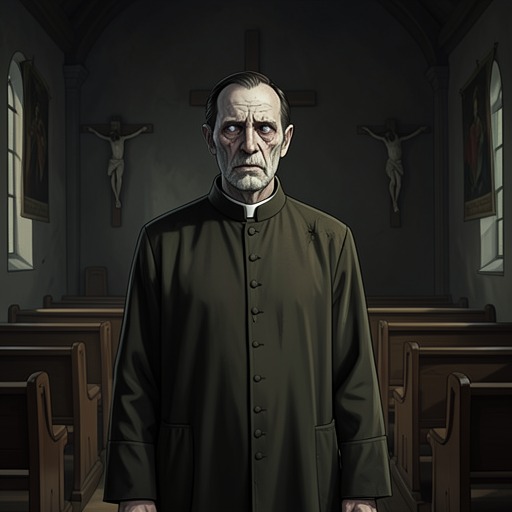
'Salem's Lot: A NovelFather Donald Callahan is the parish priest of St Andrew’s in Jerusalem’s Lot and one of the novel’s central figures in the struggle between religious faith and supernatural evil. He is not merely a local cleric who blesses the dead: his long interest in occult subjects gives him unusual knowledge, while his willingness to investigate the vampire threat places him directly in opposition to Kurt Barlow. His decisive defeat is therefore both a physical reversal and a theological catastrophe.## Identity and Background Father Donald Callahan is identified as the priest of St Andrew’s among the missing residents whom the state police hope to locate after Jerusalem’s Lot becomes a ghost town. The newspaper account places him alongside John Groggins of the Jerusalem’s Lot Methodist Church, Mabel Werts, Eva Miller, and other vanished townspeople, making his disappearance part of the town’s institutional collapse. The disappearance of its clergy signifies more than the loss of individual citizens: the churches that once organized the community’s moral and ceremonial life have been absorbed into the wider catastrophe.
Callahan’s religious vocation coexists with an old fascination with forbidden subjects. He explains that he had been interested in “the occult and the outré” as a boy, and that entering the priesthood intensified rather than extinguished this curiosity. Age has changed the pleasure he once took in the strange. His questions about the nature of evil have become serious enough to spoil the entertainment value of the occult, turning amateur fascination into a burden of moral responsibility.## The Priest as Investigator Callahan enters the active investigation after Matthew Burke tells him that Ben Mears, James Cody, and Susan Norton cannot be reached. Burke asks him to investigate and to bring holy water and a portion of the Host. Callahan recognizes that the request carries difficult theological implications, but he does not retreat behind ordinary parish duties. His knowledge makes him useful to the group precisely because he can treat the vampire threat as both a practical danger and a challenge to the meaning of sacred ritual.
His first major act in the assault on the Marsten House is an eruption of recovered authority. As the group approaches, the house seems to radiate accumulated evil through its cracked paint, yet Callahan is impelled forward rather than held back by hesitation. He commands the evil to leave in the name of God the Father and strikes the door with his crucifix. The result is materially violent: light flashes, ozone fills the air, the fanlight explodes, the bay window sheds its glass, and the new Yale lock is welded into an unrecognizable mass. The scene makes faith visible as force, but it also prepares the later question of whether that force belongs to the object or to the believer who wields it.
Barlow understands the danger Callahan represents and has studied him since arriving in Jerusalem’s Lot. In his message, Barlow compares his observation of Callahan to a chess player studying an opponent’s games. He acknowledges the age and power of the Catholic Church, yet insists that he is older, more experienced, and knowledgeable about both goodness and evil. His threat is not simply that Callahan will be physically overcome; it is that the priest’s own spiritual uncertainty will become the means of his defeat.## Confrontation with Kurt Barlow Callahan’s encounter with Barlow centers on the unstable boundary between sacred symbol and genuine faith. The crucifix initially carries enough power to drive through resistance and break the house’s defenses. Later, however, the light in it vanishes. Barlow takes the cross from Callahan and breaks both its arms, leaving it as a piece of plaster that Callahan’s mother bought in a Dublin souvenir shop. The object’s physical origin matters because it strips away any automatic holiness: without conviction, the relic cannot act as a substitute for the person who holds it.
Barlow explicitly interprets the defeat as a failure of faith. He argues that the cross, bread, wine, and confessional are only symbols when belief has been abandoned. Callahan’s collapse is thus presented not as proof that Christianity is powerless, but as proof that ritual authority cannot operate independently of inward commitment. The priest has known the language of faith and possessed the instruments of faith, yet Barlow forces him to experience the terrifying gap between possessing a sacred sign and being able to inhabit what it signifies.
The breaking of the cross also awakens an older fear in Callahan. His cry recalls the terror of a child left alone while Mr Flip appeared from the closet between the shutters of sleep. Barlow’s violence therefore reaches backward as well as outward: the vampire does not merely disarm a priest in the present but exposes the frightened child beneath his public office. The two dry snaps of the broken cross become a sound that will haunt Callahan for the rest of his life, binding supernatural defeat to enduring psychological trauma.## Defeat, Survival, and Consequence Callahan survives the confrontation, but survival does not restore him. Barlow’s victory leaves him spiritually contaminated and separated from the institution that had given his identity structure. The defeat transforms him from an active defender of the town into a displaced figure whose authority has been shattered at its source. His failure is especially consequential because the novel has established him as one of the few adults capable of recognizing that the evil in Jerusalem’s Lot is real and that ordinary explanations are inadequate.
His arc contrasts with the younger resistance represented by Mark Petrie. Barlow concedes that Mark is a formidable opponent while dismissing Callahan as a false priest, making the comparison a judgment on age, certainty, and spiritual vitality rather than simple physical courage. Callahan’s knowledge of ritual and evil is extensive, but knowledge without sustained faith cannot withstand the vampire’s pressure. Mark’s resistance, by contrast, demonstrates that a sacred symbol can remain effective when conviction gives it force.
Callahan’s defeat also clarifies the novel’s treatment of institutions. Police authority refuses to hear Ben Mears and Mark Petrie describe what has happened; the town’s gossip converts unexplained events into rumors of UFOs, a dark coven, Satan worship, or mass graves; and the churches themselves fail to provide a stable refuge. Callahan stands at the point where institutional religion, private belief, communal panic, and actual supernatural danger meet. His fall shows that the presence of a priest does not automatically make a community protected.## Narrative and Thematic Significance Father Donald Callahan embodies the novel’s argument that evil is not defeated by labels, offices, or objects alone. He possesses the right vocation, the relevant learning, and the traditional weapon, but Barlow’s attack reveals that each depends on an active act of faith. The crucifix is powerful when Callahan’s belief is alive and becomes meaningless wood when that belief gives way. Sacred ritual is therefore neither dismissed as superstition nor treated as mechanical magic; its efficacy is tied to the moral and spiritual condition of the person performing it.
His story also connects personal weakness to collective disaster. Jerusalem’s Lot preserves old horrors through gossip and ceremonial memory, while the vampire outbreak turns those inherited stories into present danger. Callahan is drawn into that history as both priest and witness, only to become one of its casualties. His confrontation with Barlow gives the town’s supernatural occupation a theological dimension: the battle is not only between predator and prey but between a patient, ancient evil and a faith that must continually renew itself in action.
For that reason, Callahan’s significance extends beyond his defeat. He is the novel’s clearest test of whether religious language can survive contact with genuine evil. His answer is tragic rather than simple. The church, the cross, the Host, and the rituals of protection possess meaning, but they cannot save a representative who has lost the inward certainty that makes them more than forms. Callahan’s broken cross is therefore both a weapon destroyed and an image of a spiritual vocation emptied from within.