Floyd Tibbits
'Salem's Lot: A NovelFloyd Tibbits is Susan Norton’s long-term boyfriend and eventual former lover, a recognizable presence in Jerusalem’s Lot whose wounded pride becomes dangerous when Susan begins drawing closer to Ben Mears. Introduced through the town’s social world as a man attached to Susan for a year and a half, Floyd is first framed by romantic rivalry, but his alcoholism, violence, and death soon place him inside the novel’s larger pattern of possession and vampiric corruption. His trajectory moves from ordinary jealousy to bodily and psychological disturbance, making him one of the earliest figures through whom private disorder becomes part of the town’s supernatural emergency.
Identity and Romantic Entanglement
Floyd’s central identity is defined by his relationship with Susan Norton. Her mother, Ann Norton, treats the length of the relationship as evidence that it has gone beyond innocent courtship and suggests that Susan introduce Floyd to Ben. Susan resists the implication that the relationship is settled or fully binding, although she acknowledges that Floyd and she are “more than friends.” The exchange exposes a relationship already under strain: Susan has been cooling toward Floyd over a period of weeks, while her mother continues to interpret the couple through older assumptions about commitment, sexuality, and social respectability.
Floyd’s attachment to Susan is not merely a private matter because Susan’s interest in Ben makes it visible to the whole social network of the Lot. Matt Burke jokes about Ben as “The courting male in full plumage,” placing Floyd’s displacement within the town’s amused but intrusive observation of courtship. The relationship therefore functions as both romance and public knowledge. Susan’s declaration that there is nothing firm between her and Floyd does not dissolve his claim upon her; instead, the discrepancy between her withdrawal and his continued sense of possession prepares the confrontation that follows.
Jealousy, Alcohol, and Violence
Floyd appears at Dell’s as one of the town’s regular men, but his emotional condition is already deteriorating. On a night when the bar is sparsely populated, he sits with “thunderclouds on his brow” after speaking with Susan three times during the week, with none of those conversations going well. The image gives his jealousy a visible, almost atmospheric form: his anger is not a sudden interruption but a pressure gathering in public while the town continues its ordinary drinking and conversation.
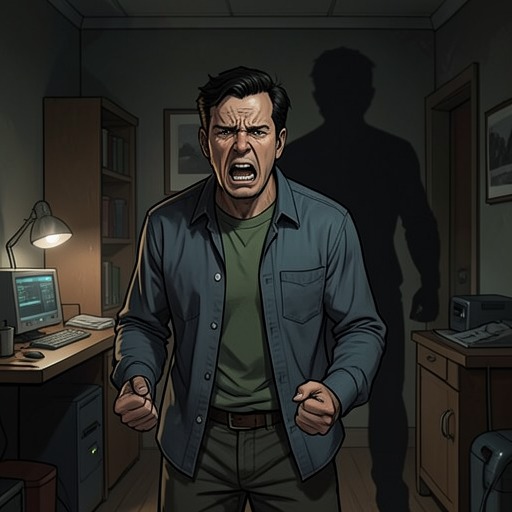
His conflict with Ben becomes explicit when Floyd attacks him in the parking lot at Eva Miller’s boardinghouse. Speaking in a “grating, toneless voice,” he identifies Ben as the man who stole his girl and declares, “I’m going to kill you.” He then wades into the assault before Ben can fully understand what is happening. The violence is personal in its language but abnormal in its manner. Floyd’s accusation reduces Susan to an object transferred from one man to another, while the toneless delivery makes the threat sound less like an emotional outburst than an imposed command.
The attack has immediate consequences for Susan and Ann. When Susan learns that Floyd beat Ben in the parking lot, she is alarmed and asks whether Ben is all right. Later, after Floyd has appeared at the Norton home, Ann tells Susan that he came there and describes the emotional collapse he had confessed to her, including his crying. Susan responds by declaring that she is through with him and that he must accept the end of the relationship. The household argument joins Floyd’s violence to the larger struggle between Susan’s independence and her mother’s conviction that Floyd’s suffering gives his claim emotional legitimacy.
The Assault’s Supernatural Context
Floyd’s behavior cannot be understood only as ordinary romantic jealousy. Around the same period, Ben encounters Floyd dressed in an old-fashioned overcoat and a strange hat, with his hands in his pockets, before hearing that Floyd beat him. The description makes Floyd seem physically out of time and contributes to the growing uncertainty about what has happened to people in the Lot. His body and manner no longer belong securely to the ordinary social world represented by the bar, the boardinghouse, and the Norton home.
The novel later places Floyd beside Mike Ryerson and the McDougall baby in a pattern of suspicious deaths. Father Donald Callahan lists Mike Ryerson, Floyd, and the McDougall baby while observing that mortality has been unusually high in the Lot. Floyd’s death is therefore not an isolated consequence of his assault or drinking. It becomes one of several deaths that allow the surviving investigators to perceive a concealed process working through the town, even before its full vampiric nature is openly confronted.
Death and the Evidence of Enthrallment
Floyd is arrested after the attack and held in a drunk tank. When Nolly Gardener brings him breakfast, Floyd is asleep; by lunchtime he remains asleep in the same position. Nolly initially leaves him undisturbed, but the persistence of the sleep frightens him enough to bang on the bars and consider whether Floyd might be pretending to be ill before attacking the turnkey. Floyd does not wake. The scene turns a familiar local institution into a place of ominous stillness, and his apparent sleep echoes the novel’s recurring association between unnatural rest and death.
Susan later calls Ben in the hospital with the news that Floyd has died in his cell sometime during the night. She reports that Jimmy Cody has diagnosed acute anemia, but immediately challenges the diagnosis by explaining that Floyd had high blood pressure and had been rejected by the Army for that reason. The contradiction makes the death medically suspicious and narratively important. Floyd’s known condition does not fit the explanation offered for his sudden death, and his end joins the book’s developing evidence that ordinary authorities are naming symptoms without recognizing their cause.
Floyd’s death also becomes a warning about Kurt Barlow’s power. During preparations to confront Barlow and Susan, Father Donald Callahan tells the group not to look into Barlow’s eyes because he can catch a person and turn him against the others, “even at the expense of your own life.” He explicitly adds, “Remember Floyd Tibbits!” Floyd is thus remembered not simply as a victim of a vampire but as an example of what enthrallment can do: erase or redirect a person’s agency until he becomes a weapon against those who oppose the invading force. His assault on Ben retrospectively acquires a second meaning, connecting his romantic grievance to Barlow’s method of control.
Narrative Role and Aftermath
Floyd’s story follows a descent from possessive courtship into violence, confinement, inexplicable sleep, and death. The sequence is causally legible at the human level—Susan withdraws, Floyd feels displaced, and Ben becomes the target—but the supernatural explanation gradually overtakes that surface plot. The character’s apparent simplicity as the jealous boyfriend is unsettled by the evidence of abnormal behavior and by the later revelation that his condition belongs to a wider vampiric system.
His name continues to circulate after death as the town’s social and institutional response grows evasive. When Nolly asks Parkins Gillespie what became of Floyd and the McDougall baby, Parkins answers that he does not know and offers no further explanation. The refusal to speak does not restore order; it reveals how quickly the town’s ordinary mechanisms of knowledge are failing. Floyd’s death is both concealed by that silence and made more ominous by it.
Floyd therefore occupies a hinge position in the narrative. His relationship with Susan supplies the emotional motive for the attack on Ben, while his alcoholism and public humiliation make him vulnerable to dismissal as merely unstable. Yet his death, the unexplained anemia, the unnatural sleep, and Callahan’s later warning convert him into an early diagnostic figure. He shows that the evil entering Jerusalem’s Lot does not begin with spectacular attacks alone; it works through existing resentments, bends familiar people toward violence, and leaves survivors struggling to distinguish personal failure from supernatural domination.