Ghost town
'Salem's Lot: A NovelGhost town names the abandoned condition of Jerusalem’s Lot after its population disappears and ordinary community life collapses. The state is significant because the town does not begin as a picturesque ruin or an obviously cursed settlement: it is a comfortable, socially intricate Maine township whose deserted streets, locked businesses, empty schools, and silent houses reveal that something catastrophic has passed through the fabric of everyday life.
Definition and Physical Setting
A ghost town is presented through comparison with other emptied communities, especially Momson, a Vermont town whose 312 residents vanished during the summer of 1923. Momson’s houses remained standing, often still furnished as though daily life had been interrupted in mid-action: one table was set for an evening meal, another bedroom had its covers turned down, and a mercantile store retained a rotted bolt of cloth, a cash-register total of $1.22, and nearly $50 untouched in its drawer. Local people turned this mystery into a haunting story, although geographic isolation offered a more practical explanation. Jerusalem’s Lot is introduced as another version of the same disturbing pattern, with the crucial difference that its disappearance is tied to a much deeper history of violence and supernatural danger.
Jerusalem’s Lot lies east of Cumberland and twenty miles north of Portland. Before its abandonment, it contained a nearly circular township organized around two principal roads, with the Royal River flattening its eastern boundary. North Jerusalem was wooded high ground crossed by old logging roads, and the Marsten House stood on the last of the hills overlooking the town. The northeast held open hay and alfalfa fields, the Royal River, the Brock Street Bridge, and the cliffs known locally as Drunk’s Leap. The southeast was the most prosperous-looking quadrant, marked by farms, commuter homes, Schoolyard Hill, and the large Griffen barn; the southwest, by contrast, contained trailers, junked cars, makeshift yards, and Dell’s, a place associated with beer, dancing, and fighting. The abandoned town therefore preserves not a single uniform landscape but a map of class, mobility, work, leisure, and exposure to danger.
From Ordinary Township to Empty Settlement
The Lot was incorporated in 1765, long before Maine became a state, and celebrated its bicentennial with fireworks and a park pageant. Its name came from a violent-tempered sow named Jerusalem, whose escape into the woods inspired Charles Belknap Tanner’s warning to children to stay out of the Jerusalem wood lot. The anecdote gives the town an almost comic origin, but the later history makes the name seem ominously suited to a place associated with religious extremity, hidden crimes, and recurrent evil.
In the 1970 census Jerusalem’s Lot had 1,319 inhabitants, exactly sixty-seven more than in the previous census. It was characterized by older residents, poor families, and young people who left after graduation and did not return. The oldsters gathered in the park or around the stove at Crossen’s Agricultural Market, discussing the Fire of ’51 and the small incidents of local life. The town’s social world was sustained by two- and four- or six-party telephone lines, which made gossip a daily institution. Its apparent stability depended on the conviction that nothing truly terrible could happen there. National wars, political crises, changing youth culture, drugs, alcohol, and fatal road accidents remained, for most residents, distant or manageable forms of trouble. The town’s ghostly transformation is consequently a collapse of its own governing assumption: that its pleasant smallness placed it beyond catastrophe.
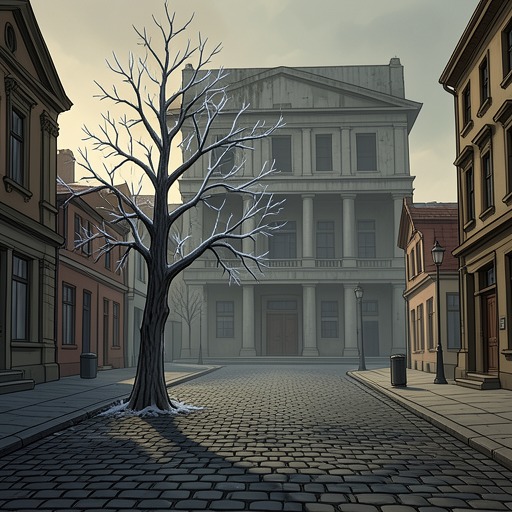
The physical evidence of abandonment is comprehensive. No business remains open. Spencer’s Sundries and Pharmacy was the last to close, after Crossen’s Agricultural Store, the hardware store, Barlow and Straker’s Furniture Shop, the Excellent Café, and the Municipal Building had already been boarded up. The grammar school and the tri-town consolidated high school, built in 1967, stand empty; their books and furnishings have been moved to makeshift facilities in Cumberland, and no children from the Lot are expected to attend a new school year. Houses, lawns, streets, and back roads remain, but they are stripped of the population that gave them purpose. The town is not destroyed in the ordinary sense. It is intact enough to display what has been lost.
Historical Memory and Concealed Violence
The ghost-town condition is inseparable from the Lot’s habit of carrying old horror forward through memory. When people think of the Marsten House, their recollections lack the comforting nostalgia attached to other local stories. The scandal surrounding Hubert Marsten and Birdie Marsten occurred before the current generation was born, yet small-town memory passes it down ceremonially. The house functions as the town’s inherited skeleton: a place whose history is known in outline but never fully understood.
That pattern extends beyond the Marsten House. Four children disappeared between 1928 and 1939, during the period when Hubert and Birdie lived there, and none of the children was ever found. The disappearances might have been explained individually as accidents common to rural life, but the absence of remains and their concentration in the same historical period make the town’s apparent normality unstable. The Lot’s social knowledge is similarly incomplete in other cases. Residents may know that Albie Crane murdered his wife and hid her in an old well, or that Hubert Marsten killed Birdie, but they do not know the full circumstances behind those crimes. Local knowledge preserves fragments while concealing causes.
The town’s older history deepens the sense of recurrence. Robert Boone’s decoded diary records that the settlement was founded in 1710 by a splinter Puritan group led by James Boon and organized around a church where Boon preached or exercised authority. The community combined religious fanaticism, exorcistic rites, incest, and the study of a sinister book. The diary’s first entry is dated June 1, 1789, and its last October 27, four days before the cataclysmic disappearance remembered by Mrs Cloris. It therefore connects the town’s earliest religious history with a prior mass vanishing and with the desecrated church. The modern ghost town is not an isolated anomaly but the latest visible layer in a history that repeatedly converts belief, secrecy, and violence into communal ruin.
Silence, Fear, and the Final Transformation
The abandoned town produces rumors before it produces understanding. People in surrounding towns report colored lights over the Central Maine Power lines, speculate about UFOs, and speak of a dark coven whose black-mass practices may have brought divine punishment. A visit to the Lot makes such explanations seem less absurd because the visible facts are so extreme: every commercial institution is closed, no children remain, and the streets and houses have been left to silence and overgrowth. Rumor becomes an imperfect attempt to give narrative form to a space from which explanation has vanished.
The town’s silence is repeatedly linked to death. During the burial of Danny Glick at Harmony Hill Cemetery on September 28, the first real day of fall, the community briefly gathers in a long procession of cars with their lights on, including Mark Petrie and his parents, relatives, classmates, and older residents drawn compulsively toward funerals. Later, in the Marsten House, silence becomes proof that the living are not alone: Ben Mears and Susan Norton listen to a dead stillness and understand that another presence occupies the building. The same transformation reaches the wider town during the catastrophe. Some residents remain asleep or untouched, especially isolated people without close relatives, while those who are awake turn on every light and search drawers, attics, and jewelry boxes for religious symbols without fully knowing what they fear. They move room to room and refuse to look out their windows. The ordinary town has become a defensive enclosure, and ignorance itself becomes a symptom of supernatural occupation.
Ghost-town status is therefore both an aftermath and an active condition. The Lot’s people disappear, its institutions cease to function, and its built environment remains as a shell, but the shell continues to hold secrets, memories, and the traces of repeated evil. Even the later account of Charles Boone’s story introduces another possible historical cycle: his papers are attributed to a recurrence of brain fever after his wife’s death, and he is believed to have murdered Calvin McCann, while his journal is judged a forgery created to sustain paranoid delusions. Yet the uncertainty surrounding the old town is never fully neutralized by rational explanation. Jerusalem’s Lot remains a place where official records, family documents, local gossip, and supernatural possibility overlap, making abandonment not simply the absence of inhabitants but the visible form of a community’s buried past.