Henry Petrie
'Salem's Lot: A NovelHenry Petrie is Mark Petrie’s father and June Petrie’s husband, an accomplished economist whose precise, skeptical intelligence initially places him at the opposite pole from the supernatural world overtaking Jerusalem’s Lot. He trusts education, evidence, orderly institutions, and the natural laws of physics; that confidence gives his family stability, but it also leaves him disastrously unprepared for an enemy that violates the categories by which he understands reality.
Identity and Background
Henry is described as an educated man with a B.S. from Northeastern, a master’s degree from Massachusetts Tech, and a Ph.D. in economics. He left a secure junior-college teaching position for an administrative post with the Prudential Insurance Company, motivated partly by curiosity about whether his economic theories would work in practice. They did. He expected to take the CPA examination the following summer, the bar examination two years later, and begin the 1980s in a senior federal economics position. His ambitions reveal a mind that moves confidently through systems, credentials, and measurable progress.
His political and social outlook is equally rationalizing. He is a registered Democrat who voted for Richard Nixon in 1972 because he judged the opposition economically dangerous, not because he considered Nixon honest. He regarded the counterculture of the late 1960s with calm tolerance, believing that movements without a monetary base would collapse harmlessly. His love for June and Mark is not romanticized as poetic passion; it is characterized as sturdy, unswerving, and practical. Henry balls his socks before his wife, and the domestic detail captures his larger nature: disciplined, methodical, and committed to the small procedures by which a life is kept in order.
Family Life and the World of Order
Henry’s methodical habits shape the Petrie household. The farmhouse on South Jointner Avenue still contains the old second-floor heating grates, remnants of a kitchen-stove system that once carried warm air upstairs. Although the oil furnace has made them obsolete as heaters, the grates conduct sound with remarkable efficiency. Mark can hear his parents downstairs almost as clearly as if they were outside his door, making the house a place where family intimacy and inadvertent surveillance coexist.
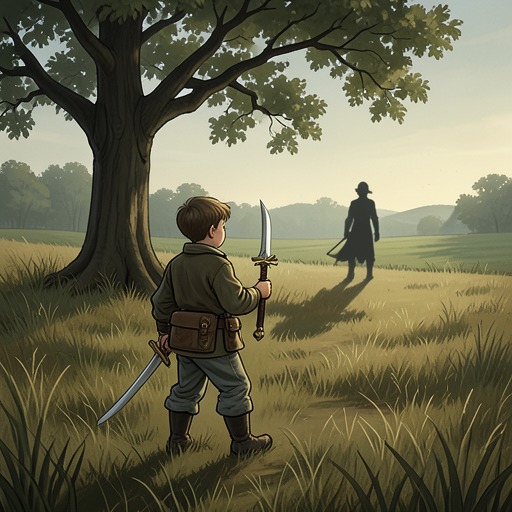
The father’s orderly material world is mirrored in the woodpile behind the house. Henry and Mark cut yellow ash with a McCulloch chain saw during July and August, and Henry ensures that each stove length is within roughly an inch of three feet. He knows the proper dimensions just as he knows that winter follows fall and that yellow ash burns longer and cleaner in the living-room fireplace. The detail becomes grimly significant because Mark, who knows other things, recognizes ash as suitable material for a weapon against the vampire threat and shapes one length into a stake while his parents are away on their Sunday bird walk.
Henry’s relationship with Mark is affectionate but not sentimental. When he once caught Mark listening at a door, he warned him with the old English proverb, “Never listen at a knothole lest you be vexed.” The warning concerns more than manners: knowledge can expose a person to truths he does not want. Later, after Mark’s encounter with Danny Glick, Henry wakes with a vague but powerful sense that disaster has been narrowly avoided. He checks the room and finds the window shut and nothing overturned, yet the feeling remains beyond his understanding. The scene places paternal concern beside the limits of his perception: Henry senses the disturbance emotionally before he can recognize it intellectually.
Confronting the Supernatural
Mark’s encounter with Danny Glick forces the family’s private world into the vampire crisis. Danny appears at Mark’s window with grave-pale skin, reddish feral eyes, dark matter around his mouth, and teeth grown hideously long and sharp. When Danny whispers, “Let me in,” Mark understands that the danger exceeds ordinary physical harm. The boy repels him with a cross whose light briefly shines with fierce intensity, then leaves a blue afterimage. From the bedroom below, Henry hears the cross’s disturbance and asks what happened, but the event remains outside his explanatory framework.
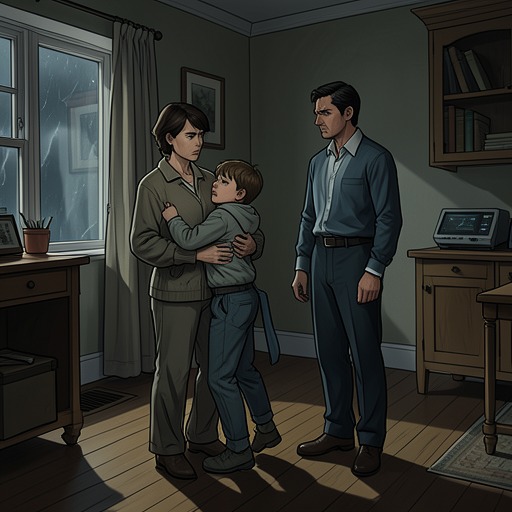
Henry’s decisive confrontation with the supernatural occurs when Mark and Father Donald Callahan tell him what has happened. He listens over coffee, asking lucid questions whenever their account becomes tangled or unclear. His calm increases in proportion to the grotesqueness of their story and June’s agitation. His verdict is a single word: “Impossible.” The response is not simple cowardice or indifference. It is the conclusion of a man whose entire intellectual identity has been organized around external facts and coherent causal laws.
He tries to convert the vampire testimony into a rational dispute between competent adults. Speaking pleasantly to Father Donald Callahan, he proposes that they work the matter out “like two reasonable men.” When asked whether he drove a stake through a girl’s body, he rejects the act as an intolerable breach of ordinary standards. He accuses Callahan and the others of involving his son in something deranged and possibly dangerous, threatens legal consequences, and decides that the matter should be discussed further at Matthew Burke’s hospital room. Even when he concedes that the story is disturbing, he insists that accepting internal belief over external fact is not logic but “cant.”
Death and Narrative Function
Henry’s rational resistance becomes precisely the opening through which Kurt Barlow destroys the Petrie family. The telephone line is dead, the lights fail, and a window crashes inward. In the sudden darkness, Father Donald Callahan’s cross illuminates the kitchen, revealing Barlow behind Henry and June. Barlow seizes Henry’s head in one long-fingered hand and June’s in the other, then brings their heads together with a grinding crack. They fall instantly, and Barlow fulfills the threat he had made against the family.
Mark attacks Barlow without thought and is captured immediately, but Henry’s death has already transformed the meaning of the scene. The man who demanded evidence is killed by an impossible fact made physically undeniable. His education, professional ambition, and faith in natural law cannot protect him because the invasion is not merely an argument he has judged incorrectly; it is an assault that enters the house, cuts the telephone, extinguishes the lights, breaks the window, and annihilates the family’s ordinary protections in seconds.
Henry therefore functions as both a character and a structural contrast. Mark’s knowledge comes from monsters, folklore, and direct supernatural experience; Henry’s comes from economics, institutions, and physical regularity. The narrative does not make Henry foolish for demanding proof. Instead, it shows the tragic cost of applying a sound standard of ordinary reasoning to an extraordinary enemy. His death clears away the last possibility that the vampire crisis can be contained as rumor, delusion, or courtroom misunderstanding, while leaving Mark to carry forward the knowledge his father could not accept in time.