Hubert Marsten’s murder of Birdie Marsten
'Salem's Lot: A NovelHubert Marsten’s murder of Birdie Marsten is the decisive human crime at the center of the Marsten House’s history. Hubert, remembered by Minella Corey as one of the two truly evil men she had known, shot his wife on August 12, 1939; the killing made the house not merely a site of scandal but a durable emblem of concentrated evil whose influence reaches into the later history of Jerusalem’s Lot.
Crime and Immediate Circumstances
Minella Corey was not present when Birdie died. She was three hundred miles away on Cape Cod, working as a housekeeper for a wealthy family and preparing a tossed salad in a large wooden bowl. At approximately quarter past two in the afternoon, she experienced a sudden pain in her head, which she described as being like lightning, and heard what she understood as a shotgun blast. She fell to the floor, and when she rose again, twenty minutes had passed. Looking into the wooden bowl, she screamed because it appeared to be filled with blood.
The vision then vanished. A moment later, Minella’s headache was gone and the bowl contained only salad, yet she remained certain that Birdie had been murdered. Her story is explicitly described as unsubstantiated, but its force lies in the combination of distance, bodily sensation, and precise timing: the murder seems to announce itself across three hundred miles before ordinary information could reach her. The scene therefore presents Birdie’s death both as a factual act of domestic violence and as an uncanny rupture in the boundaries separating witness from victim.
Hubert Marsten and the Marsten House
Minella did not regard Hubert as merely a violent husband. She called him one of the two genuinely evil men she had known in her lifetime, placing him alongside Adolf Hitler. That comparison enlarges the meaning of the shotgun killing. It is not treated as an isolated outburst whose significance ends with the deaths in the house; it becomes evidence of a monstrous moral character, the human face of an evil that the Marsten House appears to retain.
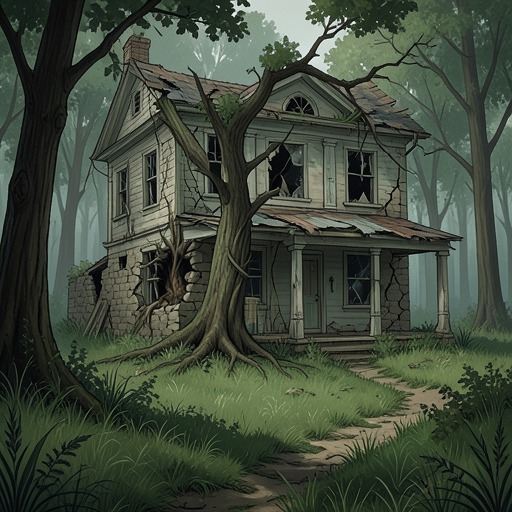
The house’s later reputation is filtered through this crime. Ben Mears recalls that he was the child who opened an upstairs bedroom door and saw Hubert hanging from a beam. His childhood encounter gives the murder-suicide a second life as traumatic memory: the event is not directly narrated at the moment it occurred, but returns through the testimony of those who remember its aftermath and through the adult interpretation of the house. The remembered image of the hanging man becomes inseparable from the building’s atmosphere, so that the house seems to preserve the violence committed within it.
Dates, Evidence, and Retrospective Reconstruction
The physical record of Hubert’s life appears in Harmony Hill Cemetery, where Mike Ryerson notices a fallen slate headstone and brushes dirt from the inscription. It identifies the dead man as Hubert Barclay Marsten, born October 6, 1889, and dead August 12, 1939. The date on the stone confirms the day associated with Minella’s remote perception of Birdie’s murder, binding the uncanny account to a concrete historical marker.
Yet the grave inscription does not explain the crime by itself. The reader receives the event through layers of recollection, hearsay, inference, and material evidence: Minella’s account of the psychic shock, Ben’s memory of the upstairs bedroom, and the cemetery’s dates. This delayed construction makes the murder feel like a buried fact that repeatedly surfaces rather than a closed incident. Each return adds a different kind of certainty while leaving the central horror intact.
Consequences for Jerusalem’s Lot
The murder gives the Marsten House an origin point for its accumulated evil, but the surrounding town is also shaped by longer histories of violence and vulnerability. Jerusalem’s Lot is crossed by electrical pylons, marked by abandoned logging roads, a former sawmill, a clay-producing dump, and the scar of the 1951 fire. The later vampire disaster does not emerge into an untouched pastoral world; it takes hold in a community already accustomed to hidden damage, local silence, and the persistence of old wounds.
The house stands on the last of the wooded hills above the town, close to an electricity pylon that looms over it like an alien sentinel. Its isolation and elevation make it a visible landmark, while the murder gives that landmark a remembered interior history. Years later, when Ben Mears and Mark Petrie leave the village and Ben looks back toward the house, the shutters still sag and the lawn is tangled with witch grass and goldenrod, but a beaten path cuts across the grass toward the porch. The path indicates renewed occupation and repeated approach, suggesting that the old crime has not remained in the past.
Narrative and Thematic Significance
Hubert Marsten’s murder of Birdie Marsten establishes a pattern in which evil is both intimate and contagious. The act begins as a husband’s shotgun killing of his wife, then expands through memory into a legend, through the house into a local haunting, and eventually into the wider supernatural crisis associated with Kurt Barlow and Richard Straker. The later threat is not identical to Hubert’s crime, but the narrative places them in the same moral landscape: private brutality becomes a beacon for forces that outlive the original perpetrator.
The event also reverses the reassuring logic associated with Dracula. In Stoker’s model, modern knowledge and organized courage ultimately drive the vampire back and stake him at sunset. The darker conception behind ’Salem’s Lot imagines a world in which supposedly protective systems and inventions have become sinister, while evil survives through neglected places and inherited damage. Hubert’s murder is the human prehistory of that reversal. Before the vampire hunters face an inhuman enemy, the Marsten House has already demonstrated that the deepest horror can enter through an ordinary domestic door, leave a body hanging upstairs, and continue speaking long after the gunshot has ended.