James Robert Boone
'Salem's Lot: A NovelJames Robert Boone appears at the end of the Boone papers as their recipient, custodian, and prospective publisher. He identifies himself as the final descendant of a branch of the Boone family that relocated to Central Falls, Rhode Island, making his connection to Chapelwaite and to Charles Boone both genealogical and archival. His decisive narrative function is to frame the preceding letters and journals while trying to distinguish inherited truth from the distortions of a mind collapsing under grief and obsession.
Identity and Inheritance
James Robert Boone describes himself as Charles Boone’s second cousin, removed by three generations. This relationship descends from Robert Boone, who fathered at least two children outside the main line: one died in infancy, while the other took the Boone name and settled in Central Falls. James therefore presents himself not as a direct continuation of Charles’s household but as the surviving descendant of a collateral branch, separated from the events by both time and geography.
His ancestry matters because Robert Boone’s diary links the family to Jerusalem’s Lot, the town’s founder James Boon, and the book kept in the desecrated church. The surviving account treats blood relation as a possible carrier of historical and supernatural significance, but James approaches that inheritance through documents rather than prophecy. He has lived with the papers for ten years before offering them for publication, turning family history into an act of controlled disclosure.
Custodian of the Papers
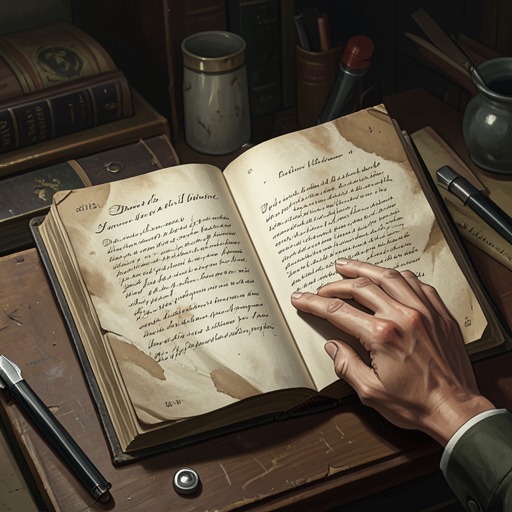
James presents the documents on the occasion of his residence in Chapelwaite, the Boone ancestral home. The papers include Charles Boone’s correspondence and the pocket journal attributed to Calvin McCann, though the later editorial account argues that the latter was forged by Charles to reinforce his paranoid delusions. James’s position is therefore not that every surviving document deserves equal trust. His postscript establishes a hierarchy of testimony: personal papers may preserve intimate experience, but they may also record illness, fabrication, or self-deception.
The framing is especially important because the evidence arrives through several documentary forms: newspapers and local records preserve the public history of Jerusalem’s Lot, Robert Boone’s coded diary reconstructs the town’s eighteenth-century origins, and Charles’s letters dramatize the final collapse of his private world. James’s signature and date, October 2, 1971, place him at the end of this chain of transmission. He is not merely a name attached to an archive; he is the figure who makes the archive available while warning readers against accepting its claims uncritically.
Judgment on Charles Boone
James reports that Charles Boone is assumed to have suffered a recurrence of the brain fever that first struck him after his wife’s death in 1848. In this explanation, Charles lost his sanity and murdered his longtime companion, Calvin McCann. The formulation preserves a rational account of the catastrophe without fully erasing the disturbing material that precedes it.
James specifically identifies McCann’s journal as an exercise in forgery, probably created by Charles to strengthen his paranoid convictions. That judgment places the reader at a distance from Charles’s interpretation of events. Yet James does not dismiss the entire Boone history as meaningless. He states that Charles was wrong in at least two particulars, which implies that the documents still contain claims requiring examination rather than simple rejection.
The first correction concerns Jerusalem’s Lot’s supposed destruction. When the abandoned town was later rediscovered, the rotted narthex floor showed no evidence of an explosion or comparable devastation. Overturned pews and broken windows could instead be attributed to vandals from neighboring towns. Rumors persisted among older residents of Preacher’s Corners and Tandrell, but James treats those rumors as historically weak. This correction makes local legend part of the machinery by which Charles’s fears may have been fed.
The second correction concerns the Boone line itself. Charles was not the last descendant of his family. Robert Boone had left another surviving branch, and James is its final known representative. The discovery undercuts Charles’s sense of genealogical closure while simultaneously confirming that the family connection he feared was real. James’s ancestry thus both disproves one of Charles’s conclusions and preserves the bloodline at the center of the mystery.
Residence at Chapelwaite and Narrative Role
James’s decision to live in Chapelwaite gives the old family history a present-day setting. He offers the papers for publication in the hope that readers will sympathize with Charles Boone’s misguided soul, a phrase that combines moral judgment with compassion. Charles is neither validated as a reliable investigator nor reduced to a monster; he becomes a damaged inheritor whose terror and violence must be read through the evidence he left behind.
The closing note also punctures the grandeur of the ancestral mystery with an ordinary practical complaint. James hears huge rats in the walls and concludes that Chapelwaite badly needs an exterminator. That detail does not settle whether the house is merely decayed or genuinely contaminated by the forces described in the papers. Instead, it leaves the reader with a deliberately unstable contrast: inherited horror is preserved in elegant documents, while its surviving descendant confronts the immediate, physical signs of a neglected house.
James’s role is therefore structurally brief but consequential. The main narrative has already accumulated newspaper reports, town memory, private correspondence, coded diaries, and disputed journals. His postscript gathers these fragments into a publishable record, tests them against later observation, and admits the limits of certainty. By signing the papers, he becomes the final human link in the Boone archive and the figure who carries its unresolved history beyond Chapelwaite into the reader’s world.