Jerusalem’s Lot vampire hunt
'Salem's Lot: A NovelJerusalem’s Lot vampire hunt is the improvised counteroffensive mounted when the town’s scattered attacks and disappearances can no longer be treated as isolated tragedies. Its decisive significance lies in the change from fear to method: Jimmy Cody proposes dividing the work, Ben Mears manufactures the weapons, and Jimmy and Mark Petrie move through the town locating vampires. The familiar geography of homes, roads, woods, and marginal districts becomes a tactical map, while the hunt exposes how little the living community understands about the danger surrounding it.
Causes and Background
The operation emerges from a town that had long mistaken normality for protection. Jerusalem’s Lot is organized around intersecting roads and distinct quadrants, with wooded north Jerusalem, farms and open land near the Royal River, and the poorer trailer settlement known as the Bend. The town’s spatial divisions are social as well as geographic: the Bend is marked by junked cars, makeshift housing, children, beer cans, and hastily installed septic tanks, while other areas contain farms, commuter homes, the cemetery, and the Marsten House. These differences give the hunters separate kinds of terrain to search, from houses and roads to wooded margins and improvised dwellings. The town’s infrastructure also becomes part of the hunt’s atmosphere. Telephone wires carry gossip through the settlement, and their strange humming makes communication seem almost animate; electricity pylons cut a broad diagonal through the timberland, with one looming close to the Marsten House. Yet neither communications nor modern utilities have given the inhabitants a reliable understanding of what is happening. The town has heard about national wars and crises largely through television, but its local confidence rests on the belief that nothing truly terrible can happen there. The vampire hunt begins only after that civic assumption has collapsed. The immediate tactical background is the discovery that the transformed residents do not simply disappear; they hide in familiar houses and other places throughout the Lot. The night’s terror has already taught the survivors that they are not alone, even when a house appears completely silent. At the same time, frightened residents who do not know the truth turn on every light and search drawers, attics, or jewelry boxes for religious symbols, while refusing to look out their windows. This behavior reveals a community acting on instinct before it possesses an explanation. The hunters must therefore operate in an environment where the living are terrified, the dead may return, and the enemy remains concealed among ordinary domestic spaces.
Organization and Method
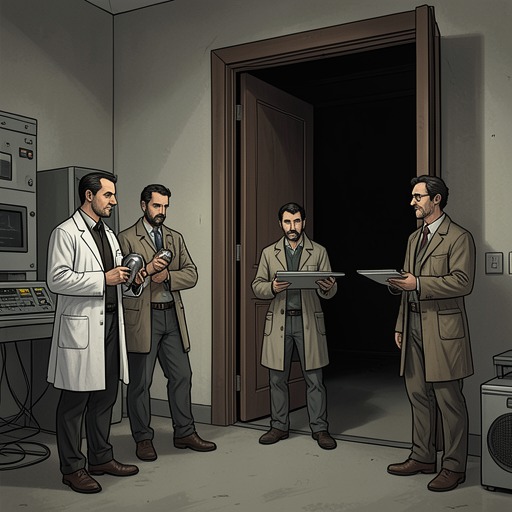
Jimmy Cody frames the response as a division of labor. He tells Ben Mears to remain behind and begin turning out stakes, insisting that the work must be scientific: Ben will be the production department, while Jimmy and Mark will be research. Their task is to go through the town, find the vampires, and mark their locations with a grease pencil; the next day, the group can return with stakes. The plan gives the crisis an industrial rhythm—production, reconnaissance, marking, and later attack—even though the materials are crude and the available knowledge is incomplete. Jimmy’s confidence depends on an estimate of the vampires’ condition. He believes Mrs. Glick is not connecting events through sustained thought and that the transformed creatures move initially more by instinct than by strategy. On that assumption, the hunt may be temporarily straightforward, like shooting fish in a barrel. Jimmy nevertheless allows for adaptation: the vampires may eventually become more intelligent and begin hiding better. The plan is therefore a race against the enemy’s capacity to learn, not a claim that the hunters possess permanent superiority. The division also follows local knowledge. Jimmy argues that he knows the town and that the town knows him, just as it knew his father. Living residents hiding in their houses may refuse to answer a stranger’s knock, but most will answer Jimmy’s. He knows some of the places where people shelter, including the locations where winos stay in the Marshes and the pulp roads leading through the surrounding country. Ben does not know these routes. Jimmy’s role is consequently not merely that of a fighter; he is a guide to the town’s social and physical margins, able to turn familiarity into access. Ben accepts the production role because he can operate the lathe, but the arrangement carries an emotional cost. He feels relief at not having to go outside and confront the vampires, then feels guilty for that relief. The hesitation shows that the hunt is not a clean heroic advance. Every participant understands that reconnaissance means entering the space of the enemy, while staying behind can resemble safety purchased at another person’s risk. When Jimmy prepares to leave after noon, Ben considers giving him several stakes first, an offer that emphasizes both the urgency of the search and the fragile adequacy of their equipment.
Course and Spatial Stakes
The hunt’s geography is inseparable from its method. A town once read as a nearly circular, orderly settlement is now divided into zones of concealment and exposure. The central roads provide routes of movement; the wooded high ground near the Marsten House offers cover; the farms and river corridors create open stretches; and the Bend supplies a dense borderland of shacks, trailers, vehicles, children’s possessions, and neglected yards. Jimmy’s knowledge of the Marshes and pulp roads extends the operation beyond respectable public space into places the town’s ordinary social map tends to overlook. The contrast between public visibility and hidden danger intensifies during the aftermath of the first night. A driver passing through might see houses with their lights blazing and mistake the illuminated town for the scene of a fire or accident. Yet the residents who are awake do not know the truth, and they avoid their windows. The hunters therefore work against a peculiar blindness: the town is visibly altered, but the meaning of that alteration remains unrecognized by most of its inhabitants. Reconnaissance must supply the knowledge that lights, gossip, and telephones have failed to produce. The operation also reverses the usual meaning of domestic space. Houses are no longer automatic shelters; they may be hiding places for vampires, and entry itself carries danger. Earlier, Matt Burke hears Mike Ryerson’s dead voice give an invitation into the house, turning a familiar threshold into a supernatural vulnerability. During the hunt, the same kind of ordinary residence becomes an address to be located, marked, and revisited. The campaign thus redraws the town not through official boundaries but through the hidden presence of the undead.
Consequences and Significance
The hunt’s first achievement is organizational rather than conclusive. It creates a common procedure at a moment when terror threatens to isolate everyone inside separate rooms. Ben’s stakes, Jimmy’s local knowledge, and Mark’s participation form a small but functional apparatus for resistance. The plan gives the survivors a way to act before they can fully explain the vampire outbreak, and it transforms helpless observation into a sequence of concrete tasks. Its deeper significance is that it makes knowledge itself a weapon. The hunters do not begin with an omniscient understanding of the enemy. They infer behavior from encounters, identify patterns, and test the limits of instinct, concealment, and adaptation. The grease-pencil marks are modest, temporary signs, but they impose order on a town whose spaces have become unreadable. In that sense, the hunt is a struggle to recover a map of Jerusalem’s Lot before the vampires’ occupation becomes complete. The action also exposes the cost of defending the community. Jimmy’s willingness to go out depends on personal history and local recognition; Ben’s usefulness depends on labor performed out of sight; Mark’s role places a child in the field of danger. The arrangement distributes risk unevenly, but it does not eliminate it. Even the person who remains at the lathe is implicated in the violence, while those who search must carry the knowledge that every familiar doorway may conceal an enemy. As a literary action, Jerusalem’s Lot vampire hunt marks the point at which the novel’s small-town realism becomes an organized counterforce to supernatural invasion. The town’s gossip network, roads, utility lines, houses, cemetery, woods, and class-marked outskirts are not background scenery. They are the material through which the hunt must proceed. Against an enemy that spreads through intimate spaces and exploits the passivity of the living, the survivors answer with local knowledge, manufactured stakes, daylight reconnaissance, and a deliberately practical division of labor.