Killing the vampire master does not destroy his dependents
'Salem's Lot: A NovelKilling the vampire master does not destroy his dependents is the rule that separates the defeat of Kurt Barlow from the defeat of the vampire colony. When Ben Mears and Mark Petrie destroy Barlow, the master’s body dissolves, but the vampires sheltering beneath Eva Miller’s boardinghouse remain fully active. Their survival converts a single triumph into an unfinished campaign: the center of the evil has been removed, while its distributed agents still occupy the town and threaten the living.
Definition and Mechanism
The rule establishes that vampiric dependence is not a single shared life. Barlow may be the governing intelligence and spiritual center of the outbreak, but his death does not automatically transmit to those whom he has converted or commanded. The distinction is dramatized rather than explained abstractly. Ben and Mark open Barlow’s sealed coffin together, drive the stake into him, and witness a rapid dissolution that reduces his body from living-looking flesh to clothing, bones, dust, and finally nothing recognizable as a human corpse. The destruction is decisive for Barlow himself, yet the surrounding vampires do not collapse with him.
The scene makes the separation especially clear through its movement from dissolution to escape. Even after Barlow’s body has disintegrated, dust still billows and twists inside the coffin, and a force rushes past Ben like a strong wind. At that same moment, every window of Eva Miller’s boardinghouse blows outward. The image links the destruction of the master to a violent release, not to the extinction of his followers: Barlow’s end opens the way for the dependents to emerge.
The Root Cellar Encounter
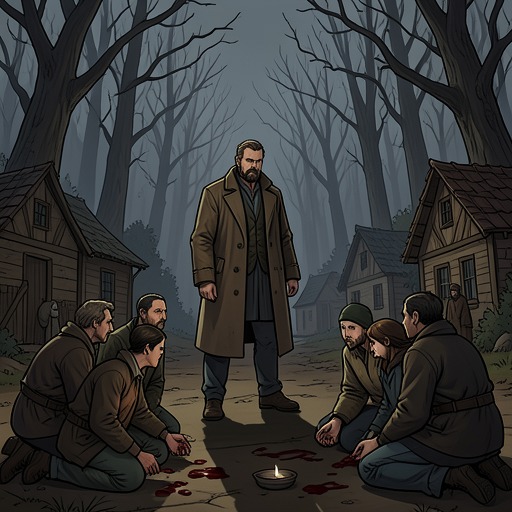
Immediately after Barlow’s destruction, Mark sees Eva, Weasel, Mabel, Grover, and the other vampires coming out of the root cellar. Ben does not face an empty refuge or a harmless remnant. He must pull Mark toward the exit, order him up the board, and invoke holy water because the undead are still able to attack. The dependents stand about fifteen feet away, passively watching Ben with a flat hatred that is explicitly no longer human, demonstrating that their agency, hostility, and supernatural condition survive the master’s death.
Eva’s response states the rule in emotional as well as structural terms. She tells Ben, “You killed the Master,” and speaks as if Barlow’s death were a grievous loss. Her words recognize his authority even after he has ceased to exist, but they do not indicate that she or the others have died with him. Ben therefore promises to return for all of them. The promise is essential: Barlow has been destroyed, but the vampires in the cellar remain separate targets whose elimination will require further action.
Consequences for the Town
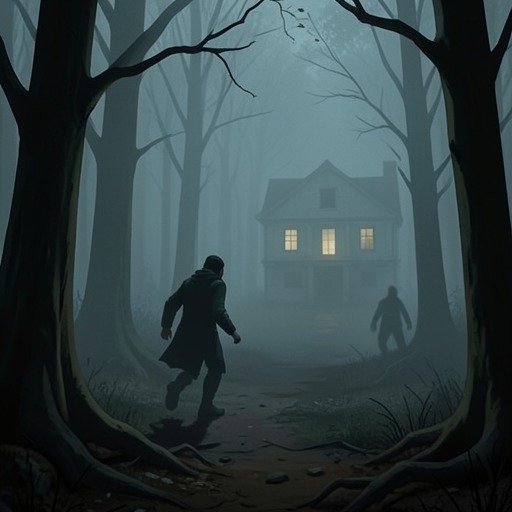
The aftermath confirms that the rule applies beyond the cellar. ’Salem’s Lot sleeps in darkness while vampires walk its streets and country roads “like a trace memory of evil.” Some have recovered enough from death to possess rudimentary cunning. Lawrence Crockett invites Royal Snow to his office under the appearance of an ordinary cribbage game, only for Lawrence and his wife to fall upon him. Glynis Mayberry calls Mabel Werts in fear and asks to spend the evening with her, but arrives naked and grinning with enormous incisors; Mabel has time to scream only once.
Other attacks follow through familiar social and commercial spaces. Carl Foreman and Homer McCaslin emerge from the shadows outside Delbert Markey’s deserted tavern and claim they have come for a drink. Milt Crossen is visited at his store by faithful customers and old cronies, while George Middler visits high-school boys who once looked at him with a mixture of scorn and knowledge. These incidents show the dependents using memory, familiarity, invitation, and ordinary community routines as predatory instruments. Barlow’s death does not restore the town’s social relations; it leaves those relations available for the vampires to counterfeit and exploit.
The town’s condition also exposes the limits of a leader-centered explanation of evil. Tourists and travelers continue along Route 12, seeing only an Elks billboard and a thirty-five-mile-an-hour sign before accelerating outside town and dismissing the place as dead. Inside the community, however, the vampire network continues to operate. The Marsten House still broods over the town like a ruined king, a residual emblem of centralized evil overlooking a threat that has already spread beyond its source.
Narrative and Thematic Significance
The rule frustrates the expectation that killing the master will automatically cure the kingdom. It rejects a convenient chain of supernatural causation in which every subordinate is merely an extension of one body. Barlow is both ruler and individual; his followers are both subjects and independent threats. His destruction removes the most powerful opponent, but it does not erase the consequences of his invasion, the identities he has altered, or the community of predators already established in ’Salem’s Lot.
The pattern also gives the novel’s religious and ritual actions a practical dimension. Holy water protects Ben and Mark during their retreat, while the earlier use of a crucifix against the Marsten House demonstrates that sacred objects can force an opening or repel evil. Yet no single ritual, even the staking and dissolution of Barlow, completes the work by itself. The attack on the master is one stage in a larger destruction protocol, and the surviving dependents preserve the danger after the apparent climax.
Most importantly, the rule changes the meaning of victory. Ben and Mark have stopped Barlow’s direct command, but they have not yet reclaimed the town. The remaining vampires can recruit, deceive, remember, and hunt; they continue to occupy domestic, commercial, and public spaces. Barlow’s death is therefore a breach in the vampire order rather than its immediate conclusion, leaving the survivors with both a continuing threat and a future obligation to destroy the dependents one by one.