Mark Petrie
'Salem's Lot: A NovelMark Petrie is the young resident whose imagination, knowledge, and decisiveness become indispensable to the resistance against the vampires overtaking Jerusalem’s Lot. Introduced as a slender, bookish boy with steel-rimmed glasses, he is initially treated as an easy target by Richie Boddin, the school bully. Yet Mark’s apparent defenselessness conceals unusual composure: the monster magazines his mother fears might damage him have given him the vocabulary to recognize what adults hesitate to name, while his own judgment allows him to turn that knowledge into action. By the end of the crisis, Mark has moved from a protected child to an informed witness, a survivor of direct supernatural attack, and one of the principal agents of the town’s counteroffensive.
Identity and Ordinary Life
Mark first appears on the school playground as a new boy whom Richie Boddin intends to dominate. He is as tall as Richie and therefore taller than most classmates, but his slender build, bookish face, and glasses make him look vulnerable. When confrontation becomes unavoidable, Mark removes his glasses and hands them to another boy, protecting the fragile object before facing the bully. The gesture is practical rather than theatrical: his intelligence is accompanied by an awareness of what must be preserved if he is to see and act clearly.
Outside school, Mark is presented as an ordinary child rather than a damaged prodigy. He lives with Henry Petrie and his mother in an upper-middle-class family that remains upwardly mobile; his parents’ marriage is sound, and they love each other even if their domestic manner is somewhat stodgy. Mark generally gets along with his peers, wants many of the same things they want, and has not been shaped by some prior great trauma. His school fights have not scarred him, and the narrative specifically resists the idea that his interest in monsters proves a disturbed psyche.
His room provides the clearest picture of how ordinary childhood play becomes preparation for extraordinary danger. While listening to his parents through the old second-floor grates of the farmhouse on South Jointner Avenue, Mark works on a model of Frankenstein’s monster. He keeps an entire table of Aurora horror monsters and continually rearranges the tableau as new pieces are added. The set includes Dracula menacing a girl, the Mad Doctor torturing a woman on a rack, and Mr Hyde creeping toward an old man. The images are products of play, but the knowledge behind them will later become a survival tool. Mark’s horror culture is not merely escapism; it is an informal education in the rules of the supernatural.
From Bully’s Target to Vampire Witness
Mark’s connection to the emerging crisis begins through the disappearance of Ralphie Glick. He was the boy Ralphie and Danny Glick had been on their way to see on the night Ralphie disappeared, a detail that places him near the outbreak before he understands its meaning. At Danny’s funeral, Mark is part of the procession that travels up Burns Road behind Carl Foreman’s hearse and Tony Glick’s 1965 Mercury. The public ceremony gathers relatives, neighbors, and children around a death that the town still treats as an ordinary family tragedy, even while the circumstances are becoming increasingly impossible.
The decisive change comes when Danny Glick appears at Mark’s bedroom window. Danny’s skin is grave-pale, his eyes are reddish and feral, dark substance stains his lips and chin, and his smile reveals teeth that have grown long and sharp. Mark does not need an adult explanation to understand what he is seeing. His monster magazines have already taught him the relevant rule: the creature must be invited inside. The scene reverses the expected relation between adult knowledge and childish ignorance. Mark is frightened, but fear does not erase his ability to interpret evidence.
Mark then acts with a speed that adult hesitation might have destroyed. He gathers the cross, closes it in his fist, and says, “Come on in, then.” The invitation is a deliberate trap rather than a surrender. The cross repels Danny, demonstrating that Mark’s knowledge is not ornamental lore but a working defense. His faith is not presented as a formal theological system; the object becomes effective through Mark’s conviction and his readiness to use it. The encounter establishes the pattern that governs his later role: he sees the supernatural threat, identifies its rule, and converts a small household object into a weapon.
Intelligence Under Pressure
Mark’s courage is practical and investigative. When he later encounters the sound of snapping twigs in the daytime, he hides behind a large spruce and waits. He understands that the vampires cannot emerge in daylight, but he also understands that their human servants can operate for them. He has seen Richard Straker in town and remembers his disturbing eyes and apparent capacity for violence. This is a crucial expansion of Mark’s understanding: the enemy is not limited to the nocturnal dead, because the vampire system includes living agents who can move through ordinary society.
His intelligence also appears in the questions he asks while the adults are still trying to organize their response. Mark notes that there is no pool hall in Jerusalem’s Lot and identifies Gates Falls as the nearest likely destination, testing whether a suspect would realistically have gone there. Such remarks show him treating the crisis as a pattern of locations, habits, and constraints rather than as a series of isolated horrors. He is not simply repeating what adults tell him. He contributes observations that help transform rumor into investigation.
The adults increasingly recognize that Mark possesses knowledge they lack. When Jimmy Cody is relieved to see him, Mark is not treated merely as a child to be sheltered. Someone asks whether he knows the most important job, and the question places responsibility on him. When Ben Mears introduces him to the group, he explains that Mark had received a visit from Danny Glick and that the boy can tell the rest. Mark’s testimony therefore becomes evidence. His experience is not dismissed as imagination, and his childhood reading becomes a source of operational knowledge for the adult resistance.
Conflict with Straker and Barlow
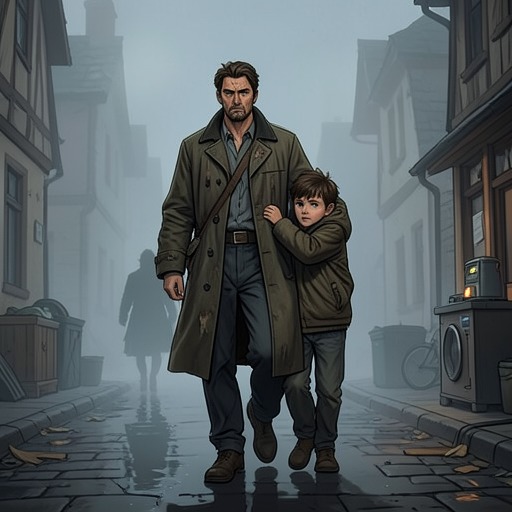
Mark’s first major human antagonist is Richard Straker, whom he associates with the vampires’ daytime operations. When Mark later returns to Eva Miller’s Rooms, his eyes are hollow, his T-shirt is smeared with blood, and his expression is stunned and slow. The physical signs record the cost of his participation more starkly than any declaration could. He has not remained an untouched observer; the investigation has brought him into direct bodily danger.
Even after this ordeal, Mark delivers crucial information to Ben Mears. He introduces himself formally and warns Ben that he has bad news. He reports that Susan Norton has become one of the vampires after Barlow got her at the house, and he adds that he killed Straker, while carefully qualifying the claim with the uncertainty that he thinks he did so. The qualification matters. Mark is brave without pretending omniscience, and his report separates what he knows from what he can only infer.
His testimony also identifies the wider pattern of violence. Asked about a disturbing sign connected with the cemetery, Mark points to the dog found on the cemetery gate. He helps the adults connect separate incidents—the disappearances, the bodies, Straker’s activities, Susan Norton’s transformation, and the town’s mounting disorder—into a single enemy structure. In this sense, his role is both combatant and knowledge producer: he supplies the clues by which the adults can understand what they are fighting.
Development and Continuing Role
Mark’s development is not a simple abandonment of childhood. The horror models remain part of his imaginative world, but the difference between the model table and the real vampire threat becomes impossible to ignore. The child who once arranged Dracula, the Mad Doctor, and Mr Hyde in a tableau now recognizes Danny Glick at a window and uses a cross against him. Play has become rehearsal, and rehearsal has become disciplined action.
The crisis also changes his relation to adult protection. Father Callahan’s car in the Petrie driveway produces an immediate physical reaction: Mark sucks in his breath, looks away, and loses all color from his face. The reaction reveals how much terror remains beneath his competence. His courage does not mean fearlessness; it means that fear and action coexist. Later, when he wakes during the flight from Jerusalem’s Lot and discovers that it is dark outside, fright seizes him, and he claws for the cross still hanging around his neck. The object has become both weapon and reassurance, a portable reminder of the rule that once saved him.
Mark’s final importance lies in his willingness to enter danger because his smaller size gives him an advantage. During the plan to attack Barlow, he states, “I’m smaller,” and volunteers to go in. The decision is not framed as childish recklessness. It is a tactical judgment based on his body, his prior experience, and his knowledge of the enemy. The boy whom Richie Boddin had read as a defenseless target has become someone whose physical difference can determine the plan’s success.
Narrative Role and Significance
Mark embodies the novel’s insistence that supernatural evil cannot be confronted by authority alone. The town’s adults are surrounded by rumor, denial, institutional hesitation, and competing explanations, while Mark’s monster magazines provide a crude but surprisingly accurate grammar of danger. He recognizes the invitation rule, trusts the protective power of the cross, notices the role of human agents, remembers physical clues, and reports what he has seen with unusual precision.
His importance is also ethical. Mark does not gain power by becoming less humane or by imitating the violence of the vampires. He remains a child with parents, school relationships, toys, and fear, yet he accepts responsibilities that adults cannot safely leave to him. His actions repeatedly convert vulnerability into agency: the boy with glasses faces the bully; the reader of monster magazines faces Danny Glick; the witness to Straker’s violence becomes an informant; and the smaller member of the resistance volunteers for the dangerous entry.
Mark therefore serves as both survivor and counterpoint to the town’s collapse. Jerusalem’s Lot is increasingly described through disappearance, rumor, blood, and darkness, but Mark preserves the possibility that knowledge can still lead to resistance. His story does not erase childhood; it shows childhood becoming politically and morally consequential when adults fail to recognize the shape of the threat. Through Mark, the novel makes imagination a form of preparation, testimony a form of combat, and courage a repeated decision made in full awareness of fear.