Mark Petrie repels Danny Glick
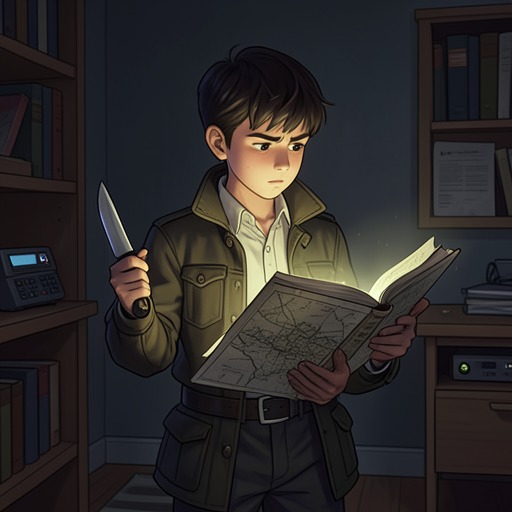
'Salem's Lot: A NovelMark Petrie repels Danny Glick during a night encounter that transforms a child’s bedroom into a supernatural threshold. Danny, no longer merely the missing boy from the Glick family but a predatory undead creature, appears outside Mark’s second-floor window and attempts to gain entry through persuasion, command, and hypnotic attraction. Mark’s refusal to surrender his will, followed by his use of a plastic cross, makes the scene a decisive early demonstration that the vampire’s power is real but not absolute.
The Nighttime Threat
Something awakens Mark in a house that otherwise seems silent. The scratching returns, and when he looks through the window he sees Danny Glick staring in at him through the glass. Danny’s skin is grave-pale, his eyes are reddish and feral, and a dark substance stains his lips and chin. His smile reveals teeth that have grown hideously long and sharp, converting the familiar face of a child into the face of a hunter.
Danny’s position makes the apparition more terrifying: Mark’s room is on the second floor, with no ledge on which a human visitor could stand. The creature nevertheless hangs in the air or clings to the shingles like a dark insect. Its physical impossibility prevents Mark from explaining the sight as an ordinary intrusion, while its resemblance to Danny makes the danger intimate rather than anonymous.
Danny first asks to be admitted, whispering, “Let me in.” He then appeals to their former familiarity by saying that he wants to play with Mark, and finally shifts from pleading to command. The progression exposes the mechanism of the attack: the vampire does not simply break through the window but seeks permission that will make the invasion possible.
Mark’s Resistance
Mark understands the danger before he can fully articulate it. His body recognizes the threat ahead of his conscious mind, and he judges within seconds that he is in peril of more than his life. The fear is greater than anything he has previously experienced, including the memory of nearly drowning while swimming back from the float at Popham Beach. His child’s imagination does not make him helpless; in this moment it gives him a vocabulary for recognizing the supernatural.
The crucial knowledge comes from the monster magazines his mother worries might damage or warp him. Mark remembers the rule that a vampire must be invited inside. The knowledge is childish in its source but exact in its application: the story-world’s folklore becomes a survival manual, while adult deliberation might have delayed the decision long enough to destroy him.
Danny’s eyes carry a second danger. Mark senses that looking into them makes the horror seem bearable and promises an end to fear through surrender, a joining with Danny and the others. The seductive vision is interrupted by Mark’s inward refusal: “No! That’s how they get you!” Dragging his eyes away requires all his willpower, but doing so preserves the boundary between his own judgment and the vampire’s command.
The Plastic Cross and the Reversal
A plastic ghoul on Mark’s display is walking through a plastic graveyard, and one of the grave monuments is shaped like a cross. Mark acts without the hesitation that an adult might have brought to the situation. He sweeps up the cross, curls it into his fist, and loudly invites Danny to enter. The apparent invitation is a calculated trap: Mark allows the vampire to cross the threshold only after arming himself with the object that can repel it.
Danny responds with vulpine triumph. The window slides upward, and Danny steps into the room, taking two paces forward. His breath smells of charnel pits, and his cold, fish-white hands descend onto Mark’s shoulders. The attack momentarily seems to have succeeded, with the vampire physically inside the room and Mark within reach of its shining canines.
Mark then brings the plastic cross around in a vicious swipe and lays it against Danny Glick’s cheek. The ordinary object becomes visibly charged at the instant of contact. Danny’s scream is horrible and unearthly but silent in the external world, reverberating instead through Mark’s mind and soul. The creature’s triumphant smile collapses into agony; smoke spurts from its pallid flesh, and the flesh yields like smoke as Danny twists away and half dives, half falls through the window.
Consequences and Significance
The encounter ends as abruptly as it began, “as if it had never happened,” but the cross retains a fleeting sign of the violence. It shines with a fierce inner light before fading and leaving a blue afterimage in front of Mark’s eyes. The aftermath confirms that the object’s effectiveness is not merely psychological: Danny’s body is physically damaged and forced out of the room.
The event therefore establishes several rules that govern the struggle against the vampires. Entry depends on invitation; the vampire’s gaze can weaken resistance; and a cross can function as a ward when it is wielded with sufficient conviction. The fact that the cross is plastic is especially important. Its material value is negligible, yet it becomes potent in Mark’s hand, making faith and will more consequential than the object’s commercial or physical worth.
Mark’s defense also changes his position in the story. He is not simply a frightened child witnessing the outbreak but an active opponent capable of recognizing the vampire, resisting its mental pressure, and improvising an effective weapon. The scene’s value shift is immediate: Mark moves from isolated peril to temporary safety, while Danny moves from apparent mastery to repulsion. The victory does not erase the threat, but it proves that the undead can be confronted and that knowledge, self-command, and belief can interrupt the spread of the darkness.