Marsten House
'Salem's Lot: A NovelMarsten House is the ruined residence overlooking Jerusalem’s Lot and the decisive physical symbol of the town’s buried violence. Once the home of Hubert Marsten and Birdie Marsten, it becomes associated with murder, suicide, child disappearances, Ben Mears’s childhood terror, and the later occupation of Kurt Barlow and Richard Straker. Its location above the town gives it both literal command and supernatural significance: the house watches the settlement, gathers its secrets, and becomes the point from which an old evil reenters ordinary social life.
Setting and Physical Appearance
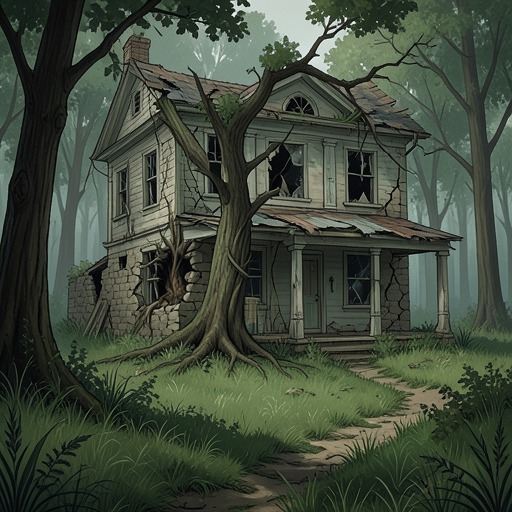
Marsten House stands beyond the town, among pine and spruce trees that rise in gentle slopes toward the eastern sky. From the approach, Jerusalem’s Lot can disappear entirely behind the woods; only the peaked, gabled roof remains visible. At the crest of the road, however, the landscape opens dramatically: the town lies on one side and Marsten House on the other, making the building the first overwhelming image of the settlement for Ben Mears when he returns. The house is huge, rambling, sagging, and visibly abandoned. Its windows are boarded at random, its paint has weathered into a uniform gray, and windstorms have torn away many shingles. Heavy snow has punched in the western corner of the main roof, leaving the structure with a slumped, hunched posture. A tattered no-trespassing sign hangs from the right-hand newel post. The damage is not picturesque decay but a physical record of neglect, as though the building’s structure has absorbed the violence associated with it. Its position makes the decay unnervingly active. Marsten House looks toward the town, stands high on Marsten’s Hill, and commands a nearly 360-degree view of the township. From the Brooks Road, Father Donald Callahan realizes that it actually looms over Jerusalem’s Lot, perched above the crossroads of Jointner Avenue and Brock Street. With its shutters closed, the house takes on the shape of a sarcophagus-like monolith, and its elevation turns architecture into surveillance: the town lives below the gaze of the place that contains its worst history.
History of Violence and Collective Memory
The house’s reputation begins with the violence committed by Hubert Marsten. Hubert was a mobster whose trucking company served as a front, and the years he spent with Birdie Marsten in the house are surrounded by guarded rumors. The most public part of the history is the murder-suicide: Birdie was found sprawled in the kitchen after Hubert shot her at close range with a thirty-ought-six, while Hubert later hanged himself upstairs. The house therefore carries two distinct but connected scenes of death, one domestic and one self-inflicted. The story of the murders survives through Jerusalem’s Lot’s oral memory. The scandal occurred before the current generation was born, yet the town passes it down ceremonially, with the horror retold to successive members of the Ladies’ Auxiliary and older residents maintaining a private circle of knowledge. People will discuss Hubert’s death and the murder, but the ten years he and Birdie spent in the house remain a taboo. Whispers claim that Hubert kidnapped and sacrificed small children to infernal gods, though the evidence presented is rumor rather than public fact. The distinction matters: Marsten House is frightening not only because people know what happened there, but because the town knows that it does not know everything. That secrecy gives the building a social life beyond its walls. Jerusalem’s Lot presents itself as a nice little town in which nothing truly terrible can happen, while Marsten House preserves the contradiction beneath that confidence. Its history becomes a form of collective inheritance, transmitted through gossip, silence, and selective disclosure. The house is thus both a local landmark and an archive of suppressed knowledge.
Ben Mears and the House’s Return to Attention
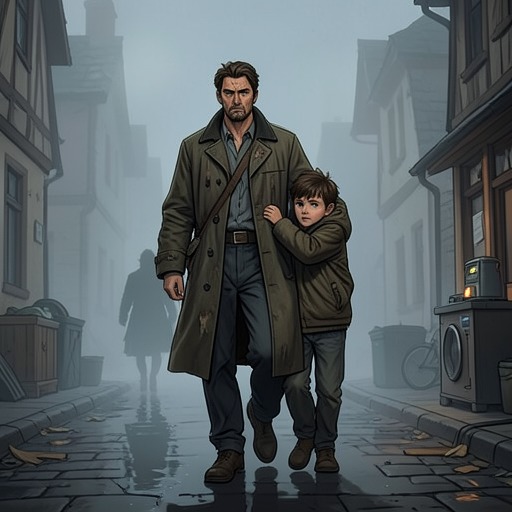
Ben Mears’s relationship with Marsten House begins in childhood, when he entered it on a dare as an initiation into a club. He brought out a snow globe from the cluttered front hall but stayed because he wanted to prove himself. He climbed upstairs to the room where Hubert Marsten had hanged himself, opened the door, and saw Hubert hanging from the beam with his body silhouetted against the window light. The experience remains lodged in him for twenty-four years, and his return to Jerusalem’s Lot is partly an attempt to write the memory out of his system. When Ben comes back, the house is almost exactly as he remembers it: unpainted, leaning, ominous, and apparently pregnant with further horrors beyond the known murder-suicide. Its upstairs windows resemble vacant eyes beneath steep eaves, with faded green shades that make them seem cataracted. Broken glass from boys’ stones does not lessen the impression of malignancy; it intensifies it. Ben’s book gradually reveals itself as a book about Marsten House rather than merely about the town, because the building has become the organizing image through which he understands both his childhood and the present crisis. Ben also chooses a room at Eva Miller’s boardinghouse specifically because it faces Marsten House. The decision makes the building a fixed object in his daily consciousness. He can see its rooftop over the trees, notice when lights appear, and register the presence of a car in its driveway as a disturbance in the town’s routine. His attempt to confront the past therefore does not place the house behind him; it keeps the house in view until personal memory and current danger become inseparable.
Reoccupation and Supernatural Function
After more than three decades of vacancy, Marsten House is sold and occupied again by Richard Straker, who arrives in partnership with Kurt Barlow. The reoccupation immediately alters the meaning of the building. Ben had considered renting it, but learned that it had already been sold. Lawrence Crockett, who handled the sale of the house and the long-defunct Village Washtub in a package deal, regards it as the strangest transaction of his career. The appearance of a car in the driveway is itself alarming because residents have not seen a car there for years. The house’s new occupants do not restore it into a welcoming home. During a delivery, Hank Peters and Royal Snow see it dark, shuttered, and crepitating; the building seems to loom ahead of the truck. Their fear differs from the rational fear of war or physical danger. It is childlike and dreamy, without a clear reference point, as if the house generates dread simply by being present. Straker’s interest in the building and his insistence on asking others how they like the old house make its occupation feel less like residence than deliberate activation. Ben develops the theory that Hubert Marsten’s evil has accumulated in the building. He imagines it as a supernatural beacon or psychic sounding board, a structure holding the essence of Hubert’s evil in its moldering bones. Matthew Burke restates the idea as an evil dry-cell, a malign storage battery: human beings manufacture evil, and the residue does not disappear. Whether treated as paranormal fact, psychological projection, or a metaphor for historical violence, the theory explains why the reoccupation feels causally important. The house is not merely a backdrop for the outbreak; it is the charged site that Barlow and Straker have chosen to inhabit.
The House as Vampire Headquarters
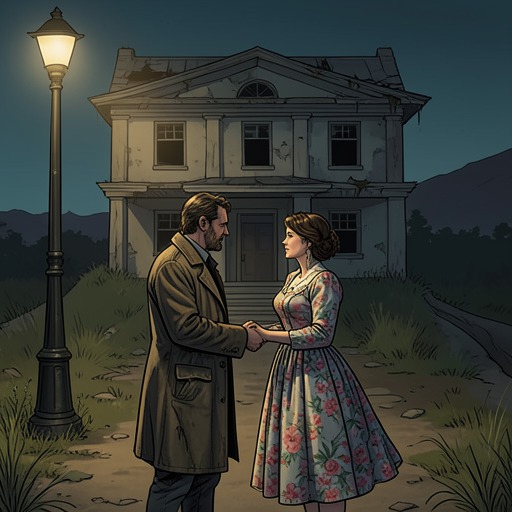
Once Barlow and Straker occupy Marsten House, the building becomes the center of the vampire conspiracy. Ralphie Glick disappears almost immediately after the house is reoccupied, recalling the earlier period in which four children vanished over ten years. The repetition makes the house’s return look like a recurrence rather than a coincidence. Local suspicion focuses on the building because the pattern of disappearances begins again at the moment it becomes inhabited. Susan Norton and Mark Petrie enter the house while attempting to understand and eventually kill Barlow. Susan initially sees no renovation: the interior remains a mess, and the shutters are still closed. In an alternate manuscript version, however, the house had been partially restored with wine-colored silken wallpaper, wing chairs, a deep green velour sofa, a mahogany rolltop desk, a framed reproduction of Rembrandt’s Boy at his Studies, sliding doors, and a chandelier. The published version’s continuing disorder emphasizes ruin rather than domestic recovery, while the surviving alternate description shows how easily the building might have been made to resemble a stately Victorian mansion concealing its history beneath surfaces of taste. The house’s interior descends from the haunted upper room into the cellar. Ben and Susan encounter an extensive wine cellar filled with dusty casks, cobwebs, crossed wine racks, and ancient magnums. Some bottles have burst, some wine has turned to vinegar, and the smell of corruption mingles with the remains of former luxury. The cellar is both evidence of Hubert’s bootlegging and an underground continuation of the house’s moral decay. At its deepest level, Ben and Mark face rats around a pool table wrapped in plastic and find a dark, huddled shape on the concrete floor in a pool of liquid that may be oil. The upper bedroom retains its power even after Ben has become an adult and joined the effort against Barlow. When the anti-vampire group returns to the house, Ben approaches the door where Hubert died and feels the old terror again. Callahan opens it, and the room provokes a scream before the group can fully process what it contains. Barlow’s taunting letter, left in the house, announces that someone close to Ben has been placed where Barlow once spent his days and that Susan has been left as an appetizer for the coming confrontation. The house turns personal memory into a weapon, using its rooms to connect Ben’s childhood trauma with the vampire master’s threat.
Destruction, Afterlife, and Significance
The destruction of Barlow and the clearing of the house strip Marsten House of its accumulated force. After the final struggle, the house looms without purpose, its evil taken away; it is just a house again. This change does not erase its history, but it breaks the relationship between the building and the active supernatural power that had made it seem alive. Architecture remains, while possession ends. Even afterward, the house continues to dominate the abandoned town’s imagination. Its shutters remain closed, its lawn fills with knee-high witch grass and goldenrod, and its malevolent silhouette overlooks empty streets. Ben considers that it might become a shrine or a dark lighthouse over the shunned, deadly settlement, imagining the vampires returning to its halls for twisted services. The possibility shows that the house’s evil has been defeated without becoming psychologically harmless. Marsten House also functions as a counter-image to ordinary town life. Jerusalem’s Lot is mapped by roads, commercial buildings, trailers, cemeteries, schools, and domestic spaces, yet the house stands outside the town’s reassuring routines while remaining visibly connected to them. It is elevated, secluded, and difficult to approach, but its windows and hilltop position make it impossible for the town to escape its presence. The vampire outbreak therefore spreads through a social landscape already organized by the house’s gaze. The building’s final significance lies in its fusion of place, memory, and recurrence. It contains the violence of Hubert and Birdie Marsten, preserves the town’s forbidden stories, reopens Ben Mears’s childhood wound, and provides Barlow and Straker with a strategic and symbolic base. It is a Gothic ruin, an archive of communal secrecy, a supernatural beacon, and a monument to the way evil can remain stored in ordinary structures until history gives it a new occupant. Once that force is removed, the house becomes physically ordinary again—but the town’s knowledge of what happened there ensures that it can never become innocent.