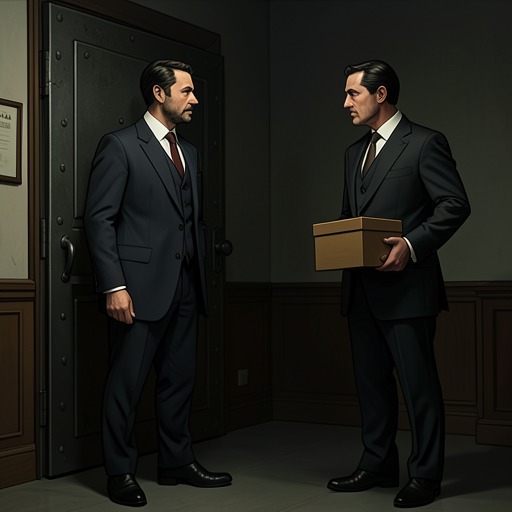
Marsten House Sideboard Delivery
'Salem's Lot: A NovelThe Marsten House Sideboard Delivery begins as ordinary commercial labor and ends as a flight from an unnamed horror. Hank Peters and Royal Snow carry a sideboard into the Marsten House, where the building’s stale corruption, cellar, and unexplained movements convert a practical errand into their first direct encounter with the house’s supernatural atmosphere. The value of the scene shifts from control and routine to helpless terror: the men arrive as workers handling an object, but leave as witnesses who cannot explain what they have sensed.
A Routine Job Entering a Hostile House
Hank and Royal unload boxes at the Marsten House and place them carefully inside, working quickly enough that Royal can close the back door and secure it with one of the new padlocks. The work appears manageable, even though the house has been shut for so long that Hank detects a dry, acrid odor resembling old corruption. Hank explains it as stale air and says the building needs airing out, but Royal’s response is more severe: he suggests that it may need to be burned down. His dislike is immediate and bodily; something about the place puts his back up before either man can identify a concrete danger.
Their unease intensifies when Hank drives the truck around the house toward the cellar bulkhead. The house seems to lean toward them as though awaiting their arrival, while the headlights pass over the rank grass without either man examining what might be there. Hank, a veteran who had experienced fear in Vietnam, distinguishes this sensation from rational battlefield danger. Combat fear had recognizable causes and reference points; the fear produced by the Marsten House is childlike, dreamy, and without an explanation that his mind can accept. He rejects ghosts and insists that a house consists only of boards, hinges, nails, and sills, yet the building appears to exhale a chalky aroma of evil through its splintered cracks.
Descent into the Cellar
The delivery’s central action is the men’s descent through the open, rusted bulkhead doors. In the red glow of the truck’s taillights, the shallow stone steps seem to lead down into hell. Hank openly admits that he does not like the place, and Royal agrees. They nevertheless carry the sideboard downward, bent beneath the low ceiling and forced to move like hags beneath the weight of the furniture. The physical difficulty of the task makes the space feel less like a passageway than a trap: the men cannot stand upright, cannot see beyond the limited cellar, and cannot easily retreat while bearing the sideboard.
They finally set the piece down with a thump and step away from it. At that instant their fear changes into near terror through an alchemy neither can name. The cellar seems filled with secret rustling noises. Rats are the most plausible explanation, but the narration leaves open the possibility of something that should not be contemplated. This uncertainty is crucial to the event’s horror. Nothing is clearly identified, yet the enclosed architecture makes every sound carry the pressure of a hidden presence. The sideboard, an ordinary object being delivered for use, becomes part of a forbidden interior whose history and contents remain concealed.
The Rat, the Box, and the Broken Nerve
The men bolt from the cellar, with Hank first and Royal immediately behind him. Royal slams the bulkhead doors, and both climb into the cab of the U-Haul. He then grabs Hank’s arm; in the darkness, his face appears to consist of huge, staring eyes. Their fear has become collective and physical rather than merely private. Neither man needs to persuade the other that the house is dangerous; their bodies have already reached the same conclusion.
Royal’s response also reveals the scene’s coercive pressure. When Hank realizes that the keys and flashlight have been left below, Royal catches them when they are thrown back and goes down again. Hank follows only after Royal opens the bulkhead doors, forcing his legs to carry him into the cellar. The flashlight exposes a long space that turns at an L thirty feet farther on and disappears into an unknown continuation. A dusty table with a checked cloth stands in the beam, and a huge rat sits upon it without moving. Its plump haunches and almost-grinning posture make the animal less a solution to the cellar’s noises than another grotesque sign within it.
Hank walks past the box toward the table and calls at the rat, but an abrupt snap behind him breaks the fragile pretense of control. He panics and sees that one of the aluminum bands around the box has come loose, projecting toward the low roof like a pointing finger. The object’s mechanical failure is enough to trigger his flight, but the moment is terrifying because an ordinary fastening suddenly behaves like an accusing or beckoning gesture. The box does not need to reveal its contents; its broken band turns material pressure into apparent intention.
Flight and Immediate Consequence
Hank stumbles up the stairs, slams the bulkhead shut, locks the catch, and runs to the truck. His body is covered in gooseflesh, though he will not recognize that fact until later, and his breathing comes in small, whistling gasps like that of a hurt dog. Royal asks what happened and what he saw, but Hank throws the truck into drive, roars around the corner of the house on two wheels, digs into the soft earth, and does not slow until he reaches Brooks Road on the way toward Lawrence Crockett’s office in town. Even after escape, he shakes so violently that he fears he may have to pull over.
Hank’s final denial is the event’s most revealing spoken response. When Royal asks what was down there, Hank says that there was nothing, that he saw nothing, and that he never wants to see it again. The denial does not restore rational control; it confirms how thoroughly the cellar has defeated it. The men’s job is technically completed only in part—the delivery has reached the house, but the experience has made the building’s ordinary ownership and use appear morally and physically unsafe. Their retreat establishes the Marsten House as more than an abandoned structure: it is an active source of dread whose evil can be felt before it can be explained.
Narrative Function and Gothic Significance
The scene functions as an early warning that the Marsten House possesses a history and agency exceeding its visible materials. The odor of corruption, the house’s apparent inclination toward its visitors, the cellar steps likened to a descent into hell, the unseen rustling, the motionless rat, and the snapped aluminum band form a chain in which perception repeatedly outruns proof. The narration does not disclose a monster or provide a complete explanation. Instead, it makes the building’s architecture carry the burden of the unknown: the low ceiling bends the men, the bulkhead seals and reopens a threshold, and the cellar’s L-turn promises spaces beyond the flashlight’s reach.
The delivery also establishes a recurring contrast between rational dismissal and involuntary bodily knowledge. Hank calls his fear stupid, rejects ghosts, and accepts the stale-air explanation, while his heart, skin, breathing, and driving betray a different judgment. Royal is less willing to rationalize what he feels, but he too can do little beyond insist that they leave. Their professional familiarity with heavy transport cannot master the house; the sideboard can be lifted, the boxes can be locked away, and the truck can escape, but none of those practical actions can make the cellar intelligible.
As a plot event, the delivery prepares the Marsten House’s reoccupation and the broader conflict surrounding the building. It links commerce—the arrival of furniture and the securing of the house—to an older evil that is already waiting inside. The men do not uncover the full secret, and the event’s power comes precisely from that incomplete knowledge. They bring an ordinary object into the house, yet what the scene truly delivers to the narrative is testimony: the first unmistakable sign that entering the Marsten House means crossing into a space where ordinary explanations, professional courage, and physical barriers may all fail.