Mass disappearance
'Salem's Lot: A NovelMass disappearance is the condition through which Jerusalem’s Lot loses its population, its institutions, and finally its ordinary identity. At first, the absences can be explained as people moving away, avoiding debts, or seeking work elsewhere; taken together, however, they become evidence of a town-wide catastrophe whose truth the survivors cannot or will not articulate.
From Ordinary Mobility to Collective Absence
Jerusalem’s Lot had been a comfortable rural township of 1,319 inhabitants in the 1970 census, a place where young people commonly left after graduation and where population movement could be treated as a normal feature of American life. The former constable, Parkins Gillespie, had gone to live with his sister in Kittery; Charles James had moved his repair business to Cumberland; Pauline Dickens had relocated to Los Angeles; and Rhoda Curless was working with the St Matthew’s Mission in Portland. These “un-disappearances” initially allow the missing-person pattern to be absorbed into familiar explanations of mobility.
The state police likewise interpret some cases through debt, bereavement, and economic failure. Lawrence Crockett vanished with his wife and daughter after leaving questionable land ventures behind, while the Royce McDougalls had lost their infant son and appeared to have little reason to remain. Chief Peter McFee regarded Royce McDougall as a debtor who had simply fled before banks and finance companies could catch him, emphasizing that missing persons were common in an automobile-oriented society. This practical account makes the later mystery more disturbing, because it establishes a plausible social framework that cannot contain every disappearance.
The Unanswered Pattern
The decisive feature of the state is not merely that people are absent but that those who can be found refuse, or seem unable, to explain their departures. Parkins Gillespie offered only that he had decided to leave. Charles James attributed his departure to the collapse of his business. Pauline Dickens did not answer an inquiry, and Rhoda Curless refused to speak about Jerusalem’s Lot at all. Their silence turns relocation into testimony without content: each response is ordinary in form, yet collectively it suggests that the town has become an object of fear or forbidden knowledge.
The list also includes people for whom the usual explanations are inadequate. Henry Petrie, his wife, and his son are gone even though Henry was a Prudential Insurance executive who could not plausibly be dismissed as a debtor or fugitive. The local mortician, librarian, and beautician are likewise placed among the missing. State authorities want at least to locate or hear from John Groggins, pastor of the Jerusalem’s Lot Methodist Church; Father Donald Callahan, parish priest of St Andrew’s; Mabel Werts, a prominent widow in church and social affairs; Lester and Harriet Durham of Gates Mill and Weaving; and Eva Miller, who operated a local boardinghouse. The range of these names shows that the disappearance crosses occupation, class, age, and social position rather than belonging to one marginal group.
A Town Rewritten by Rumor and Space
As the official explanations fail, surrounding communities begin a whispering campaign that turns the emptied town into legend. Jerusalem’s Lot is reputed to be haunted; colored lights are said to hover over the Central Maine Power lines; and some people speculate about UFOs or a dark coven whose black-mass practices brought divine punishment upon the town. Others recall young men who disappeared in Houston and were later found in mass graves, translating local uncertainty into the language of crime. These competing explanations do not resolve the mystery. They demonstrate how a community tries to make an absence legible by attaching it to whatever narrative—supernatural, religious, technological, or criminal—its listeners can recognize.
The town’s physical organization intensifies that process. Brock Street and Jointner Avenue cross at right angles through a nearly circular township, with the Royal River flattening the eastern boundary. The wooded northwest rises toward the Marsten House; the northeast opens into farms and the river; the southeast contains prosperous agricultural land and commuter homes; and the southwest Bend is crowded with trailers, junked cars, beer cans, children, and makeshift yards. Roads, bridges, fields, woods, and marginal housing create a map of differing visibility and vulnerability. The disappearance therefore does not occur in an abstract setting: it moves through a socially divided landscape whose inhabitants know one another’s routes, habits, debts, scandals, and hiding places.
The Lot’s confidence in its own safety is part of the condition’s irony. Its residents receive national wars and crises largely through television, while local life proceeds according to a slower schedule. Fatal accidents and youthful drinking exist, but they are treated as exceptions to the town’s governing assumption that nothing truly terrible can happen there. That assumption collapses when ordinary departures accumulate into depopulation. The town’s familiar roads and empty buildings become a visible contradiction of the belief that local intimacy guarantees protection.
Historical Memory and Concealed Violence
The mass disappearance is made intelligible through older absences and buried crimes. Jerusalem’s Lot was incorporated in 1765, and its history is preserved through stories repeated across generations. The Marsten House remains the town’s central inherited scandal: Hubert Marsten killed Birdie Marsten, although the community does not know the full circumstances, and four children disappeared between 1928 and 1939 while Hubert and Birdie lived there. None of those children was ever found. The earlier cases establish a recurring pattern in which disappearance is recorded without being understood, then absorbed into local memory as a troubling but incomplete story.
The town’s secrets are similarly distributed between public knowledge and suppressed detail. Residents know, or think they know, that Albie Crane’s wife ran away with a traveling man, but not that Albie killed her and hid her body in an old well. They know that Hubert Marsten killed his wife, but not that Birdie begged him to do it. Older women remember charred papers found in the Marsten House, without knowing that they represented years of correspondence between Hubert Marsten and an Austrian nobleman. Such gaps make the later population loss feel less like an unprecedented intrusion than the latest eruption of a history that the town has repeatedly preserved in distorted fragments.
The same structure extends farther back. Robert Boone’s diary records a 1789 disappearance that occurred four days after his final entry and connects Jerusalem’s Lot to a fanatical Puritan sect, familial bloodlines, and a desecrated church. The diary suggests that the town was founded in 1710 by James Boon’s splinter religious group and that its communal life involved exorcisms, incest, and religious control. Much later, papers concerning Charles Boone describe another cycle of obsession and violence, ending in the assumption that a recurrence of brain fever led Charles Boone to murder Calvin McCann. Across these periods, records, rumor, and forged or incomplete documents make disappearance both an event and an archival problem: the dead vanish, while the explanations surrounding them become unstable.
The Final Emptying and Its Meaning
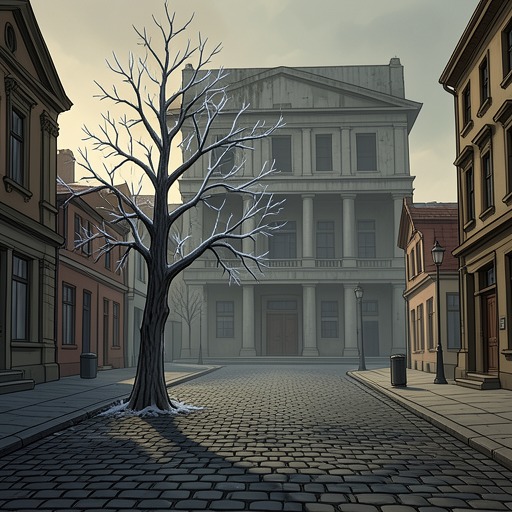
By the time the town can be visited after the recent disappearances, the process has reached its material conclusion. No business remains open. Spencer’s Sundries and Pharmacy closed in January, and Crossen’s Agricultural Store, the hardware store, Barlow and Straker’s Furniture Shop, the Excellent Café, and the Municipal Building are boarded up. The grammar school and the tri-town consolidated high school are empty, their furnishings and books transferred to temporary facilities in Cumberland. There will be no children from Jerusalem’s Lot in the new school year; the town contains abandoned shops, deserted houses, overgrown lawns, empty streets, and neglected back roads.
The emptied geography is accompanied by a strange nocturnal behavior among those who remain awake. Some residents turn on every light, search drawers and attic boxes for religious symbols, and move cautiously from room to room without understanding what they fear. Above all, they do not look out their windows. The gesture reveals a knowledge deeper than conscious explanation: the inhabitants may not know the truth, but their bodies recognize that the town is no longer safe to observe from the ordinary domestic position.
The condition culminates in the transformation of Jerusalem’s Lot into a place where people are not simply missing but removed from the social world that once named and monitored them. The town’s first explanations—migration, debt, grief, failed businesses—remain partly true, yet they become inadequate beside the disappearance of respectable professionals, clergy, children, and whole families. Mass disappearance thus functions as both a plot condition and a historical pattern. It exposes the limits of official rationality, turns collective silence into evidence, and makes the abandoned town the final visible record of a violence that its inhabitants had long been practicing, remembering, and refusing to see.