Matt Burke Repels Mike Ryerson
'Salem's Lot: A NovelMatt Burke Repels Mike Ryerson is the decisive confrontation in which Matt Burke recognizes that the figure before him is no longer the cemetery worker he knew but the vampiric return of Mike Ryerson. The scene converts Matt’s earlier intellectual unease into immediate physical danger, then gives him a means of resistance through the crucifix and the authority of spoken refusal. Mike’s retreat through the window demonstrates that invitation can be withdrawn and that faith, even under extreme terror, can become an active supernatural force.
Causes and Background
The encounter is prepared by Mike Ryerson’s desecration of Danny Glick’s grave. After returning to Harmony Hill Cemetery, Mike opens the boy’s coffin and finds Danny’s eyes open, his face animated by “hideous life,” with no death pallor and cheeks that appear “rosy, almost juicy with vitality.” The discovery is not merely a gruesome revelation about one corpse. It marks the collapse of the boundary between burial and continued activity, and it places Mike in the path of the same force that has restored Danny Glick. The cemetery’s larger atmosphere is already associated with ritualized evil: a dark figure stands inside its gate, invoking the “Lord of Flies” and presenting spoiled meat and reeking flesh as a sacrifice. Against that background, Mike’s later appearance in Matt Burke’s house is the consequence of an unseen contagion becoming personal and domestic.
Matt’s resistance also belongs to a wider pattern of religious and symbolic action. In the early days of his seminary education, Father Donald Callahan had laughed at a blasphemous sampler that asked for serenity, tenacity, and good luck not to fail too often; years later, the crude credo seems increasingly true to him. The novel repeatedly places ordinary human inadequacy beside ritual demands that exceed it. A makeshift cross fashioned from tongue depressors is blessed in haste when Ben Mears and Jimmy Cody confront the supernatural, while Father Donald Callahan later leads an assault on the Marsten House by striking its door with a crucifix and commanding the evil to depart. Matt’s crucifix therefore participates in an established, though imperfectly understood, system of protection rather than functioning as a decorative religious emblem.
What Happens
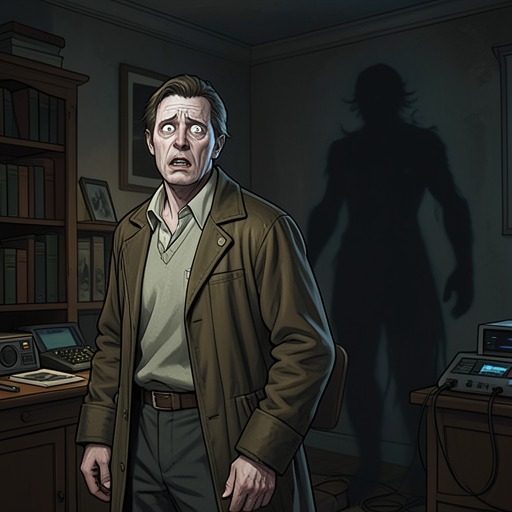
Mike approaches Matt with the unnerving calm of a person who knows that his victim is already within reach. He tells Matt, “Look at me,” and Matt obeys. The command creates the scene’s first decisive imbalance: Mike’s gaze is an instrument of enthrallment, and Matt’s attention begins to narrow toward the blank yet profoundly deep eyes in which he seems to see “little silver cameos” of himself drowning. Fear, which had been an internal reaction, is momentarily transformed into surrender. The vampire’s power works not through a spectacular attack at first but through the demand that the victim participate in his own capture.
Matt breaks that spell by stepping backward and crying out, “No! No!” He holds the crucifix before him, and whatever remains of Mike Ryerson reacts as though scalded. Its arms rise defensively; Matt advances while the vampire retreats. The movement reverses the expected relationship between predator and prey. Matt is still terrified, but terror no longer dictates his conduct. The crucifix gives physical form to his refusal, and his command, “Get out of here!” is followed by the explicit declaration, “I revoke my invitation!” The phrase identifies the encounter as a contest over the threshold of the home: Mike’s access depends not only on strength but on an opening granted by the living.
The revocation produces a violent value shift from apparent helplessness to temporary survival. Mike screams with hatred and pain, then stumbles backward until the backs of his knees strike the ledge of the open window. He falls outward into the night, hands thrown above his head like a diver leaving a high board. The image retains an eerie trace of human motion while making the body’s unnatural pallor unmistakable; it gleams like marble, marked by black stitches crossing the torso in a Y pattern. Mike’s exit is therefore both expulsion and exposure. The familiar man has been stripped away, leaving a corpse-like body whose supernatural identity can no longer be denied.
Mike’s final threat, “I will see you sleep like the dead, teacher,” keeps the victory from becoming secure. His body disappears below the window, and the remaining motes briefly gather into a hideously humanoid pattern before dissipating. Matt then experiences crushing pain in his chest and arm and clutches at the crucifix as he doubles over. The vampire has been driven away, but the encounter leaves a bodily and psychological consequence: Matt survives the immediate attack while his heart responds as if under intolerable strain.
Consequences and Aftermath
The expulsion confirms that Mike Ryerson’s death was not an ordinary death and that his return is governed by rules different from those of the living. The later investigation establishes the practical difficulty of proving that transformation. When Susan Norton asks whether an exhumation order requires the Glick family’s permission, the answer is legally complicated: in theory permission is not technically necessary, but opposition could force a hearing lasting two weeks to a month. More disturbing still, Danny Glick is the only corpse with a marked grave; all the others have disappeared. Matt’s encounter supplies the experiential evidence that official procedure cannot easily accommodate, while the missing bodies reveal that the danger is wider than a single revenant.
The event also changes Matt’s position in the developing anti-vampire response. A constable later demands statements from Ben Mears and Jimmy Cody and threatens to send a patrol car if they do not appear at his office by ten the next morning. This insistence on testimony shows the collision between supernatural violence and ordinary institutions: the witnesses must translate an impossible event into a form the law can record. Yet the official setting cannot explain what Matt has seen. His crucifix, his revoked invitation, Mike’s reaction, and the vapor-like figure below the window belong to a reality in which spiritual conviction and ritual language possess direct force.
Ritual, Threshold, and Narrative Significance
Matt’s action follows a compact ritual sequence. Mike crosses into the domestic sphere and attempts to claim Matt through the gaze; Matt enters a threshold state between panic and resistance; the crucifix is raised, the invitation is verbally withdrawn, and the intruder is expelled. The ritual does not restore Mike’s human identity or return the dead to their proper place. Its success is narrower and more precarious: it separates the living man from the invading dead. The home becomes temporarily reintegrated as human space, but the threat remains active outside it.
The scene’s horror intensifies through delayed recognition. The reader first encounters a familiar voice and a recognizable person, then notices the eyes, the blankness, and the seductive depth beneath them. Only after Matt raises the crucifix does the body display its nonhuman condition openly. This progression moves from terror—the fear of being drawn into an unseen power—to horror, when the returned corpse is visibly revealed, and finally to revulsion in the stitched, marble-like body. The supernatural is thus not introduced as an abstract rule; it is made legible through a sequence of commands, gestures, recoil, and escape.
Matt’s victory is also an answer to the book’s recurring opposition between passive knowledge and active faith. He does not defeat Mike through legal authority, medical explanation, or physical force. He acts while frightened, using a sacred object whose power depends upon belief and a spoken formula that reasserts his control over the threshold. The scene’s irony is that the elderly teacher, confronted by an impossible fact, becomes more practically decisive than the institutions that later struggle to document it. Mike Ryerson is repelled, but the town’s darkness has crossed into Matt’s house, and the cost of forcing it back is a renewed heart attack-like pain that announces how little safety the ritual can guarantee.