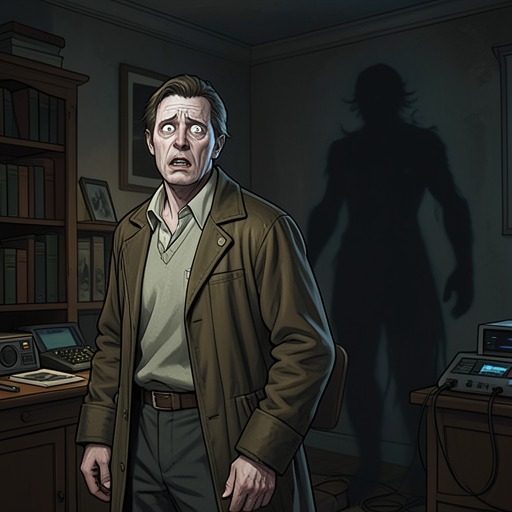
Matt Burke and Mike Ryerson
'Salem's Lot: A NovelMatt Burke and Mike Ryerson are joined first by the ordinary intimacy of a teacher and a former student, and then by the horror of a teacher watching that student become unrecognizable. Matt’s concern gives Mike’s transformation a human scale: the supernatural threat does not arrive as an abstract legend but as the corruption of a young man Matt had taught, liked, and once believed he understood.
Teacher and Student
Matt had taught Mike Ryerson English, as he had taught almost all of the young people in Jerusalem’s Lot. Mike was not exceptionally gifted, but he was a diligent student who repeatedly asked questions until he understood what he was being taught. He also possessed a quick, uninhibited sense of humor and an independent streak that made him a favorite in class. Matt’s response to him at the tavern therefore rests on more than civic duty. He approaches Mike as a former student whose decline violates the memory of a recognizable, likable person.
Matt’s habitual awareness of young people who come to miserable ends deepens this relationship. His life has generally been calm, but the deaths and ruined lives of students have disturbed that calm: a student killed in a Vietnam helicopter crash, another murdered by a drunken boyfriend, another blinded by an unexplained disease, another drowned, and others damaged by drugs. Mike initially appears to Matt as one more young person lost to some form of illness or self-destruction. That accumulated experience makes Matt attentive, but it also gives his concern a history of grief rather than the detached curiosity of an investigator.
Recognition of Mike’s Deterioration
When Matt joins Mike at his booth, the sight of him produces immediate shock. Matt first suspects heavy drug use, but Mike’s condition is more severe and less intelligible: his voice is listless, his complexion is pasty white with deep shadows beneath the eyes, his eyes look unnaturally large and hectic, and his hands move slowly through the tavern’s dimness. The untouched beer before him reinforces the impression that ordinary appetite and ordinary participation have been withdrawn.
Mike denies having used heavy drugs and says that he has been sick since Monday. He recalls falling asleep at Harmony Hill Cemetery on Sunday night and not waking until the following morning, after Danny Glick’s funeral. He had returned to finish work after the mourners left, but Royal Snow never appeared, and the period afterward has become painful and confused in his memory. Matt listens to this account as a medical and personal crisis, while the cemetery, the timing, and the unexplained marks gradually place it within the darker pattern overtaking Jerusalem’s Lot.
Matt’s manner remains gentle even as fear enters the scene. He asks Mike what he has taken, questions whether his denial is truthful, and then offers a concrete form of protection rather than an accusation. The value at stake shifts from routine teacherly concern to the preservation of Mike’s life: Matt asks him to come home, sleep in the guest room, and visit Dr Cody the next day. Mike agrees with exhausted indifference, accepting care because he no longer seems able to protect himself.
Care Under Supernatural Threat
At Matt’s house, the relationship becomes more intimate and more alarming. Matt brings Mike pajamas and tries to make the guest room a place of safety, but Mike remains passive and abnormal. When Matt asks about marks below the angle of Mike’s jaw, Mike says he does not know where they came from. The question is simple, almost clinical; its implications are not. The marks suggest an attack that Mike cannot remember, while his inability to account for them makes his own body an unreliable witness.
Matt’s response combines practical hospitality with barely controlled terror. He checks the window catch and rattles it even though it is securely fastened, then tells Mike to call during the night for anything, including a bad dream. The gesture reveals the limits of his understanding: he still frames the danger through the language of illness and sleep, yet his agitation shows that he senses an external presence pressing against the house. His care is therefore both protective and belated. He is trying to keep a former student inside a human order that has already begun to fail.
The relationship also connects the personal scene to the novel’s wider investigative structure. Matt thinks of calling Ben Mears but does not do so immediately. Later, the two men leave much unsaid while presenting a shared account that is not precisely a lie, yet conceals enough to bind them in a fragile conspiracy. Matt has chosen Ben because he believes Ben may be the only person in Jerusalem’s Lot willing to listen to such a story. Mike’s condition is thus one of the facts that pushes Matt from private caretaking toward collective recognition of the supernatural crisis.
Death and the Disappearance of Evidence
The bond reaches its most devastating turn when Matt identifies a dead man upstairs as Mike Ryerson, the town groundskeeper. The blunt announcement collapses the earlier possibility that Mike is merely sick, drugged, or psychologically damaged. His death confirms that the danger Matt sensed at the tavern and in the guest room has become fatal, even though the outward evidence is strangely incomplete.
When the body is examined, there are no marks on Mike’s neck. Matt recalls the folklore rule that such marks disappear when the victim dies, and Ben confirms that the idea is familiar from Bram Stoker’s Dracula and the Hammer films featuring Christopher Lee. The vanished marks make the case harder to prove while making the pattern more ominous. Mike’s body seems to erase the very sign that could explain his decline, leaving Matt and Ben with knowledge that depends on memory, folklore, and inference rather than a visible wound.
This disappearance of evidence is crucial to the relation between the two men. Matt’s earlier perception of Mike is emotionally certain but rationally unstable: he knows the young man was changed, yet the corpse does not preserve the cause in an easily demonstrable form. The teacher’s responsibility survives the failure of proof. Mike cannot explain what happened to him, and after death he cannot testify at all; Matt must therefore become his witness, carrying the meaning of the altered body into the investigation of Jerusalem’s Lot.
Narrative Significance
Matt Burke and Mike Ryerson embody the movement from familiar community life into vampiric horror. Mike is introduced through the social memory of the classroom—as a hard-working, funny, individualistic young man—and then shown in the tavern as a pallid, lethargic figure who can barely think. That contrast makes the supernatural transformation legible before it is fully named. The reader experiences the outbreak not only as a sequence of deaths but as the destruction of relationships that once depended on recognition.
Their connection also gives Matt’s role an ethical foundation. He does not begin as a fearless vampire hunter. He begins by noticing a former student, controlling his own shaking hands, offering a bed, arranging a visit to Dr Cody, and asking Mike to call if frightened. His first response to the dark is care. When that care cannot save Mike, it becomes testimony and investigation, linking private grief to the broader alliance against the vampire threat.
Mike’s death consequently marks more than the loss of a minor townsman. It exposes the inadequacy of ordinary explanations, demonstrates that the vampire attack can leave no surviving physical signature, and helps transform Matt from a teacher who shelters one sick student into a participant in the conspiracy with Ben Mears. The relationship’s tragedy lies in that progression: Matt recognizes Mike precisely because he once knew him as a person, but the recognition comes too late to restore him.